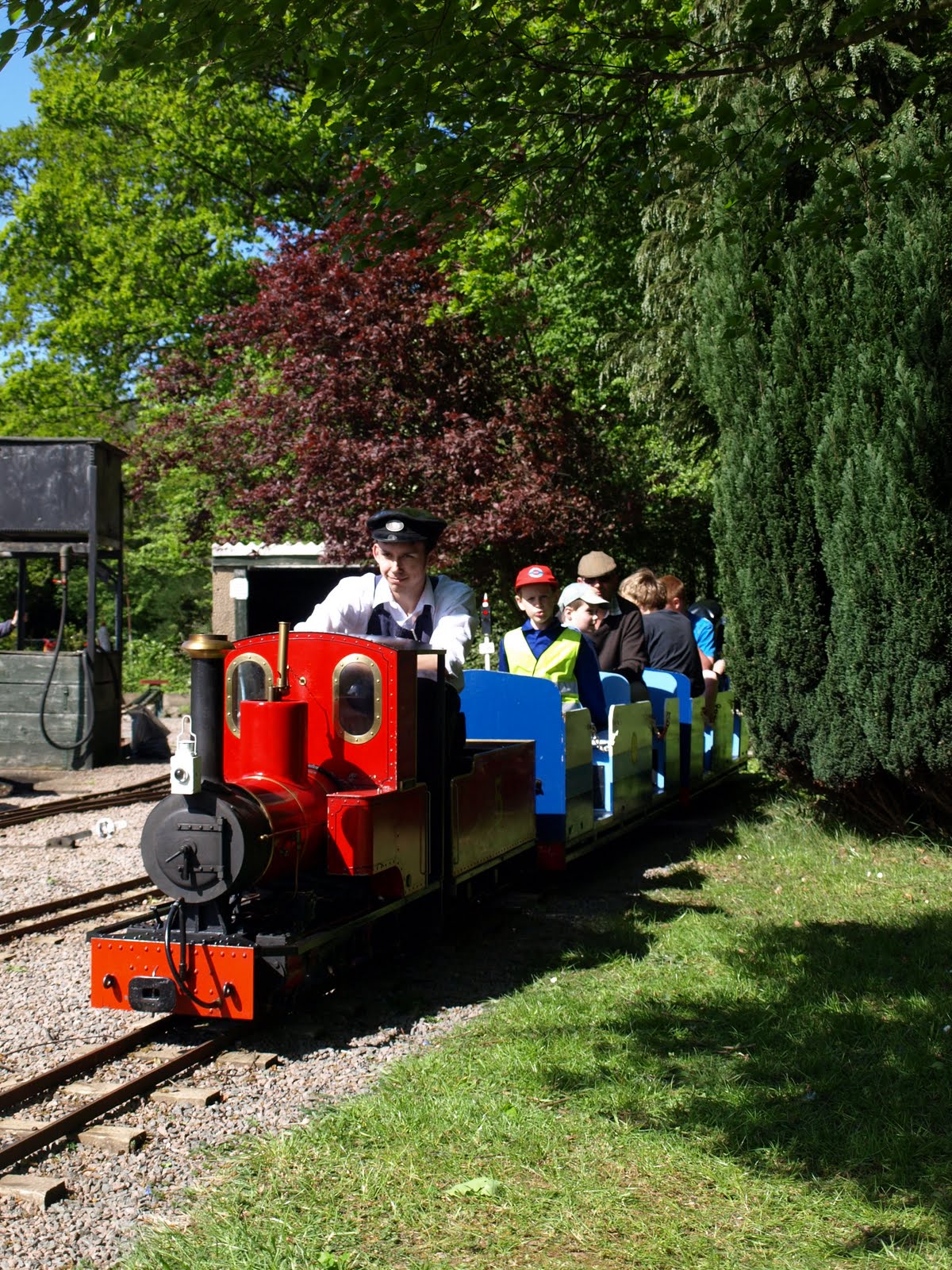
Hello everybody. Well, it's Post No42, and another 'first'; a driving turn at Rugby MES' "Rainsbrook Valley Railway". My friend James, who's Romulus I drive sometimes at the GEC, invited me along today as he was taking his engine for her bi-annual Rugby visit. The Rainsbrook Valley Railway has a raised 3.5"/5" line and also a ground-level 7.25" gauge line; the latter being the one which we would use today. The two tracks are based on a scenic site set just off Onley Lane on the outskirts of Rugby. The supporting society; Rugby Model Engineering; looks after the entire site and has a wide variety of members and visiting locomotives. Trains run for the public every 3rd Sunday in the month, from April - October (2pm - 5pm). Rides on both tracks are priced at a very reasonable £1 each; particularly for the 7.25" which is a lovely 7-minute or so ride. Today, we pulled up at Rugby in the Defender at around Midday, with "James" the Romulus in tow...
 Many engines were already being readied for steaming up. The RVR has good facilities for locomotives. The steaming bays are equipped with pits for the operatives to stand in; bringing the loco up to a good working height. As well as this, the bays have water and electricity. There is also ample space to ash-out/blow-down. The loading ramp is equipped with a hydraulic 'Lifting Table'. I must admit, these things are fantastic! The trailer is reversed up to the ramp, the table rises, the loco goes on, the table descends and the loco is pushed up to the turntable..."Easy!". Below, "James" is half way onto Rugby territory, on 'his' way to the bays...
 Up on the bays, the locomotives were already being prepared; some having arrived alot earlier. One engine that I know well is the Brown family's 0-4-0 Freelance tendered Saddle Tank No10 "Trojan". Based at the Brown's own private 7.25" railway, "Trojan" used to be a regular GEC engine; and I have driven her a few times up there (see previous posts). The loco is now a regular at Echills Wood and I hope to take at least one trip up there with her this year. Below, the loco stands on her bay awaiting steaming; on the left you can see another Kingsbury regular...the 0-4-2 Tinkerbell "Douval"...
 A view of the bays can be seen below. Closest, "James" is receiving boiler treatment and water through the filler mounted in the dome. Next, "Trojan"; proudly displaying 'EMR' on the tender. The third engine is "Douval". She is a ride-in locomotive and is pretty big for 7.25". This explains why Tinkerbell's are often known as 'track bashers'...look at the size of it! Next, another engine I have seen before; "Romburg". Regular readers will know that I took at a ride behind this lovely 0-6-0 Romulus variation at a friends private line last September (see post). Fifth and final steamer today was "Colsyn"; a little, blue, small-boiler Romulus. Impressive bays ay?! Mind you, a roof like the one at Kingsbury wouldn't go a miss!...
 Below, "James" fills with water as her owner checks out lunch...
 By 2pm, "James" was in steam and on the track, along with the other 4 steamers. Each loco was given two green RVR coaches; minus "Douval" which had three very small brown ones. First trip, I was driven around on the train by "James" so that I could 'route learn' as it were. I'd never driven here before but had been a passenger back in 2006 I believe. It was a lovely line then, and it still is. Following the first trip, James drove again on the 2nd with me packing away some of the preparation tools. Just then, the loco returned with a problem...
 The mechanical lubricator cap, which is meant to be flat, jumped off the lubricator and into the valve gear. Unusually, rather than knock off and into the ballast, the cap became jammed and ended up stopping the loco dead. The cap became tangled between the crosshead and the end of the slidebar at the cab-end of the piston stroke. With the cab removed, the loco struggled back to the station where steam was low. I took the cap away and straightened it a little before returning. "James" then struggled in after another low-pressure trip. We removed the loco from the track and checked her over. The fire was good, the smokebox was clean, the ashpan was clean and the injectors worked fine. The loco was also pulling well. However, on the run, she wouldn't keep pressure or make it back. Upon further examination we found that a leaf spring had become disconnected from its compensator bar. This would mean that the loco could potentially lose proper valve timing and steaming would be impared. Therefore, we reconnected the spring, made up a good fire and tried again. The railway was by now very busy so we had to get "James" back on asap. Soon however, she was roaring along again. Below, "James" barks through the cutting on the steepest part of the line...
 She seemed to steam better, holding pressure easier. However, she still wasn't up to her usual standard. Very unusual! Meanwhile, I ended up driving "Trojan" on quite a few laps. She is a lovely machine. Injectors are a dream, steaming is a dream, the bark is very crisp and the strength is considerable. She really is a proper driver's machine. She took one look at the severe incline on the return run and just chugged up like it wasn't even there! Below, "Douval" crosses the entrance to the steaming area with another train...
 At the busy station, Kevin prepares his engine ("Trojan") for departure whilst the huge Tinkerbell takes water. When I say busy, I mean busy! The railway took 1034 passengers(!) today in only 3 hours!...
 The journey? Well, the line leaves the busy station before crossing two crossings; a foot crossing and a road crossing. Both crossings are manned for safety reasons but it is still a good idea to whistle. The train then crosses a bridge before turning 90-degrees and a crossing another. The line then climbs past the 5" station before crossing another foot-crossing; also manned and lit. The track then heads through a wooded section, upgrade past the carriage sheds. The 5" line then comes into view and 3-tracks immerge; the 5", the down-line and the up-line. We are currently on the down-line if you follow me! The tracks then seperate again as the line heads heavily downgrade. A signal can be seen at the bottom of the bank and this will tell us if a train is in the approaching 'blind bend'. If the signal is clear, the train curves to the left 90-degrees. Below, the image shows two bridges. From my current location in the description, the train will be approaching from the top-right corner, and will pass under this bridge. This over-bridge is the 2nd of the two bridges described at the beginning!...
 Once under the first bridge, the train curves 240-degrees heavily upgrade, also passing under the 2nd over-bridge which in turn is the first bridge on the line. Still following me?! Out of the curve, the train continues to climb in a straight line, with views over the Rugby countryside. At the top of the bank, the train is now on the up-line of course, and reaches the 3-track formation again, now on the left rather than in the centre. Soon, the line splits off again and climbs neatly towards the station signal. The train is then allocated a platform and given a signal when required. There are two platforms; arrival and departure; in two bays (1 & 2). Its a great set-up and a lovely run. And, they hope to extend! My goodness it will be long; but not as long as Kingsbury! I must admit though, it is a lovely drive; really nice and lovely sights to see. "Trojan" performed very well and I loved driving her again; thanks Kevin! "James" meanwhile was having great fun, hauling her own trains again. Soon however, with 1034 passengers carried, closing time arrived and the loco's went back on shed. "James" was then discovered to have lost a compensator bar; thereby sending the springing "out" again. No wonder she wasn't at her best! Oh well, these things happen. However, a very good day out. Sorry about the phone pics but I didn't think I'd have time to take my proper camera. Thanks all for reading and thanks to James, Kevin and Rugby MES for a great day out. "Another one done!". Evening all...
Hi all. Just a short one from today, but still worthy of inclusion in my mind! Today I spent a good few hours (11am - 5pm) on my 00 gauge garden railway; known as the Sutherland Steam Railway. It was a blustery spring day and, with the track cleaned and ready to go, the trains began! Many different loco's were spotted out on the line today; perhaps most impressive was the visiting A4 Pacific No60022 "Mallard" in striking BR Blue livery. I have filmed an 8-minute or so clip for this post and it is included above. I hope you enjoy it and comments are always welcome. The Garden Railway has always been very popular on Youtube for example. Thanks all; good evening.
 Hello all. Welcome to another post; No40 of 2011 in fact; wow this year is going by fast! Well, after a restful day yesterday, it was nice to be back on the railways again this afternoon. Today, I was rostered for my first of three crew turns (in 2011) on the Ryton Pool Miniature Railway, operated by Coventry Model Engineering Society. The 2000ft-long raised 3.5"/5" gauge line operates every Sunday from Easter until the end of September, giving rides at £1 per passenger, using either steam or diesel haulage; all weather permitting of course. I became a member at CMES back in Spring 2004, at the ripe old age of 12. I was immediately passed out as a Guard up there and was up on many Sunday afternoons, as well as during the Steam Up's when I often drove engines; learning alot as I did so. Eventually, the moment I turned 16, I was passed out as a Driver, taking my first trains on the Easter Sunday of 2008. Since then, I've fallen in love with the practise of driving the 5" gauge steamers on heavy Sunday afternoon trains. Thats where my phrase; "I don't do diesels"; has come from! The regular steam engine; though I've driven others on Sundays in the past; is the society's own 0-4-0 Sweet Pea class No499 "John H Owen". This engine, built by various club members and finished in 1999, has become a powerful, reliable work-horse and can often be seen working trains. Indeed, today, she did all of them!...
 Sweet Pea is the name given to this 5" gauge locomotive class. They are an 0-4-0 as a rule but can also be edited to become 0-4-2's and some even have tenders. Indeed, a tender is in the pipeline for No499 as we speak. The loco itself is designed as a 'Contractors Locomotive'. I myself see stark resemblences between the Sweet Pea and the 2ft gauge Bagnall Saddle Tanks which were often used in the slate quarries. Being such a successful 5" gauge engine, the Sweet Pea has become very popular and countless examples exist the world over, in one form or another. They employ a maintainence friendly Marine Boiler, connected to large Cylinders which then connect to their wheels via durable Hackworth Valve Gear. No499 herself employs a Handpump and two Crosshead Pumps for watering purposes, connected of course to the sizeable side tank. Even now, I sometimes don't realise just how big a Pea boiler is...it takes alot of water to fill it from empty! Employing a Pole Reverser, No499 pulls well and works economically. Indeed, I think she is the easiest engine to drive/fire I have ever known. Even better; the harder you work her, the better she steams. She is a dream. The only problem she has, as you would expect for a chunky 4-wheeler, is that she likes to 'rock & roll' on the track a little but, of course, careful handling will improve this no end. Today, I arrived at Ryton at 11:45am, and carried out a walking Line Inspection before the rest of the team arrived. My younger brother, as well as two extra members were also present. Steam was chosen as the motive power almost immediately, so myself and my brother soon set to cleaning and raising steam. By 12:40pm, she was blowing off. Below, 499 awaits passengers in the sunshine...
 Taking our first passengers at just gone 12:45pm, I drove the loco until 2:45pm. I realise that 2 hours without a break; a proper one at least; is a long time but with No499 you really don't notice it. She steams freely, pulls well and is more than capable of doing the tasks we put to her. 3 full passenger cars really didn't tax her as much as you would expect. On average, the most she hauled today was 9 adults, including myself and the Guard...not bad going for a little engine, ay?! Meanwhile, the powerful Class 37 electric; which is usually the club stalwart; did no work all day...steam for the win! I must admit, I have achieved my ambition...steam worked all day and all trains..."Yes"! I do think the passengers notice us more, and enjoy the ride more, when we run steamed hauled trains. The smell, the sound and of course the sight of the engine is a huge cut above that of an electric loco; but thats just my opinion. Travelling steam hauled is by far the best way to see this part of the Ryton Pool Country Park anyway! My brother was out with the camera today, taking a few snaps. Below, I've included the pictures in route order. Below, the train has not long left the station, with a regular load. We have traversed the 'S' bend and are now crossing the Ryton Bridge. I will soon be shutting off to coast down across the Bendy-Beam and towards the Carriage Shed...
 Below, I'm still coasting. This section, as the loco is shut-off with the blower cracked, is normally a good place to check the fire and thicken it if necessary. The pump(s) can also be turned on here to replenish the boiler water if required. Just around this corner, I usually whistle as the train travels through the trees, before opening up again to climb the steep 1 in 70 bank, particularly the lower section as it rests on a 180 degree bend!...
 Once around the 180 degree curve, the loco will usually accelerate as the effort required to climb the same gradient on straight track is slightly less. Interestingly though, the track is actually getting steeper, from 1 in 100 at the bottom to 1 in 70 nearer the top! At the top of the bank, the loco needs to be shut-off immediately to avoid a slip. The train can then coast downgrade over the bridge, again giving the driver a chance to check the fire and to add more water to the boiler again...
 Next, the train runs along a relatively straight section before rounding a large 225 degree right-hand bend back up into the station again. The trip will generally take around 5-6 minutes. Below, I have shut-off and am now coasting the final stretch into the station. The blower will now be just cracked and the water pump(s) running...
 In the 'Arrivals' platform at Ryton Halt, the passengers can leave the train whilst the driver checks pressure, water level and the fire. If all is well, the train can continue through into the Departure platform and to the Water Tower...
 After an hour's break, I was handed back the regulator to work the final few trips, between 3:45pm and 4:15pm. I think I did about 4 trips on my later stint. Even then, No499 steamed fantastically with no problems to report at all. She really is a fantastic machine. Below, see a couple of video clips of us in action. First, "John H Owen" attacks the daunting 1 in 70 incline as the sun continues to shine...Secondly, the train chugs up into the station on the very last leg of the journey...After the last trip, we all helped clear up; me in particular putting the loco to bed, with the help of Paul. This involves whipping out the firebox and cleaning out any clinker, as well as the fire itself and any ash too. The inner firebox, tubeplate, tubes and smokebox also need cleaning out. The loco will then be Blown-Down. This process involves the opening of a tap underneath the boiler. This tap will release any steam and water from the boiler, hopefully removing any scale as it does so. With all of the steam and water gone, the tap can be shut. The resulting vacuum should then suck any water from the Saddle Tank through into the boiler again to fill it slightly, ready for the next operator. (Thats the plan anyway!). Now, all thats left is to clean the engine and put the various tools away, as well as the passenger cars. After a successful day with pleasant weather and a lovely engine; I left Ryton at 4:50pm. Thank you all for reading - I hope you enjoyed Post No40...Sam.
 Hi everybody. Following our visit to Shackerstone, we branched out through Derby Lane and across to Twycross before continuing out onto the M42. Destination?: Kingsbury. On arrival in the busy Kingsbury Water Park, we paid the (slightly over-priced in my opinion) £3 parking fee before parking up. From the car, we walked past the Visitor Centre. There, we heard the familiar toots of steam whistles on the nearby Echills Wood Railway. I have driven here, on the 7.25" gauge line, a few times in the past (see seperate posts) and throughly enjoyed it. So, passing by, we couldn't resist a ride. Unfortunately, after paying for our good value return tickets to Far Leys and back, we ended up behind a diesel. Can't win them all. But, oh well, no soot or hot ash for a change...unfortunately! Mind you, jokes aside, the diesel was very well kept and looked very powerful; I think it was called 'CP Rail'. She gave us a smooth ride, carrying us easily in a comfortable rake of articulated coaches. The EWR journey takes around 15-20 minutes and is around 1.5 miles. For £1.50; you can't go wrong! Its a very scenic run, taking in wooded areas, double-track sections, sharp curves and open plains over impressive bridges. As I say, I have driven here before, so I know the road quite well; its lovely. We throughly enjoyed our ride with 'CP Rail'. Below, perhaps one of the most impressive engines on the railway; "Peggy". She is a 2-4-2 I believe, and is of course American. She is very large for the gauge and is a supremely powerful machine. Mind you, you should see her sister "Douglas"; she is even bigger...massive even! "Peggy" approaches the main station...
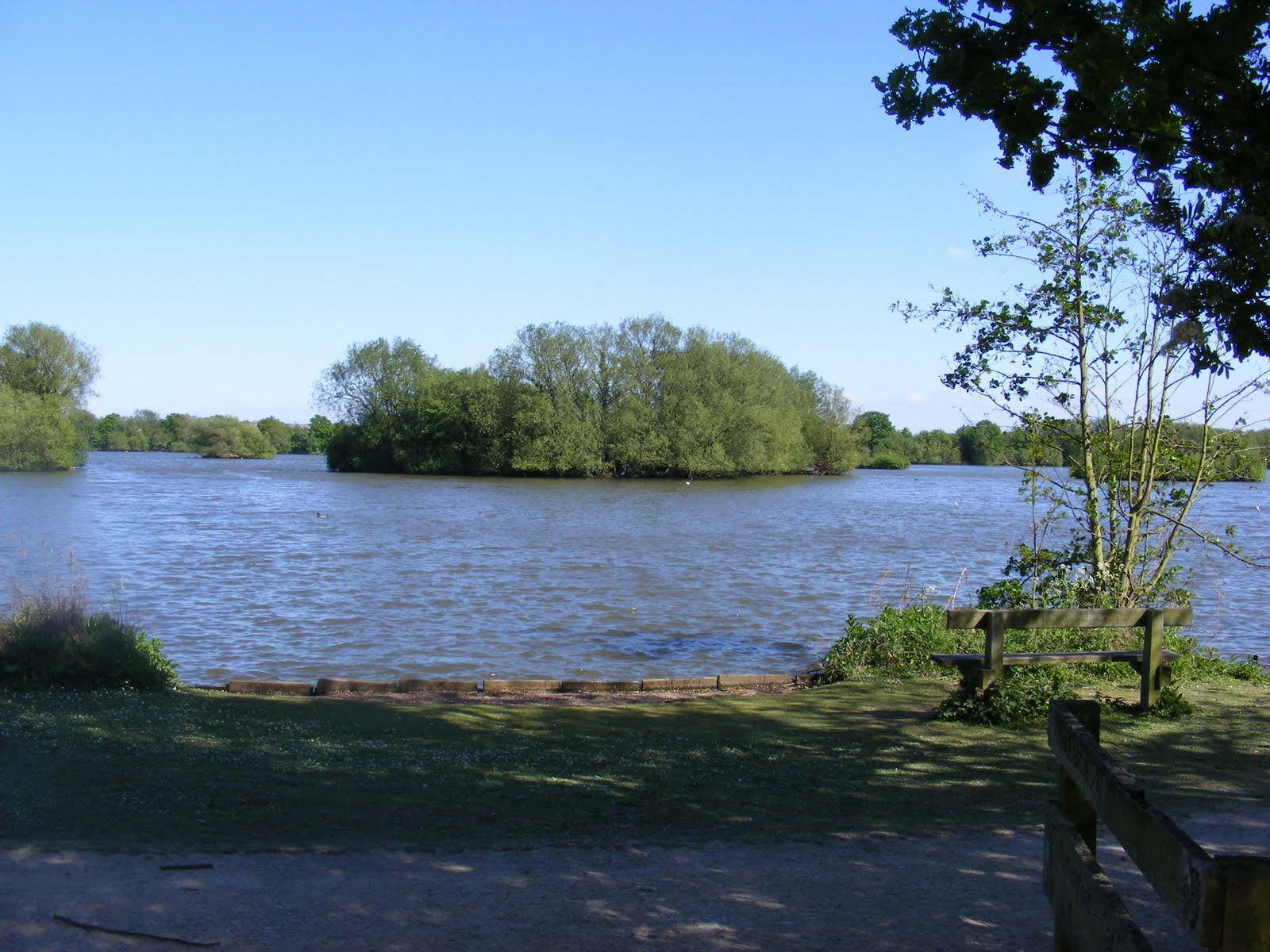
 Out on the lake, the usual antics of water-skiing were continuing, even in the chilly breeze. The views here are beautiful. It is a lovely park...
  From the lakeside near Harvesters Station, we walked up towards Far Leys along the lake edge. Nature is very apparent here, with Swans, Mallards, Rabbits and many other wild creatures in the locality. The walks are very tranquil and scenic, with plenty of route availability. Times like this I wish I had a dog! Up at Far Leys, now away from the lakeside, we crossed the Car Park and discovered the Far Leys station which we had passed through by train just half an hour earlier. Below, we see a John Drury engine. John Drury, a member of CMES, is a prolific model engineer. He has built many engines from stationary loco's to a 5" Royal Scot class, as well as a Showmans Engine too, amongst countless other examples. John built the 7.25" K4 2-6-0 Mogul "Loch Lomond" seen below. John sold the loco on and she is now based at the EWR. She always seems to perform well and is very attractive. Below, she approaches Far Leys on an ECS run of BR coaches...
 Tyseley-Supremo Bob Meanley tries out something a little smaller as he boards the Modified Hall Class 4-6-0 owned by John Hancock. This must be a far cry from tearing up the mainline on "Rood Ashton Hall"!...
 After a good walk around the park, and the spotting of many trains, we made our way back to the Saxo. Many engines were in action on the EWR. We saw "The Baron", the huge Garrett, the Hall, "Peggy", "Douglas", "Loch Lomond", "CP Rail", "Vulcan" the Royal Scot and some others too. And this must be a normal EWR day! Anyway, a lovely restful day out; first to Shackerstone and then on to Kingsbury for the EWR. I have been invited by my friend Dave to do a day or two at the EWR later this year...keep an eye out for that! Next weekend?: A quiet one really...a simple Sunday afternoon turn on the RPMR, owned by CMES...hopefully steam hauled if I have my way ;). Thanks all, Good Evening...
 Hi everyone. Today, in the warm but very breezy weather, myself and my girlfriend were out for a ride on the train at Shackerstone. I must admit, it was weird not crewing an engine or doing some kind of shed work but, no complaints from me; a lovely ride. I also took my girlfriend in the shed to see "Mayflower"; as usual, she made an impression, she is a lovely machine after all, fresh from her cleaning session last Sunday. We caught the 12:30pm train from Shack, down through the tranquil Leicestershire countryside, pausing at Market Bosworth and then on to Shenton. Husband & wife crew George & Marie were in charge of the loco and seemed to be having a slightly stressful day with the lack of a trainee to do some of the hard work. At Shenton, we broke our journey; as most visitors do; and took a walk through the beautiful surroundings of the Battle of Bosworth Country Park, down to the Ashby Canal and then back up through Ambion Wood to the Visitor Centre. We then returned over Ambion Hill to the bustling little station at Shenton. Shenton is an attractive little terminus; the building having came from Humberstone Road in Leicester after BR closure. The station is now well looked after and includes a small tea room and a glass-blowing display. On the opposite platform stands the old Lamp Room; now the Station Pottery. The sun really brought out the charm of this country terminus...
 3803 at Shenton. Today was a nice break after firing her on Saturday (see previous post)...
 Down at the Ashby Canal, the old trackbed crosses via a bridge. The views from here on days like today are lovely...
 Returning to Shackerstone on the 2:20pm service, 3803 performed in fine style. We enjoyed our little train ride, even if I did end up serving on the Buffet Car for 15 minutes during a queuing period! No rest, ay?! From Shackerstone, after a look in the well stocked Souvenir Shop, we returned to the vehicle and then headed off to the next destination...(see next post)...Good Day all...
 Hi everyone. Well, its May...already! How fast is this year going?! Anyway, today, after another invitation, I was driving my friends 7.25" gauge engine at the GEC Miniature Railway in Coventry. My friend James owns an 0-4-0 tendered Romulus loco; incidently also named "James". I have driven the loco many times before (see previous posts) and I have also driven other engines at the GEC too. The GEC Miniature Railway is just off the Allard Way in Binley, and owns two different tracks; one 7.25" and one raised track in dual 3.5"/5". The line runs every first Saturday and Sunday in the month from May until October from 2:30pm until 5pm. Today, being the first Sunday of the month, the 7.25" line was in operation and, with a Birthday Party run to do at 11am as well, the GEC required three locomotives. In all, four turned up; an electric, a diesel and two steamers. The electric (Y7 Tram "Toby") stood idle for most of the day, with steam doing most of the work, operating alongside Diesel Hydraulic "Sammy". Arriving at the GEC at around 10am, I was just in time to help unload "James" from his trailer and down onto the loading ramp. The loco was then pushed up onto the steaming bays where myself and James prepared 'him'. At 11am, we were ready to go...
  "James", "Sammy" and "Luna" (the Romulus/Sweet William mixture), took it in turns hauling the two different 2-car rakes up and down the line. The Party took place from 11am until 1pm, with many children taking their private rides. Myself and James took it in turns driving the Romulus, one trip each. "Sammy" departs the station on one of the first trains, with Stuart on the throttle...
 With the Birthday Party rides all completed by 1pm, we filled "James" up and made up the fire too. 'He' was then left to simmer in the yard, at the head of his 2-coach train, closely watched by us of course. The trains at GEC are limited to two coaches as this format fits both the station run round, and the triangle spurs correctly. If the trains were longer then the engines would not fit correctly, and neither would the coaches. So, a good idea to keep them 2-coaches in my book, unless of course the loops can be extended slightly. During the lunch break we all rested, with the fabulous 'Tea Room Ladies'; already having done a stirling job in the morning; getting up to their usual tricks of making us endless cups of tea! This is service that I have never experienced anywhere else! Also during the break, I popped out and caught a McDonalds from the one around the corner, bringing it back to GEC and eating it whilst watching "James" feathering away. I must admit, I did get a funny look at the Drive-Through when wearing a Pocket Watch, Driving Jacket, Bib 'n' Brace Overalls, Shirt, Safety Shoes and a Greasetop! Dear me! Anyway, the sunny lunch break didn't last long and we were back on the engines by 2pm as the first early customers arrived. Train rides on the 7.25" are priced at a very reasonable 75p per trip, meaning that many passengers enjoy at least two rides each in many cases! Good stuff. The roving GEC Reporter Gary Bland was out again today, taking snaps of the trains. Gary has kindly sent in the following photos of me driving during the 'Public Running' session in the afternoon, and I have included them in 'route order'. Firstly, on leaving the station, trains pass through a wooded clearing before joining the main line; which is mostly straight. The line stays straight for a short while, on a downgrade, before arriving at the fully-signalled Car Park Passing Loop. Below, I arrive southbound on "James", crossing over with "Sammy" who is bound for the station...
 Once through the loop, trains accelerate again. I generally like to have a little bit of a 'chuff' on this bit before shutting off. This is generally a good place to crack the blower very slightly, check the fire and then use the injector(s) if required. The loco and train seem to coast nicely along this bit, which takes the track along the edge of one of the large playing fields on the Sports Ground. In the distance, the Driver can see the Signal for the Triangle; if it is occupied at any location, the Signal will show 'Red' and the train must stop until the offending train has departed. Normally however, the triangle is clear. Arriving into the triangle, the train curves to the left and then sharply to the right. Here, there is a trailing point and an illuminated "Stop Board" at the top of a rising gradient. Behind the buffers lies a sharp drop into the river so the buffers are usually a good place to stop! Once stationary, the Guard should give a Whistle and a Green Flag to signify that the train is clear of the trailing point. The train then propels back through the point, with the Guard being 'the eyes' as it were. The Driver can again check the fire and water level before stopping again on the third leg of the triangle. Once clear of the last trailing point, the blade should spring back and the driver will stop. The Guard can then give another whistle, as if starting from a station. The train is now facing the other way and can run upgrade towards the Signal which controls access to the main line. On the run below, Gary was pretty close to the point so I decided to give him something worth hearing. At the point, I got the 'right away' before releasing the brakes, cracking the regulator and whistling. "James" moved away slowly with drain cocks hissing...then, I shut the taps and opened 'him' up a bit. "James" roared away from the spur and past Gary. The sound was great. Though, admittedly, once past Gary I decided to shut off a bit; after all there is a speed limit! Below, James barks away from the triangle...
 Once out of the triangle, trains retrace their steps to the top of the bank, climbing all the way, past the Car Park Loop and beyond. At the top of the hill there is a 'Feather Signal' on a facing point. This point is always set to send trains to the right, towards the station and back through the wooded clearly. When the feather is set to the Upwards position, trains are sent straight on and up into the old station. This section is only used on Santa Special days now, as return to the main line requires complete reversal. Dropping back through the wooded clearing, I normally give a long whistle on approach to a blind bend. The raised track passes by alongside here. Below, having whistled to the passing 'Speedy' on the 5", I drop into the blind bend and into the yard...
 Once in the yard, trains pass over another facing point and through another passing loop. The station is then seen coming up on the right. Below, I have shut off, with injector running and blower just cracked, preparing to brake as the train approaches the platform; after all, there is a marker to stop at!...
 Once in the platform, the Driver destroys the vacuum and tends to the engine, also ensuring that the loco is in mid-gear whilst still coupled to the train. Good practise is to open the drain taps too, or I like to at least. The Guard, or a member of the station staff, will generally uncouple the loco, and then fit a tail-lamp at that end of the train. The Driver is then given a 'clear' from the staff on the platform to pull away. This is done carefully when you are dealing with a crowded platform. Once clear of the loop point, the blades spring back and allow the loco to run round, subject to the train having been stopped on the right side of the marker! Below, I drive "James" in reverse past "Sammy", who is backing down onto the next departure. The line in the centre is the main departure line, with the line on the right being the return line...
  Up in the yard, the loco is turned, and coaled and watered if necessary. There is normally then a minute or two between runs, until the next train arrives. But, when the drivers are swapping every trip, it isn't too bad. When the next arriving train pulls in, an Amber light is given in the yard, meaning that permission has been given for the loco to 'Drop Back' and onto the train to couple up. Below, "James" poses in the sun, awaiting 'his' next turn...
 The other steamer in use today, as I've mentioned, was "Luna". This engine, owned by the Bland family, is made up of a Sweet William boiler on a Romulus chassis. Though an unusual combination, the loco works well, and barks cheerfully. She is also painted in an attractive blue livery with brass boiler bands and a chimney cap. A nice looking machine. Below, Stuart prepares "Luna" for departure at the station...
 At lunchtime, "James" awaits 'his' afternoon turns. Below, we can see the cab. The tender is very spacious for the driver to sit and work in, and its comfortable too. The tender is in fact just about as long as the loco herself, meaning the right amount of room but, importantly, it still looks right! Lovely machine...
 Throughout the afternoon, with the sun shining, many passengers enjoyed a cuppa' and a steam train ride on the GEC Miniature Railway. The 'Tea Room Ladies' were fantastic again...tea on the footplate...fabulous! They always make my day! I'm going to make a bit of a plea now. If you haven't been to the GEC, why not go along for a train ride one day? It's a very friendly place with a pleasant train ride in quiet surroundings. It's a far cry from the traffic of the bustling city centre and is well worth a look. There is a 00 gauge model railway and an indoor seating area to take a rest in, not to mention tea and cakes often on sale on running days. Finaly, for 75p a trip...you can't really go wrong can you?! For more details on this line, please comment; its a lovely place. By 5pm, the passengers had all gone home and the loco's were retiring to the shed. Myself and James disposed his loco before putting 'him' on his trailer. I later left GEC at around 6pm. Thanks very much to James for a fabulous driving his lovely loco, and to all of the staff at GEC for giving me another great day out. Finally, thanks to Gary for sending in SIX of the photographs used in this post. Thanks mate! Thank you all for reading. I'm sure I'll be at GEC again a few times this year; I always enjoy it up there. As for "James", I will hopefully be seeing him again when I go along to hopefully help with him at Rugby MES for their Public running on May 15th. Evening all...
 Hi all. Now, I don't use the term "best day ever" lightly but, this was pretty much the "best day ever" at Shackerstone; the only catch was the VERY early start. Arriving at 4:45am, myself and Carl wandered down to the shed where we found the lovely B1 and her older companion; GWR No3803, which I would be firing today. I fired my first engine at Shackerstone in May 2008 and it was 0-4-0VBT Cockerill "Yvonne"; a quaint little machine from abroad. Since then, I have 'developed' through many different machines from Peckett's to Panniers and on to Prairies and the lovely B1 of course. Most recently, I have been firing 1306 & 3803; as many of my regular readers will know. Hopefully, I will be soon at the end of my fireman training as, more often than not, I am now being left alone all day to fire; as I was today. Back to us at 4:45am this morning; we checked inside 3803's firebox and discovered some embers still burning from the warming fire the night before. Overnight, a leaf-spring had been replaced under the loco; keeping a very capable team working until gone 11pm! Well done to them. Carl lit up 3803, simply by placing coal on top of the still burning embers, and opening the dampers. The 38xx was warming up and she had steam by the time my crew; John and Dave; arrived. In the morning, at 9am, the 38 was booked for a 'Foot Ex' and Carl and Adrian crewed that outing, giving me a chance to wash, change and get some breakfast before joining the rest of my crew on the 38' at the start of the public day...
 At 10:45am, Adrian and Carl handed the loco over to us three and I began making up the fire as we ran round onto the 4-coach train. Dave coupled up whilst John prepared for departure, and I fed the 27ft grate. Soon, 3803 was ready and we left on time with the 11:15am departure; the first public run of the day...
 We were very worried that we would be cold on the 'open-back' loco today but, once again, we were in luck and the sun shone down on us. It was lovely weather, just right for 3803. I fired all 5 runs today, with success I believe; and of course the praise from my experienced crew at the end of the day was very reassuring. Thank you very much to Dave and John for a great day. 3803 was a joy and the 5 trips were 'just right'; 4 isn't enough and 6 is too many! Below, Driver Dave Johnson takes 3803 through Far Coton towards Market Bosworth with the 1:05pm to Shackerstone...
 3803 chugs happily towards Far Coton with the Vacuum Pump ticking away in its usual enthusiastic manner...
 GWR engines were often fitted with a flap, allowing more 'Top Air' (Secondary Air) to access the fire through the firehole doors. However, with the flap up, Secondary Air can still enter, but not too much. Too much cold air at once can affect the tube plate, tubes, stays and the foundation ring. Therefore, it is advisable not to let too much in at once. Below, the Flap is up but the doors partially shut too as the engine is chuffing well. However, the Top-Air creeping through the gap above the flap gets rid of some of the smoke, giving a light grey exhaust as is expected. Of course, too much air isn't good either as it cools the fire and weakens the combustion. The correct balance means complete combustion and the best results from the fire in the box...
 3803 steamed and ran very well all day, performing her duties with ease; well, after all, 4 coaches is child's play for an engine designed to pull freight trains as heavy as 2000 tons! My favourite part of the engine is probably her huge size; particularly the cab. I've been on many engines where there is room to move about in the cab, so it's nice to be on the 38' as 3 people really isn't confined at all; you could probably throw a party on there! Lovely machine. The Leicestershire Countryside was also lovely today; really scenic, especially when viewed from the lovely Great Western. Below, 3803 roars away from Market Bosworth tender first; if you look closely you can see me in the cab (C = D.Hanks)...
 "The calm after the storm"; Market Bosworth Station rests in the quiet countryside as 3803 roars through Far Coton for Shenton (C = D.Hanks)...
 One problem we had today was the coal. In hot weather, especially when running tender first on a low-back engine like 3803; you need to keep the coal damp. This keeps the dust level low, meaning that you get much less in your eyes when running backwards! The coal is washed using the slacking hose; a rubber pipe connected to a valve which in turn connects to the live steam injector feed. When the injector is running, the valve can be opened to release pressurised water immediately, allowing you to 'wash' the coal. (For the jokers out there, no matter how much you wash it it won't come clean; but it does help the dust problem!!). Myself, John and Dave had a lovely day on the engine, with me firing all day and the other two taking it in turns on the regulator. I had a lovely time; 3803 is by far the best engine I've ever fired; closely seconded by 5542 the Small Prairie. By 5:45pm, we had 3803 back inside the shed and disposed. I raked the well fire, or what was left of it at least. Other than a little bit of clinker under the firehole door, no problems were discovered and 3803 was given a clean inspection report by the Driver(s). We then retired to "Jessie" for a restful drink and a chat before leaving. What a fantastic day. Thanks to John & Dave, and Carl & Adrian, for a great day out. Also thanks to D.Hanks for providing the two pics above and the opening image too; thanks Dave! And, finally, thank you for reading! Keep it up please! :). Tomorrow?: I'm driving 7.25" at the GEC in Coventry. Goodnight All, Sam...
 Hi all. Today, in order to escape the family for a short while as they enjoyed in the fabulous Royal Wedding, the 5" gauge railway at Coventry Model Engineering Society was pressed into service to provide some welcome entertainment. The 'RPMR', as it is known, was open to members today so that engines could be given a run; wether they were club-owned or privately so. I must admit, the turnout was better than any I have seen in some years. I counted at least 12 locomotives touching down on the track, from the smallest of 3.5" tank engines to the biggest of 5" gauge electrics and tendered steamers. The action at the steaming bays was non-stop, right from the 10am start time, and it continued after we left! Below, 4 engines wait on the steaming bay, with a marshalled train waiting on the run-up-rail nearby...
 Amongst many other engines, we had two 3.5" loco's present; a Class 1F 'Molly' and a 'Princess Marina'; owned by Eddie Jones; which is a Stanier Mogul 2-6-0. From the 5" range we had a; 'Butch', 'Pansy', two LNWR Precursors (see later), a Bagnall, Class 37, a Dock Shunter, a 'Sarah Siddons', an RC 0-4-0 electric and a RoR 'Hercules'. The stalwart 'Butch', owned by Mr Farr, which always runs like a well-oiled sewing machine, can be seen getting up a head of steam below...
  'Pansy' (Pannier Tank) "Victoria", wearing her lovely GWR Green livery, experienced a few problems early on but seemed to be running fine after some minor attention. 5717 on the bay...
  Now, some say; tongue in cheek; that there is "Only one Great Western, and thats the North Western". Well, I can truly say hand on heart that I do like the Great Western engines; I really do. But, the fact remains, that pre-grouping designs, like those of LNWR, were arguably way ahead of their time. LNWR engines were indeed very big for their era, usually baring huge wheels with plenty of ability for speed. After all, fast journey times from London to the North were required and, in these days of still-rather primitive lubrication, the bigger the wheel meant the better the running; surely! The LNWR developed the 'Precursor' Class as a fast passenger 4-4-0, keeping a tender behind for better running on longer journeys which required more capacity. However, the design was so successful that the LMS, after the amalgimation, built a Tank Engine version. Today, the 'newest' engine in CMES was enjoying her first ever steam outing...
 This beautiful LNWR Precursor Tank, built by Mr M Sweatman, was a pleasure to see and ran beautifully. Check out that cab detail...
 With the Tank in the background, the RC 0-4-0 (+ owner) is readied for running...
 The 'mad' brother even managed to bag a drive; on the club's 37 electric...
 Of course, I had a drive on the 37 too but, though it echoes usefulness, it isn't anywhere near as interesting as the steamer. Luckily, Colin offered me a drive on his fabulous engine, which is incidently the tendered version of the Precursor. I've driven this engine many times before and its always a joy. You never have trouble with steam, or with water, and the bark is fantastic. Never a problem on LNWR?! I must admit, I do really like this one...
 Just two quick clips below of me driving the tendered Precursor...Some Royalists, ay?...
 All in all, a fantastic steam up at CMES and well done to the guy above (Mr Wilson) for organising it; a great morning. Now its time for home; we have a party to be at by 13:00! (And to see the newly weds on the balcony of Buckingham Palace at 13:30 of course!). Thank you for reading everyone. Whats coming up tomorrow; a 5am start at Shackerstone on GWR No3803...(yawns begin). Good Day all...
 Hello everybody. Well, it's Post No42, and another 'first'; a driving turn at Rugby MES' "Rainsbrook Valley Railway". My friend James, who's Romulus I drive sometimes at the GEC, invited me along today as he was taking his engine for her bi-annual Rugby visit. The Rainsbrook Valley Railway has a raised 3.5"/5" line and also a ground-level 7.25" gauge line; the latter being the one which we would use today. The two tracks are based on a scenic site set just off Onley Lane on the outskirts of Rugby. The supporting society; Rugby Model Engineering; looks after the entire site and has a wide variety of members and visiting locomotives. Trains run for the public every 3rd Sunday in the month, from April - October (2pm - 5pm). Rides on both tracks are priced at a very reasonable £1 each; particularly for the 7.25" which is a lovely 7-minute or so ride. Today, we pulled up at Rugby in the Defender at around Midday, with "James" the Romulus in tow...
 Many engines were already being readied for steaming up. The RVR has good facilities for locomotives. The steaming bays are equipped with pits for the operatives to stand in; bringing the loco up to a good working height. As well as this, the bays have water and electricity. There is also ample space to ash-out/blow-down. The loading ramp is equipped with a hydraulic 'Lifting Table'. I must admit, these things are fantastic! The trailer is reversed up to the ramp, the table rises, the loco goes on, the table descends and the loco is pushed up to the turntable..."Easy!". Below, "James" is half way onto Rugby territory, on 'his' way to the bays...
 Up on the bays, the locomotives were already being prepared; some having arrived alot earlier. One engine that I know well is the Brown family's 0-4-0 Freelance tendered Saddle Tank No10 "Trojan". Based at the Brown's own private 7.25" railway, "Trojan" used to be a regular GEC engine; and I have driven her a few times up there (see previous posts). The loco is now a regular at Echills Wood and I hope to take at least one trip up there with her this year. Below, the loco stands on her bay awaiting steaming; on the left you can see another Kingsbury regular...the 0-4-2 Tinkerbell "Douval"...
 A view of the bays can be seen below. Closest, "James" is receiving boiler treatment and water through the filler mounted in the dome. Next, "Trojan"; proudly displaying 'EMR' on the tender. The third engine is "Douval". She is a ride-in locomotive and is pretty big for 7.25". This explains why Tinkerbell's are often known as 'track bashers'...look at the size of it! Next, another engine I have seen before; "Romburg". Regular readers will know that I took at a ride behind this lovely 0-6-0 Romulus variation at a friends private line last September (see post). Fifth and final steamer today was "Colsyn"; a little, blue, small-boiler Romulus. Impressive bays ay?! Mind you, a roof like the one at Kingsbury wouldn't go a miss!...
 Below, "James" fills with water as her owner checks out lunch...
 By 2pm, "James" was in steam and on the track, along with the other 4 steamers. Each loco was given two green RVR coaches; minus "Douval" which had three very small brown ones. First trip, I was driven around on the train by "James" so that I could 'route learn' as it were. I'd never driven here before but had been a passenger back in 2006 I believe. It was a lovely line then, and it still is. Following the first trip, James drove again on the 2nd with me packing away some of the preparation tools. Just then, the loco returned with a problem...
 The mechanical lubricator cap, which is meant to be flat, jumped off the lubricator and into the valve gear. Unusually, rather than knock off and into the ballast, the cap became jammed and ended up stopping the loco dead. The cap became tangled between the crosshead and the end of the slidebar at the cab-end of the piston stroke. With the cab removed, the loco struggled back to the station where steam was low. I took the cap away and straightened it a little before returning. "James" then struggled in after another low-pressure trip. We removed the loco from the track and checked her over. The fire was good, the smokebox was clean, the ashpan was clean and the injectors worked fine. The loco was also pulling well. However, on the run, she wouldn't keep pressure or make it back. Upon further examination we found that a leaf spring had become disconnected from its compensator bar. This would mean that the loco could potentially lose proper valve timing and steaming would be impared. Therefore, we reconnected the spring, made up a good fire and tried again. The railway was by now very busy so we had to get "James" back on asap. Soon however, she was roaring along again. Below, "James" barks through the cutting on the steepest part of the line...
 She seemed to steam better, holding pressure easier. However, she still wasn't up to her usual standard. Very unusual! Meanwhile, I ended up driving "Trojan" on quite a few laps. She is a lovely machine. Injectors are a dream, steaming is a dream, the bark is very crisp and the strength is considerable. She really is a proper driver's machine. She took one look at the severe incline on the return run and just chugged up like it wasn't even there! Below, "Douval" crosses the entrance to the steaming area with another train...
 At the busy station, Kevin prepares his engine ("Trojan") for departure whilst the huge Tinkerbell takes water. When I say busy, I mean busy! The railway took 1034 passengers(!) today in only 3 hours!...
 The journey? Well, the line leaves the busy station before crossing two crossings; a foot crossing and a road crossing. Both crossings are manned for safety reasons but it is still a good idea to whistle. The train then crosses a bridge before turning 90-degrees and a crossing another. The line then climbs past the 5" station before crossing another foot-crossing; also manned and lit. The track then heads through a wooded section, upgrade past the carriage sheds. The 5" line then comes into view and 3-tracks immerge; the 5", the down-line and the up-line. We are currently on the down-line if you follow me! The tracks then seperate again as the line heads heavily downgrade. A signal can be seen at the bottom of the bank and this will tell us if a train is in the approaching 'blind bend'. If the signal is clear, the train curves to the left 90-degrees. Below, the image shows two bridges. From my current location in the description, the train will be approaching from the top-right corner, and will pass under this bridge. This over-bridge is the 2nd of the two bridges described at the beginning!...
 Once under the first bridge, the train curves 240-degrees heavily upgrade, also passing under the 2nd over-bridge which in turn is the first bridge on the line. Still following me?! Out of the curve, the train continues to climb in a straight line, with views over the Rugby countryside. At the top of the bank, the train is now on the up-line of course, and reaches the 3-track formation again, now on the left rather than in the centre. Soon, the line splits off again and climbs neatly towards the station signal. The train is then allocated a platform and given a signal when required. There are two platforms; arrival and departure; in two bays (1 & 2). Its a great set-up and a lovely run. And, they hope to extend! My goodness it will be long; but not as long as Kingsbury! I must admit though, it is a lovely drive; really nice and lovely sights to see. "Trojan" performed very well and I loved driving her again; thanks Kevin! "James" meanwhile was having great fun, hauling her own trains again. Soon however, with 1034 passengers carried, closing time arrived and the loco's went back on shed. "James" was then discovered to have lost a compensator bar; thereby sending the springing "out" again. No wonder she wasn't at her best! Oh well, these things happen. However, a very good day out. Sorry about the phone pics but I didn't think I'd have time to take my proper camera. Thanks all for reading and thanks to James, Kevin and Rugby MES for a great day out. "Another one done!". Evening all...