Monday, 8 September 2014

'Bittern' by the Bug: The Torbay Express...

Hi everyone. Today, at last, we would be travelling aboard the much recommended "Torbay Express". Operated by Pathfinder Tours, the Torbay Express runs every Sunday during the summer season, from Bristol Temple Meads to Kingswear, for Dartmouth. Taking the main line from Bristol, the train makes passenger stops at Weston-Super-Mare and Taunton, as well as taking water at the latter. The train then continues towards Paignton where passengers may alight for a day at the seaside. Continuing on from Paignton, the train takes the PDSR route along preserved metals through Goodrington and then on to Kingswear, for Dartmouth. This route takes the train through some beautiful scenery: rolling fields, steep grades and the beautiful sea wall. We had opted for the Pullman Dining class; mainly because we like stuffing our faces! I'd booked this trip some time last year and, though it had came around quickly, it seemed ages away at the time. We stayed last night in the Holiday Inn Express at Bristol, which proved to be in fact, just over the road from Temple Meads which was ideal for our 9:15am departure this morning. We arrived on our advertised platform at around 8:50am with the locomotive for the day at the head of the 10-coach train. Unusually, today's train was hauled by LNER A4 Pacific No4464 "Bittern", one of Sir Nigel Gresley's famous East Coast Racehorses. Built at Doncaster in 1937, the 4-6-2 now looks resplendent in LNER Garter Blue livery. Sister engine to world steam record holder "Mallard", "Bittern" gained fame last year when she hauled three special 90mph trains on the network as part of the 'Mallard 75th Anniversary' celebrations. Special dispensation was given to the immaculate pacific to do these commemorative runs, which she did so with ease, achieving 93mph at one point. The loco certainly looked good today...
I've never been much of a fan of Eastern stuff. Don't get me wrong, I can appreciate the engineering and the achievements that they had, but apart from the GNR types such as the C1 and the Stirling, I can't say LNER stuff really floats my boat. However, "Bittern" would certainly prove herself today!...
Having admired the sleek lines of the streamlined A4, we boarded Coach A at our already set table-for-two. Immediately came the Bucks Fizz reception: a lovely touch...
With the bucks fizz slipping down the little red lane quite nicely, the train got underway. To my surprise, the A4 walked away without fuss. The traditional 3-cylinder Gresley beat was very much in evidence as the blue pacific got the load up to speed. Whilst enjoying our porridge, the sunlit countryside was just flying by...
Following the porridge there was a short break before a round of toast appeared. The good lady was enjoying the bucks fizz as the A4 pounded along. My talks about A4's and their 3-cylinder design compared to traditional 2-cylinder locomotives seemed of little interest however...
Following the toast and a stop at Weston-Super-Mare to collect more passengers, the full breakfast appeared, much to our delight. We were more than ready for this!...
Following the full breakfast, even more toast and some tea, it was time to apply the brakes for Taunton. 4464 had been in great form so far, and the busy hi-viz clad crew soon set to work filling the tender and trimming the coal. She was just shining, a real tribute to the guys who look after her...
As well as her nameplate, the A4 now carries two 'Mallard-style' commemorative plaques which talk of her 90mph runs for the 'Mallard 75th'. Sister engine "Mallard"s plaques talk of her 126mph World Record achievement. Note the side valances on the A4, which were later removed in BR days to aid maintenance...
A quick view of the menu aboard the luxury Pullman Class coaches...
Having left Taunton behind, the A4 was soon back into her stride and was putting on some marvellous performances as we raced through Somerset and into Devon. She pretty much flattened the climb of Whiteball bank and shut-off quickly as we entered the tunnel, blowing off loudly as she did so. The engine was making good time, with each passing stop on the running notes seeming to pass by 1-minute early. The part of the run I think everyone had been waiting for was the run along the sea wall through Dawlish. This section, newly repaired after the winter damage, is one of the most beautiful pieces of railway engineering in the country. As we passed along, it looked fairly murky but the view was just brilliant. The A4 was flying at this point, whistling loudly as we passed through Dawlish at probably 70mph...
The A4 was soon easing off, slowing for Newton Abbott and Torquay. The train was soon descending into the first drop off point of Paignton...
At Paignton the network rail crew changed for the PDSR crew and the engine and 10-coach train were soon slowly heading over the cross-over, whilst 2-8-0 Tank "Goliath" watched from her waiting departure. Once on PDSR metals, the A4 was working hard to accelerate the train up to as near to 25mph as was possible, ready to attack the steep grade of Goodrington Bank. The engine did really well in fairness, as in the past even the best of engines have come into bother here. A4's were not climbers, they were racers, and so I was surprised when the A4 easily climbed up into the summit station of Churston at around 15mph: not bad at all. The loco could then take a breather as we dropped down into Kingswear on falling gradients. Then, bang on time, came our arrival at Kingswear. Well done "Bittern"... 
From the A4's train we walked through the station and down onto the waiting Ferry. The weather was still a little bleak but it would soon brighten up for warm sunshine. The Ferry then took us across to the picturesque town of Dartmouth...
We walked around Dartmouth for an hour or so, taking in some of the quirky gift shops and sweet shops dotted about the place. We had around 4 hours in total so we decided that we would take a boat trip. Most of the boat cruises are again operated by the railway itself and therefore we opted for the best on their books: "Kingswear Castle". Billed as the last coal fired paddle steamer, the 1924-built vessel has been operating cruises in Dartmouth for the last 18 months and, though I did spot her last year, we decided that this would kill two birds with one stone. So, aboard we were, and away we went (see post). Later on in the day, around 4pm, we returned to the station at Kingswear via the Ferry. Having walked to the head of the 10-coach express, 4464 soon returned from Churston after turning and servicing...
Having admired the A4 for a while longer, with the good lady commenting that "it didn't look like a proper steam engine", to which I half-heartedly agreed, we re-boarded our coach and champagne was served...
Champagne it may have been but the trusty beer was still in the background...
The return run left on time at 4:50pm. Eddie has always been a big fan of the A4 Pacific's and boasted that I would be blown away by the performance of them. Me, I'm more of a Midland fan and hold the Duchess pacific in the very highest regard. Eddie has often been annoyed by my thoughts of "an A4 will do when a Duchess is unavailable" or that "an A4 will pull a support coach with a following wind". Obviously I joked and thought of eating my words as the A4 gave the climb out of Kingswear some real stick. However she did have to stop at Churston as the boiler water level had fallen to less than was necessary to descend Goodrington bank. Though the delay was a mere few minutes, I could not resist telling Eddie! Anyway, hilarity over, the train descended to Goodrington and then along to Paignton where the final passengers rejoined. This was the view whilst descending Goodrington, eating our soup...
Leaving Paignton with the network rail crew back in control, the A4 flew. Torquay was a blur as she roared past, taking the climb through Torre in her stride. From there, she was running and running. We ate our main course of roast beef with all the trimmings as the A4 tore along the sea wall...
Any better views?...
Following our 4-course meal which stuffed us to within an inch of our lives, we were back at Taunton where the A4 watered again. Once again I opted to run down through the subway and up onto the opposite platform to take pictures. You had absolutely no chance with the "take a picture of me by the steam train" mob on the other side! The A4 was basking in the sun...
A final view of the impressive No4464 "Bittern"...
Following the Taunton water stop there was no stopping the A4: she flew. I cannot lie, I would have relished the chance to take a King to Kingswear but the A4 did sterling work. She flew, she absolutely flew, mile after mile with ease. They are beasts, they really are. Used originally for none stop work with their corridor tenders between Kings Cross and Edinburgh, the A4's were really just runners. I mean sure, they haven't got the looks of the 'traditional steam engine', that honour goes to Castle's and King's, but they are sleek and they do go. Very impressed indeed. The "Torbay Express" was a fantastic run and we had such a great time. The food was great, the staff were great and the scenery was wonderful: I cannot fault it. Bitten by the main line bug, I've now booked some dining on the 'Lincoln Christmas Fair' trip with Tyseley...why not?! All the best, Sam...

Sunday, 7 September 2014

Sailing with the Kingswear Castle (Torbay Express)...

Hi all. Today, as you will read in the following post (as the blog tends to leave it in the order of the end of the post rather than when it actually happened) we were aboard the Torbay Express. Our fine dining experience had brought us by the power of steam from Bristol to Kingswear, for Dartmouth. Having taken the Ferry from the pontoon at Kingswear across the River Dart to Dartmouth, we spent an hour or so exploring the quirky and interesting little shops that the town has in abundance. With much more time to kill on this warm and sunny afternoon, we decided to take in a cruise on the River Dart. Most of the cruises are offered by the Dart Steam Railway as they seem to own almost every item of transport in the locality. The jewel in their crown at the moment is the 1924-built "Kingswear Castle", the last remaining coal-fired paddle steamer in the country. The vessel has been operating cruises on the river on behalf of the railway for the last 18 months or so and has become a popular feature of Dartmouth. Eyeing up the paddle steamer alongside the more modern diesel vessels makes up your mind straight away: "Kingswear Castle" for the win. We purchased our tickets for the 2pm sailing, which would take us on a cruise lasting around 75 minutes. We boarded at around 1:45pm and stepped aboard the wonderfully restored vessel with pleasure. We then took our seats for the cruise ahead. With a deep blast of her hooter style whistle, the "KC" got underway. We first headed up towards Dartmouth Castle and the mouth of the river which heads out into the Atlantic Ocean...
A view out to sea from the beautiful "KC"...
The "KC" then made a wide turn back towards Dartmouth. The friendly and obviously loving crew gave a fantastic and humorous commentary throughout the voyage. Many famous people have or have had property in Dartmouth, from Dame Agatha Christie to Sir Walter Raleigh. To this day, Dartmouth is known as one of the premier places to live in the country and its views have been voted the best in Britain. The "KC" was certainly the best way to see Dartmouth and I was so pleased that we took the trip. Both myself and the good lady were both in awe of the views and the interesting facts that came one after the other from the bridge via the tannoy. You could hardly hear the beautifully restored engines working below deck, and the gentle tapping of the paddles going around just added to the experience. The "KC" then made her way up through Dartmouth and further up river...
Now for the technical bits. As I've said the "KC" was built in 1924 by Philip & Sons of, believe it or not, Dartmouth! The "KC" is now well and truly home. The steam engines below deck which provide power to the common-shaft to turn the paddles date from 1904. They are in immaculate condition and have been restored to a very high standard. The "KC" worked on the River Dart from her build-date and plied her trade between Dartmouth and Totnes until around 1965. She eventually returned to Dartmouth, fully restored, in 2013 as part of an agreement to work with the railway company and provide cruises on the Dart. Since her return she has become a popular feature and we were certainly glad to be aboard her today. The engines are seen here from the deck...
A view from the R/H paddle looking forwards...
Views on the River Dart...
Aboard the "Kingswear Castle"...
The "KC", according to her crew, carries around 2-tons of coal at a time and uses around 1/2 a ton of coal per day. That's amazing in my eyes as we would use at least 3 times that amount for a day on 3803. This is of course due to the fact that she isn't really working that hard. The engines are sort of gently ticking over and paddles push her easily through the water. The "KC" burns welsh coal that, once you get it going, provides a pretty clean burn and aids the cleanliness of the vessel as well as throwing less smuts out over the passengers. The shot below is one I took in 2013 and shows the vessel with the plastic side sheets up out on the river...
"Kingswear Castle" on the River Dart in 2013
Following our cruise we were returned in good time to the pontoon at Dartmouth to spend the rest of our afternoon ambling about the place. The cruise was great and I heartily recommend it to anyone interested in steam or heritage. The "KC" is a gem of steam preservation and is great value for money. The commentary given out by the friendly crew is well worth a listen and Dartmouth just has so much to offer. The "KC", without a doubt, is the best way to see this beautiful place. All the best guys, Sam...

Monday, 1 September 2014

Firing and Driving on 3803...

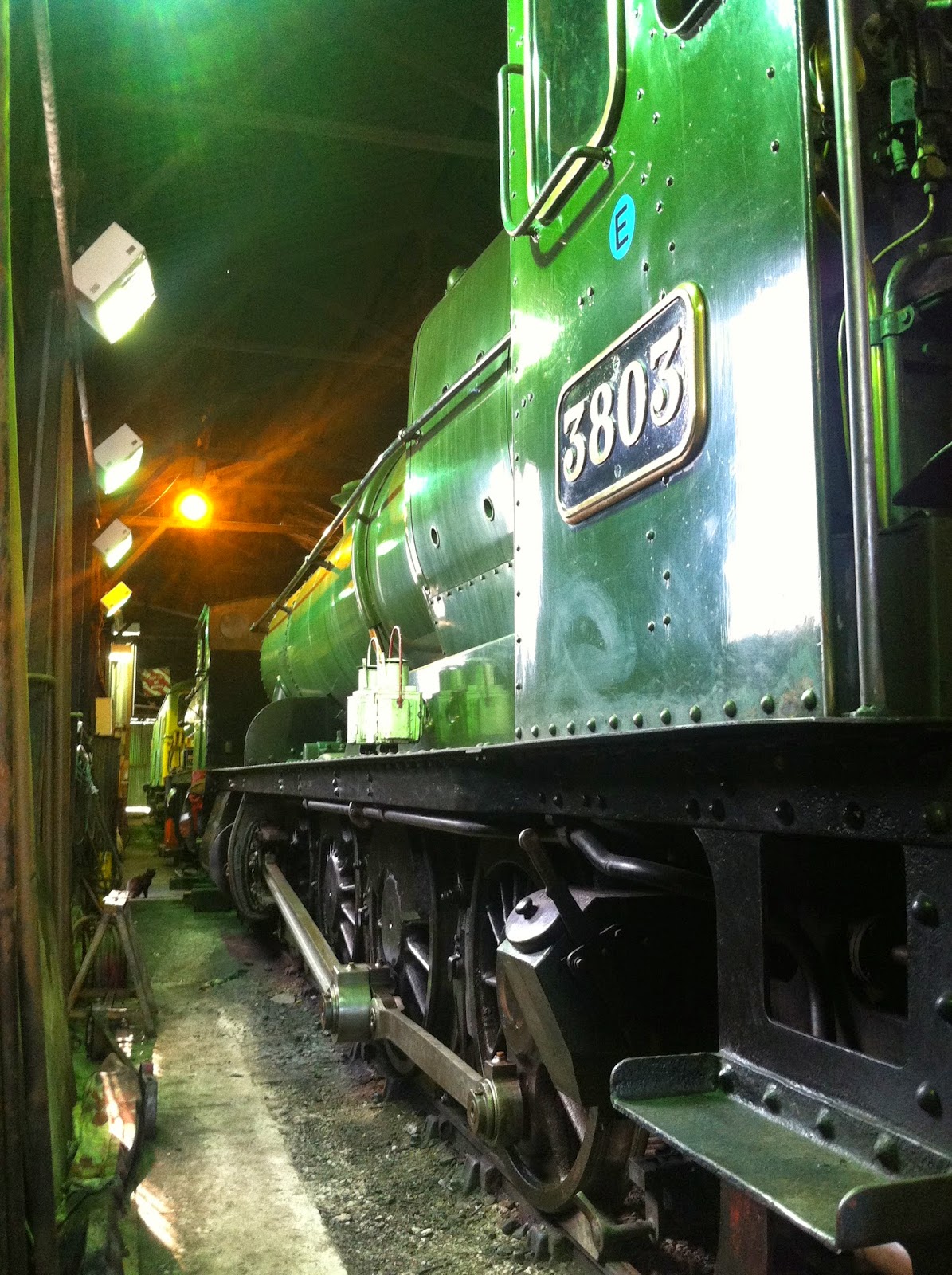
Hi everyone. Today, once again, I was booked to fire the Great Western 2-8-0 No3803 at Shackerstone. There were in fact two booked firemen: myself and Scott. Scott however was a driver a couple of years ago and has now taken up life on the footplate again, so today was about recertifying him as a driver: fair play. We both arrived somewhere around 6am, and immediately set to work prepping the big eight wheeler. The grate was cleaned, ashpan emptied and all of the usual checks were made. Following this, I lit a strong wood fire in the box before blacking it out with coal as normal. The engine was then left to her own devices with a strong Western-style wedge at the back end, which would later be pushed forward as time progressed. 40psi was already on the clock after yesterdays run so we would definitely have no problems. The morning weather was not looking good but as the first departure of the day drew near the clouds parted and the sun began to shine. The engine was soon waiting patiently at the head of the 11:15 departure for Shenton...
Throughout the day myself & Scott took turns firing and driving, with footplate inspector John along for the ride and for the all-seeing examination. The final trip was driven by John himself and I am happy to say that Scott is now a driver again. It was a brilliant day both on the regulator and on the shovel, in great company. The loco steamed and pulled well, as normal, and everything just went to plan...we even ran to time! Thanks for reading folks, all the best, Sam...

Tuesday, 26 August 2014

Wet, Wet, Wet on Bank Holiday Monday...

Hi all. Just words again today I'm afraid - too wet for pictures of any real clarity. Today I was at my usual haunt again: the Battlefield Line at Shackerstone. I was rostered to fire the 1939-built GWR 2-8-0 No3803, who remains the mainstay of services on the 5-mile line. My driver today was to be Jan and I was looking forward to the day as I hadn't been on with Jan for a good while. The weather wasn't too bad when we turned up, just murky, but the rain was soon to draw in. The 6:30am sign on was then followed by the usual antics of dragging cart-loads of equipment down to the loco shed and stumbling inelegantly through the door. First job, as always: check the loco. Having changed into my overalls I had opened the gauge glass slowly. The water level stood around 3/4 of a glass: very good. However, the top gland nut was passing well and therefore the protector was heavily misted. So, I shut the gauge glass off again and waited for the hissing to die down. The protector was then removed and the leak examined. Leaving a known leak causes the glass to become scored by the constant rush of steam coming down the outside, not to mention the fact you can't see the water level with a misted up protector. Tightening the nut by hand (as practise) sealed the leak as the seal crushed into the top frame. The protector was then refitted and the gauge opened again to reveal a leak free seal: just the job.

The firebox however gave little joy as the back end was, though free-ish, very clinkered. A few 'dinner plates' lay on the grate front & back and unfortunately, though I detest doing so, I had to 'go in'. Going into the firebox of a loco that is still in steam can seem harrowing, but it is not an unknown practise. Starting a strong, clean fire will require the cleanest possible grate that can be achieved and so at least you can say you've done your job right as a fireman, plus you can examine the tubes behind the brick arch too. You need to slide your bulk through the firehole as quickly as possible as the ring is very, very hot with the engine in steam. Once you're inside its just really humid, and not at all pleasant. Speed is the key here, with a brisk clean around the grate and bars the best possible plan. Get in, get out! With the grate cleared I left the box with the typical sigh of relief. The footplate felt like -50 degrees as I came out...oh the relief! With a look in the front end and a check around the various plugs and mud doors, the loco was declared safe to light. A strong fire was lit and the engine left to 'get on with it'. It was now time for a well deserved cuppa'. Jan is full of good stories if she's got time to tell them between her oiling duties. She's driven engines far & wide, big & small. She's even driven 4472 "Flying Scotsman" on a few occasions and it was to my amusement that she uttered, "it was always a pretty lousy engine". This sentiment has of course been repeated throughout the preservation industry over the last couple of years as the mammoth overhaul of 4472 has sparked chaos in the press.

Anyway, with the cuppa' drank, Jan oiled the loco around whilst I tended to the fire and made other preparations. The rain was now falling well so I affixed the Great Western's answer to all weather crew comfort: the storm sheet..."cheers Churchward!". Mind you, Collett was no better, fitting a tiny window to his modified 2884 class rather than a full cab! "Give me a Black Five on a rainy day...38's are for sunny weather!". At around 10:45am we moved the loco across, in the rain, to join our coaches in Platform 2. With "four on", we left on time. It was a most enjoyable day, steaming through the very wet countryside. In honesty, the footplate isn't a terrible place to be on a rainy day if you manage to stay on there. Its when you step outside, get wet, then attempt to dry off that you hit trouble as you simply cannot! But, nonetheless, a very enjoyable day and the loco steamed and ran well. For an engine now ever nearing her ticket expiry, she is still going well. We completed 50 miles today with 3803, all of which she covered as a free-steamer. Jan kindly allowed me to drive the 3rd trip, with David joining us to take over the firing for the run. Braking must be considered on a wet day like today as the wet wheels will obviously attempt to lubricate the cast-iron brake blocks underneath. The loco therefore may require slightly more stopping time and also may expect a little more tenderness on the regulator to prevent a slip.

To round off, a very pleasant day out with 3803 again, despite the rain. As I continued to feel sorry for myself throughout the day with my wet jacket, Jan reminded me of one of her sayings, "anybody can crew an engine in fair weather, but it takes enginemen to do it in the rain", and I guess that's a fair statement to agree with! I must thank Jan for her company today and for a good day out with the 2-8-0. However, I cannot lie, I wasn't sad to put the engine away today...I hate rain! All the best everyone, Sam...

Saturday, 23 August 2014

Friday at Shackerstone...

Hi all. Today there was a working party (consisting of all of us that had a day off together today!) at Shackerstone in the Loco Shed. Work was ongoing with "Sir Gomer" and her axlebox repairs, as well as the normal cleaning out, inspection and warming of 3803. I carried out a few tasks today including shunting the engine with the 02, coaling the engine with the digger and also tidying up a few of "Gomer"s now filthy connecting rods. A very worthwhile day all told and now 3803 is ready for the weekend. All the best guys, Sam...

Monday, 18 August 2014

CMES August Steam Day: 'P' for Pleasing...

Hi all. Today was the third and final CMES Public Running 'Steam Day' of the 2014 season. These days have, this year, been specifically put into the running calendar in order to provide steam haulage on the public trains. Almost every other RPMR running day will provide electric or petrol hydraulic traction instead and therefore it is always worth attending on the steam days to see the 'real thing'. When I arrived at 11:30am there were already a couple of members loco's in attendance. With "Achilles" still incapacitated and myself on booked crew anyway, I was quite happy to attend as a member rather than a runner. Unfortunately 0-6-0 Pannier "Victoria" failed early on, leaving the large Manor Class 4-6-0 hauling services alongside a Simplex, a Butch and a Sweet Pea. The service ran well for a while before the Butch retired, followed by the Sweet Pea, with the latter coming off for a light service. Three loco's down and with a large queue in the station, Member in Charge Emma asked me if I would steam one of the society engines, namely 0-4-0 Sweet Pea "Diane". Naturally I was quite happy to do this as I love driving the Pea's on public trains when a load is guaranteed! "Diane" was built by a late club member who was both a friendly guy and a talented engineer. He built the engine to the Jack Buckler design with skill, and "Diane" is probably the best Pea I've come across in terms of giving good, reliable service. She's always been good. The engine, with safety valves feathering, was soon in steam and ready to go...
By 2:15pm "Diane" was in action on the services and "Donald" (the other Pea) had also returned to work. Together, alongside the Manor and the Simplex, the engines began attacking the queue. Slowly but surely, we were getting down them. The Simplex later retired, leaving the two Pea's and the Manor to keep up the service. I was in charge of driving "Diane": a most pleasing experience. The engine steams well, pulls well and just generally does what you want. You can bank the fire up at the station and, once the weight is underway, notch back to 3rd notch and let her go. She'll keep the water level up on the crosshead pump and if she comes more than 10psi below the red line you've done something wrong! She's a great little engine; practically perfect in every way...
"Me Driving 'Diane' With Another Return Trip" (Pic = D.Strapps)
"Diane" performed well throughout the afternoon and needed little coaxing to do the job. I've always had a high regard for this design. In 5" gauge they make for a chunky, powerful engine with lots to give. Their narrow gauge scaling makes for a large engine in 0-4-0 form, though they can bounce a bit with their little wheels on bumpy track. Criticism for them has come at the hands of the Marine boiler, which employs a very shallow grate. However, with a light, bright fire well made up, I've never come across a Pea that won't steam well or fails to pull a good load around a track. Maybe my soft spot for them came with them being the first live steam loco's I ever drove, "John Owen" and "Diane" at RPMR specifically. "Diane"s builder in fact delivered some of my first driver training about 10 years ago! Say what you like about the 'Pea', but "when other engines fall down dead, fetch a Sweet Pea to do the job instead" will remain one of my favourite 5" gauge expressions, they are lovely things...
At 4pm the railway closed and the last train was taken, of course, by "Diane". The engine then worked the ECS back to the bendy beam and into the 'run up road', still steaming well after 2 hours running. Normally you get about 3 hours before the 'Pea's start to play up, depending on how much ash has managed to find its way over the baffle plate to become lodged at the foot of the tubeplate. "Diane" was soon uncoupled from the train and duly disposed. She is captured here after disposal with smokebox emptied, boiler blown down, tubes cleaned and firebox washed out...
"0-4-0 Sweet Pea 'Diane' Rests After A Hard Days Work"
As I say I've always had a high regard for the 'Pea' design: they're great, as shown today by both "Diane" and "Donald". If they can keep up with working heavy passenger trains for a few hours on a track as long as Ryton with a 1 in 100 climb on a strong curve, there cannot be much wrong with them! There are still some non believers but, the proof is there, these are capable little engines. Ahh well, mindless dribbling over! All in all a very enjoyable afternoon both selling tickets and then later driving at the RPMR steam day. That's the last one for this season so we'll have to see what next year brings...maybe "Achilles" may be out & about for next years events...but I won't count my chickens with my run of luck! Thanks all for reading. All the best, Sam...

Saturday, 16 August 2014

A Friday Spent with 3803...

Hello everyone. Today I had planned to head over to Shackerstone in order to perform the traditional Friday task of warming 3803. The 1939-built GWR 2-8-0 is still working all Battlefield Line steam services and that means, for the summer, Saturday & Sunday outings. Therefore, we warm the engine on the Friday. Large steam locomotives take around 8 hours on average to make steam from cold but 'rushing' a boiler into steam can cause nothing but trouble. Therefore, the engine will be warmed for approximately 12 hours on average I would say, before the new, full fire is lit ready for the days work. The boiler is full of several different materials with several different expansion rates and therefore, warming everything slowly is the way to do it. I arrived at around 11am and performed the most important task first: feeding the Railway Cat 'Morris'. Morris has gone by several different alias' over the years but I would say that Morris is perhaps the most popular one, despite her being a female cat! The cat was soon chowing down whilst I changed into my overalls...
Once changed into my overalls it was time to begin the checks. First, up into the cab, to check that the engine is secure and that the water level is OK for potential lighting: yes, 3/4 of a glass. Next, torch in hand, we go for an excursion into the massive smokebox of the 38XX. We check the tubes for leaks, the flu's for leaks, the superheater header, the pipework (main steam pipes, lube pipes etc), the petticoat, the blast pipe: everything really. We are not only checking for leaks but also structural problems such as loose blast pipe etc for example. It is always better performing an FTR (fitness to run) where you can on a cold engine as its easier to get around. Mind you, I say cold engine, it was still very warm in the gloom of the smokebox from last Sunday's running would you believe! The smokebox is also cleaned out at this point...
Next it is time to secure the smokebox door using the dart handles as a loose door will lose the vacuum required for steam raising. We then check around the engine for the mudlid inspection ports and the inspection plugs, looking for leaks all over. If all is OK it is time to check the firebox. We will check the stays, seems, tubeplate, tubes, flu's, fusible plugs and the condition of the grate and brick arch. If all is well, then the dry and ready locomotive is ready to light. Lucky for me, the locomotive had already had her firebox cleaned out and ashpan emptied which saves a fair bit of time...
When lighting a warming fire we do not light across the entire grate as this fire would be too much too quickly. Therefore we just light the rear-most section of the grate and end up with a sloping fire which will eventually rise up to the firehole door, sloping down to around 3ft in from the back-plate. This will mean that the flames will gradually rise up from the old coal to the new coal and thus the fire will gradually burn down. After all, the engine will be left burning overnight with all dampers closed and firehole doors shut. I lit the engine starting with a small bed of coal 1-lump thick at the back end to around 3ft in, as per usual. Around 1/2 a pallet of wood (if that) was then put on top with around 3-4 well soaked paraffin rags. The last rag was lit on the shovel before being tossed on top of the pile, which duly caught light. The fire then raged for a minute or so to get going before I piled around 5-6 shovelful's on top. The firehole doors were then shut with the rear damper open in order to provide the necessary primary air to get the fire going. With hardly any coal left in the tender it was time to fetch a shunter to take the engine down for coal. The shunter for the job was the feisty 0-4-0 BR Class 02 diesel hydraulic D2857 "Diane"...
With 3803 crackling away in the shed 'getting herself going', I was down in the North End checking over D2857 which I had been told was 'fit for use', and she was. D2857 is fairly easy to operate as the controls are basic. To start, we switch on the BIS (the electrics basically) and proceed to the 'engine room'. The cold-start on the Rolls-Royce engine is pushed in and the green button pressed. Without hesitation, the 02 roared into life, spewing a little blue smoke from the exhausts to start with. The engine then ticks over happily, creating air in the reservoir from the compressor. On the 02 the air is used for all of the controls such as the reversing gear, sanding, throttle, gear lever and of course the brakes. We wait until the necessary air has been created before setting off. The 'dashboard' on the 02 is seen here...
"Cab Controls on BR Class 02 Diesel Shunter D2857 Diane"
The view ahead...
3803 was soon dragged by D2857 down to the North End and secured on the coaling road...
"GWR Heavy Freight 2-8-0 No3803"
The warming fire was now burning away brightly and so I made it up in the traditional Western wedge fashion to the firehole door, with the coal on top not remotely burning (it all burns down slowly but surely). This view was taken from atop the tender whilst 'trimming' the freshly loaded coal...
The JCB waits patiently with the next bucket full of coal until the trimming has been completed...
After the JCB had easily loaded 8 buckets of coal into 3803's tender (which pretty much filled it), it was time for D2857 to push 3803 back to the shed. I left the loco at about 4pm with the fire made up to the firehole door in the traditional fashion...
"A Back End Warming Fire"
The picture above is slightly deceptive. The fire looks big but it isn't really when you consider the size of the huge grate and overall firebox. With the dampers all shut and the firehole shut, the engine was left gently singing away to herself. Though hot around the firebox after around 3 hours alight, the smokebox is only warm, as is the manifold. This shows that the heat is gradually working its way through the boiler and fittings, and therefore we have a good while before steam will be raised. Sure enough, the following crew would later report to me that the engine was 'just fine' the following the day and had around 10psi on the clock ready for the new fire to be lit. The engine would have been warmed slowly for around 17 hours or so at this point from cold, meaning that everything had been brought up to temperature at an easy pace so as not to cause any damage. In the days of steam, engines would have remained in constant steam for a few weeks at a time, reducing possible boiler damage from excessive expansion & contraction. I don't know of any big railway that takes big engines out without warming them prior...it just isn't the right thing to do, not if the engine is cared for. Warming the engine throughout correctly will keep the boiler free of leaks and extend its life for much longer than starting from cold will. A most enjoyable afternoon with 3803, making her ready for her weekend of hard work ahead. Best Regards, Sam...

Monday, 11 August 2014

Shed Day at Shackerstone...

Hi all. A quiet day today at Shackerstone today between 10am and 5pm working in the engine shed, mainly emptying the pit and tidying around the shed. The working party rode on the 4pm train and enjoyed a beer after signing off - most pleasant. 3803 worked all trains today with ease. Best Regards, Sam...

Wednesday, 6 August 2014

Bye Bye Bala, Bala Goodbye...

Hello everyone. And so, as time passes so quickly, here we were on our final morning this year on the Bala Lake Railway. Down at the sheds at the usual start time of 8:30am we found "Holy War" at the head of the line. The bumpy ride given by the "Maid" when we had her on Sunday had caused yesterdays crew to play it safe with the blue beast once again, putting her red sister to one side for repairs. Having performed our usual preparation duties, we were soon steaming happily along the picturesque BLR metals...
A gloomy start was later rewarded by bursts of sunshine with Eddie almost uttering the word..."Alice". However, the bursts of rain in between certainly would have put pay to any thoughts of "Alice" for me! The sun came out during our arrival at Llangower with the returning 11:15 departure...
"Holy War" is pictured here standing alongside the calm waters of Bala Lake with her blue livery shining. I do like this engine...
Having returned to the base on time, we were soon out on the 12:50 departure. Its amazing how the day passes sometimes. I drove this trip and therefore adopted the drivers duties during the base station run round. This involves generally checking the engine over, oiling up and filling the water tank...
Checking the level in the tank prior to the 2:25pm departure for Bala...
Running the engine around onto the 2:25pm train...
Buffering up to the coaches...
We then departed with the 2:25 train, with "Holy War" steaming well and running easily. We always have such a pleasant and easy day out here with the engines that its almost a shame to go home. "Holy War" is pictured here running into the loop at Bala with Eddie the Egg at the helm...
The shining blue livery of the engine is apparent here, as is the condition in which the much loved BLR engines are kept. Eddie is oiling up ready for the return departure at 3pm...
"Holy War" at Bala ready for the 3pm, pictured from the opposite side 'just for a change'...
Having enjoyed the 3pm journey with "Holy War" performing perfectly well, the 4pm departure from the base saw me on the handle again. We had a very pleasant final run and it was almost sad as we pulled into Llanuwchllyn for the last time. We'll have to see what next year brings. Whatever happens, I would just like to thank the friendly team at the Bala Lake Railway for making me so welcome over the last five seasons. My first visit in 2010 was so enjoyable that I've been attending with Eddie ever since and have had some great times both firing and driving. Even though this years 'Three Course Challenge's have given me some grief over the last few evenings, Eddie assures me that they are the right thing to do when heading out for a meal. Beware all, a warning for you, an evening out with Eddie is not a cheap night out, its 'Three Courses or BUST' anytime, every time. What great times we've had here over the last few years: brilliant. Thank you for reading folks, kind regards Sam...