Friday, 10 October 2014

Achilles Report 64: Fell Over...

Hi all. This week I've been on afternoons/evenings again at work, meaning that the only thing I can do in the day, apart from watch endless repeats of Jeremy Kyle, is to work on the two engines. I mentioned in the last report that "Achilles" probably needed the water pump servicing. This was done on Monday, with the loco in a drunken state looking as if it had a run in with a much bigger engine. The eccentrics were out and the pump stripped ready to clean it out, fit new balls and repack the glands around the rams. The lack of eccentrics also allowed me to get inside with a spanner and tighten that pesky handpump feed nut which comes out from the side of the L/H tank. Following this work I took the engine outside and filled the tanks in order to prime the handpump. The fitting wasn't leaking with some real force having to be applied to the pump where I'd blocked the feed pipe off so I think that test was a success but only time will tell. The tanks were then drained before the engine was returned to the workbench. On Wednesday I was back in the workshop again and it was time for "Achilles" to have her first clean up & polish since the last repaint of the cladding. I had been advised not to clean the cladding until after a couple of steaming's but, even so, it is already showing marks and deterioration beneath the surface. Oh well, its going to get wrecked in such a hostile environment so who cares. The engine was cleaned from top to bottom, whilst the shining green contrast of "Maisie" looked on...
 "Achilles" was spruced up throughout Wednesday and, when I left for work, the engine was looking pretty pristine again with all brasswork polished and paintwork buffed up. I think her next run will be at the GEC on October 25th but you never know, it may appear before at a moments notice. "Maisie" on the other hand has had no real attention apart from just admiring her. The only thing I have done is made her some vacuum hose look-a-likes for her vacuum feed pipes. These will fill the void between the pipes and the stoppers during the Midlands show, where the engine will be appearing next week. As it seems almost impossible to get accessories for 3.5" gauge locomotives, these pipes have been made from simple measurement springs and a tiny bit of electrical heat-shrink, which brings out the springs in a pronounced way so as to give the impressive of a vacuum hose. Naturally this is cheating but they look OK. I just need to fashion a ring now for the top end to hide the end of the heat shrink but as you look at the engine you can't see any problems so I'm happy...
Things will probably go quiet now for the two engines for a few weeks, apart from "Maisie"s visit to the Midlands show of course for a spell on the Coventry MES stand. Then, after the Midlands show, perhaps we'll try and get her to go! All the best guys, Sam...

Monday, 6 October 2014

The Diesel Way at Shackerstone...

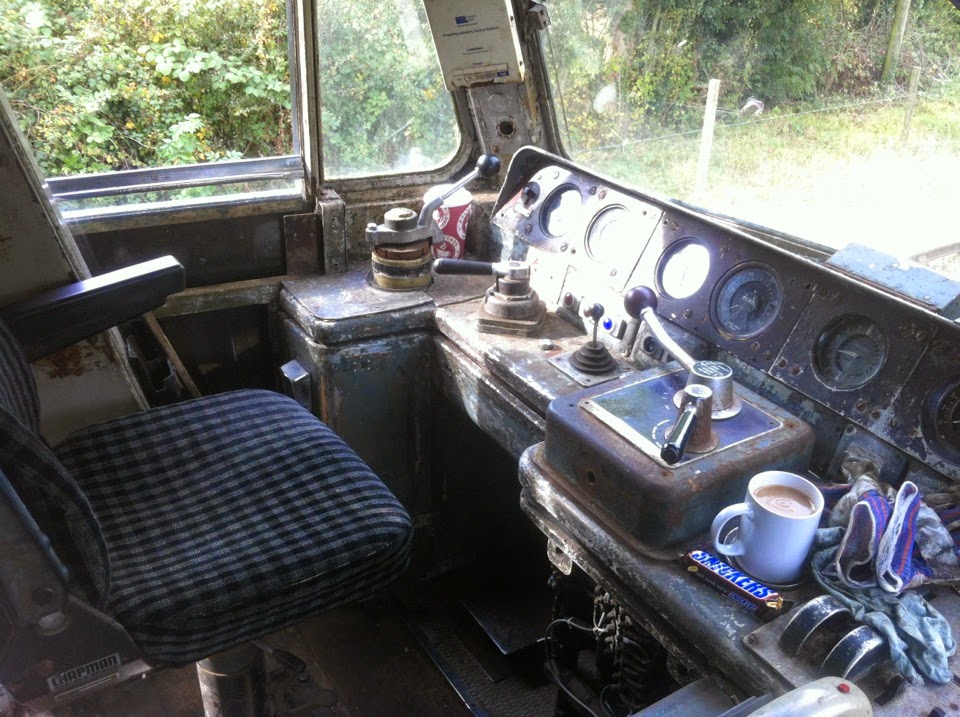
Hi everyone. Shackerstone was todays destination and I spent the afternoon on three round trips, filling in as the Secondman on the day's rostered diesel. Due to the failure of 3803 the other week with a broken spring, she has been out of traffic. The team did attempt to fit another spring but, as soon as that was fitted, another one went and so they are now waiting for a replacement for that spring. The operation of this weekends services therefore fell to Class 47 diesel locomotive 47 640. Its a different life all together on these 'modern' contraptions. You sit in a seat of all things, in a work of the devil known as the overall cab, with heaters and windows and all of these modern gadgets that just make everything so hideously comfortable. The filthy hands are exchanged for cleanliness and you just generally don't get half as tired. You may think that this is quite a leap forward which, in a way, I suppose it is, but its a lazy mans locomotive! I must admit, on a sunny autumn afternoon, it is quite nice to sit back with your feet up in a comfy seat with a cuppa' in your hand watching the scenery go by. But, even on the driving side, its just two handles: the throttle and the brake really, if we're honest. Its too easy but it is how a modern engine should be I guess. 47 640 "University of Strathclyde" was built at Loughborough by Brush in 1966; one of the affectionately known 'Duff's. The BR Class 47 was a fleet which eventually numbered 512 locomotives, putting in some great performances with a 2,750hp Sulzer engine (later de-rated to 2,580hp). It is at this point that I would like to point out that Stanier's Duchess' were estimated at 3,300hp - just saying. Myself & Jason had a pleasant and easy afternoon on the Duff but, allas, it ain't no steam engine. Best Regards, Sam...

Sunday, 5 October 2014

Achilles Report No63: Public Running at GEC...

Hi everyone. Today "Achilles" made a rather unplanned visit to the GEC Miniature Railway at Binley for their 5" gauge public running day: the last of the season. The original intention was to go to RPMR for the steam up but, following the awful rain in the morning, the destination changed to the GEC as they got in contact and said that their club loco was out of action. By the time the rain cleared it was past 1pm anyway, and the GEC's running time of 2pm - 5pm would herald some better weather. With the chance to give two steamers on the GEC's final running day for 5" only of 2014, we changed course and arrived there at around 1:15pm. The blue tank engine was duly unloaded and preparations were immediately made to steam. I think it must have been some time around autumn last year that "Achilles" actually made her last visit to the GEC. This was definitely the first time for a while and the first time in her new, brighter colours. The engine hadn't been cleaned, apart from the dome, since her last steaming for the test at RPMR a few weeks ago, but it was still presentable enough, having been rained on for most of that previous run. The loco was duly steamed up using a mixture of house and steam coal. By 1:50pm, the engine was blowing off lightly on the steaming bay with 90psi on the clock and was ready for the off...
The other engine in steam today was what I like to call "The Baby Gomer". The Hudman family's 0-6-0 Peckett look-a-like in its shining livery of bright yellow looked quite a contrast to the blue of "Achilles". The Peckett had been ready for a while and headed out to the track before "Achilles"...
The two 2-car rakes began the service at 2pm as planned with no passengers initially queuing. This early lull gave the two engines a chance to get into the swing by enjoying a few light engine laps. The GEC track is unusual as, though short, it is quite challenging as the station lies on a sharp downgrade, with a sharp upgrade following soon for the ascent of the bank. This plays around with your water level quite a lot, particularly as the station track cambers to the right so that, with an engine that has a gauge glass on the left like "Achilles", no amount of water ever seems enough! The two locomotives performed brilliantly, hauling varying loads of many passengers throughout the afternoon. There was a slight problem with "Achilles" when, without warning, the water pump just gave up. Looking around the engine I could see no reason why so retired from the track at just gone 3pm to check over the problem. The electric Class 08 took our place. Having checked the engine thoroughly on the bay, I decided to 'crack' the two chambers of the water pump. One was straight to water, the other released some air before water emerged. Then, that was it, it worked perfectly again. Its very odd when things like that happen but better safe than sorry. The tank engine was then stoked up again (as 50psi had remained on the clock throughout the pit stop) and duly returned to the track. The rest of the afternoon saw both engines continuing to perform well as the weather, though breezy, gradually improved into sunshine...
The Peckett retired at about 4:20pm, with "Achilles" leaving the track probably 20-25 minutes after for disposal. Both engines had performed well and the little Peckett for one never seems to have any trouble. "Achilles" is seen here after a successful, revenue earning afternoon at the GEC...
"Days End for Achilles"
The loco was duly blown down, grate cleaned and tools packed up. Following loading into the car we returned home and I was pleased with the engines performance on her first public running since overhaul. I think I'll service the water pump next as that hasn't been done for a while, and generally check its operation. There is also some attention required to a leak on the handpump feed which looks like the nut has just backed off slightly during refitting of the boiler. That should be a 2-minute job: fingers crossed. The locomotive is next planned to run at the GEC's Halloween night on October 25th when we again hope to do some good work on the public trains. Lets hope she does well! The engine isn't going to the Midlands show this year for Coventry MES (she went last year), "Maisie" is going instead. All the best guys, Sam...

Thursday, 2 October 2014

A New Arrival, A New Toy...

"The Finished Product" (The Steam Workshop)
Hi everyone. At last, here she is, the unmentionable Atlantic. She is now home and so I can finally say, meet No4436. The story of the 'new toy' goes back to about May this year when I had sort of put my feelers out for a second locomotive to join "Achilles". The way I saw it, "Achilles", my big blue chunky lump, was most at home pulling passengers and doing heavy work. Naturally, to counteract these uses, she is heavy and cumbersome to move around. I had always liked the LBSC designs and this one, 'Maisie', caught my eye long ago. I always promised myself one if it came up in the right colour and the right condition at the right time. However, I hadn't bargained for how fast this one would turn up! When looking out for one of the numerous 4-4-2s, I was pointed in the direction of The Steam Workshop. These friendly guys buy & sell locomotives as well as offering overhauls, finish-ups, paint jobs etc. Upon contacting Simon, he advised me that a 'Maisie' had just turned up. Driven by the 'kid in a sweet shop' enthusiasm, myself and Eddie went to see the engine after seeing the following picture...
"When She Came In" (The Steam Workshop)
The example above was the engine in question. The unusual livery did raise eyebrows all around I think but it apparently had good engineering credentials so was, undoubtedly, well worth a look. So, in June, we visited the works of TSW in Bradford to see the engine. Remember the Kirklees post? Well, that was the decoy whilst on route to see the secret new engine! It had just had a successful hydraulic test to twice pressure as the copper boiler was determined to be new. Unfortunately, though she had passed her steam test, she did not run. The slide valves were refusing to seat, thus meaning that any steam simply exhausted to atmosphere. No matter, we were here to view. Because of her 'under test' nature the engine looked less than desirable when we went up there!...
Looking passed her unusual black, red and dark green livery, we saw a nice engine. Both Eddie & myself looked all around her. The machining was nice, the bearings were new and tight, the boiler was new and looked of good construction, almost commercial. The only thing that let her down, apart from a certain mechanical issue causing her not to run, was her paint. Therefore, the negotiations began and, though she didn't look pretty, I considered the brand new boiler aspect. A brand new, working boiler is always a bonus of course, plus brand new running gear! With a change in price to reflect the extra work required to make the engine look and run well, the purchase was agreed. Since June the engine has been undergoing her full make-over to my specification. TSW lads were more than happy to do the engine just as I wanted it. Their enthusiasm for what they do really does shine through and you can tell that everything must be 'just so' for them. I have included a couple of TSW's pictures below of the overhaul. To see their overhaul report for my new engine, click here. Here is the tender and the boiler enjoying some paint stripper...
"Removing Old Paint" (The Steam Workshop)
Here we see some of her components following stripping and blasting. This method, at least on the images, seems to give a great working surface for repainting...
"The Main Bits" (The Steam Workshop)
Just to give you the odd before and after shot. Here is her dark green LNER lettered tender before...
"The Before" (The Steam Workshop)
And here is her tender after painting and lining in apple green, before the application of her transfers which finish her off perfectly...
"The After" (The Steam Workshop)
The painting was probably finished around 6 weeks ago but since then the lads at TSW have been battling with the loco. It turned out, following inspection, that the slide valves had not been made correctly, thus causing them not to seat in the chests. Once new ones were made and fitted, she ran! However, what did she do? She dropped her timing on the eccentrics! It turned out that the eccentrics were just on the axle and not properly secured against the forces acting against them. So, unfortunately, the boiler was off again and the eccentrics were off, reset and secured. The timing was then set properly. So far, so good. The second steam test: to test what had been removed and refitted: was then carried out with good results. The engine ran well with good beats and with nothing mechanically amiss. Unfortunately, the gremlin struck again and the paint blistered around the boiler bands on the barrel. Down but not out, the SW team removed the boiler yet again and fully repainted it before hardening the paint and then trial steaming without the bands on. With all now well, the bands were refitted before another steaming which rendered everything OK. At last, today, following all of their hard work and determination, the engine was being admired by her elder shed-mate "Achilles"...
The locomotive is now waiting. She is waiting for the Midlands show where she will appear on the Coventry stand on behalf of CMES. She won't be running before then so that she remains in outshopped condition. After that, she'll have a run - which I am already looking forward to. All in all, a longer experience than was planned but I cannot really fault the SW lads for the immaculate end product they have turned out. The loco is nothing like her former self, nicknamed the 'red running board beast'. I hope she will turn out to be a good performer but, as readers, you'll find out when it happens! Meanwhile, shed mate "Achilles" will hopefully have one or two runs before "Maisie" goes out but we'll see.
 
As a background, the new engine is the 3.5" gauge 4-4-2 "Maisie" designed by LBSC. This type is a pretty good model of the Great Northern Railway large boilered Atlantic. These engines were big and powerful performers on the GNR and survived through the LNER and, in smaller numbers, to BR. With big wheels and boilers they were fast, but were modified at various points in their life to make them better at starting trains with only four driving wheels. The class were also adapted from their original pole reverse with slide valves (a nightmare) to screw reverse with piston valves. This improved their economy. I think these do come out as an attractive engine and mine (4436) was modelled on that engine as I believe she was never overly modified. Some C1's ended up with Gresley inspired cabs and outside valve gear, but not 4436, keeping her true to form. To check out other work and for sale engines on the Steam Workshop, click here. All the best guys, Sam...

Sunday, 28 September 2014

North Norfolk Nine Freight...

Hi everyone. Today, whilst on a weekend away in Norfolk, we decided to take in the North Norfolk Railway, mainly just to 'tick another one off'. Upon our arrival in the bustling little seaside town of Sheringham, we parked the car before walking up through the busy streets. The attractive NNR station was reached at just before midday and after purchasing our tickets we quickly boarded the midday train: just in time. At the head, simmering away, was a massive beast: a nine freight. This particular example is No92203 "Black Prince", based at the NNR and owned by wildlife artist David Shepherd. I must admit I was surprised to find "Black Prince" out on what we thought would be a quiet Saturday but, I guess, being one of the UK's premier lines now, the NNR can justify it. The railway has 5 miles of track and runs between Sheringham and Holt, via Weybourne. Over the years the line has built up a fantastic reputation and, most recently, an old friend: B1 1306 "Mayflower": joined the already impressive resident fleet. Leaving Sheringham behind 92203, the train makes its way along the coast with pretty views...
There were two trains in operation today, with the other being hauled by a Class 37 diesel. The two trains passed on each trip at Weybourne and the 37 is seen here, cruising in...
From Weybourne it was upgrade again for the 9F but no matter, these things are brutes. The 9F class was part of the BR Standard Range of locomotives. Designed by R.A.Riddles, the 2-10-0 types eventually numbered 251 examples. The first engines appeared in 1954, with the last ("Evening Star") appearing in 1960 and gaining fame as the last steam locomotive built for British Railways. The 9F's did survive until the end of steam in 1968, though withdrawals of the class began in 1964. This gave the class notably short working lives compared to their design criteria. It was, arguably, a total waste. 92203 was built at Swindon in 1959 and had a terribly short working life which saw her withdrawn in 1967. Luckily, for the princely sum of £3000, 92203 was purchased by David Shepherd direct from BR and so never saw the scrapyard. Soon enough, David named the engine "Black Prince"; a name she has carried ever since. The locomotive has been based on the NNR for a while now, having spent a lot of time at Toddington in recent years...
Capable of hauling 900 ton trains at 35mph, the 9F's gave a tractive effort of 39,667lbs with their 250psi boilers, 20" x 28" cylinders and ten 5ft driving wheels. They were very powerful and popular engines, with some even recording 90mph performances: a scary thought! At Holt, "Black Prince" rested after a completely easy run from Sheringham...
A footplate view on "Black Prince", showing the BR standard arrangement of 'everything under the drivers hand'...
Here, in a blurry view in hot sunshine, 92203 runs round at Holt...
The 9F was then watered at the tower...
Another view of 92203 "Black Prince". I think this is a handsome engine...
Before long it was time to rejoin the train for the return journey. 92203 again found it no problem, particularly with most of the run seeming to be downhill. At Weybourne, having passed the 37 again, the train was drawn out past the engine sheds. Industrial 0-6-0s "Ring Haw" and "Whissington" stood on the shed front, blocking Black Five "George Stephenson". Also resident here, though indoors today, are B1 1306 "Mayflower" (an old friend) and LNER B12 No8572...
After a pleasant run back to Sheringham, 92203 runs round again...
"A Final View of 92203 Black Prince"
This was a very pleasant little first visit to the North Norfolk Railway. Its a pretty, friendly and interesting little line with a locomotive fleet to be jealous of. 92203 is a real beast of British Railways engineering and its such a shame that these mighty engines cannot work on the modern main line. You see, due to the long wheelbase, the 9F's have a flangeless centre axle and this is not allowed on Network Rail metals. Such a shame, but, such is life. Cheers guys, Sam...

Monday, 22 September 2014

3803 Day...

Hi all. This morning started like others at the Battlefield Line: early! Today I signed on at 5:45am in preparation for a Footplate Experience course aboard GWR 3803. The locomotive was checked over thoroughly and then lit up. Driver Jan arrived at around 6:30am to find the loco already simmering away and with 20psi on the clock. The Foot-Ex took place on time between 9am and 11am as standard, followed by the usual 5-train timetable. It was a fairly easy and uneventful day, with 3803 performing well and the weather being fairly kind. As the day drew on, a cooler breeze sprung up and we found ourselves reaching increasingly for the driving jackets! Unfortunately, 3803 ended the day as a failure. The cause?: one very broken spring. The GWR Class 38's are well known as regular spring breakers. Their spring breaking ability is known far and wide but is mainly a product of their design. The earlier variant of the 28xx was fitted with compensated springing, making spring changes less frequent. However, the later class 38xx, built under Collett rather than Churchward, did not incorporate this feature. The later 2-8-0s therefore, with their long wheelbase and eight driving wheels, give a lot of stress to their springing gear. The locomotive managed to make it home as the spring failed on the last returning trip. The spring will be changed in due course to allow 3803 to get back out again onto Battlefield Line metals. All in all a grand day out that would have been better without the poorly spring! All the best guys, Sam...

Saturday, 20 September 2014

Achilles Report No62: Success at Last...

Hi guys. Here we are, at last, its done and it only works you know! The blue tank engine has been waiting in the wings since about July, waiting for me to have the time to work on her. I think the trouble my end was that the cladding had already had two repaints, and a third would mean more mess and toil. However, with a week on nights in prospect the other week, I decided to just smash the painting out, bake it on and have another go at running the loco. Its been a terrible season for the engine thanks to my attempts to repaint her, but at least she's done now. Today, in the drizzle, the engine was steamed at the CMES base of Ryton Pools, alongside a pair of 4-4-0 types: Eddie's 3.5" gauge 2P and Colin's 5" gauge LNWR Precursor. We arrived at around 12:30pm and the engine was in steam by about 1pm. Slowly but surely, the engine left the steaming bay for the test run, with the cladding still in tact. Well, I am proud to say that she ran beautifully and had no problems. The only jobs remaining are to do a little bit of 'touching in' with a craft brush on some of the tiny marks that the engine has received during the on-going work. This job list is perhaps the smallest I have ever had since owning the engine. I am very pleased with the final result, all done and dusted and with a working superheater to boot...
The three engines are seen here lined up outside the station with the drizzle having stopped for a moment. The bright blue paintwork of "Achilles" does brighten the place up a bit though...
"Friday Afternoon Line-Up"
Also today, at last, Ken was finally reunited with the engine in its post-repaint form. As this is only the second time that the loco has appeared at RPMR in steam since its repaint, this is the first time that Ken has seen her. I am pleased to say that he was very impressed with both the livery and the performance of the loco, which is a great relief to me. My main interest since owning the engine has been to ensure that Ken is happy with the on-going work. I am now pleased to say that I am now very happy with the engine and, apart from putting new pins in here and there, she is pretty much set up right. Here is Ken with "Achilles"...
I was trying to work out in my head all of the work the engine has had done since I've had her. Ken made the engine to a good standard when she was new, but 25 years or so of sterling work had worn her out, that was all. So, here is the list:
  • New connecting and coupling rod bushes
  • New crossheads and little end bushes
  • New whistle valve
  • New steam pipe
  • New rear axleboxes
  • New pipework to and around double-acting water pump
  • Full repaint into a new livery lined in white
  • Service to handpump and axlepump
  • Various seals, little jobs and light repairs
I may have forgotten a few things from the above list but those jobs certainly have been carried out. Naturally it has been done over the course of months as the bottom-end overhaul took place the winter before last in 2013, as documented on this blog. In 2014 we have of course done the full repaint as, again, documented on this blog. So, finally, BEFORE...
AFTER... 
I still have a few 'touching in' jobs to do as I said, as well as fitting the dummy whistle when I've finished doing some work to it. The engine is now in traffic as such, and is fit to run whenever required. I am hoping that it will run again at RPMR before the winter season but the locomotive will also, I hope, be attending the GEC Railway's Halloween run at the end of October. This is a fantastic event and is well worth a visit. Best of all, it is FREE, though donations are of course gratefully accepted. So, there you have it guys, the engine works. That's it, job done. Thank you so much for reading and thank you for following the engine on this blog. I am very pleased with the end result. Al the best, Sam...

Sunday, 14 September 2014

Driving "Marchlyn" for Statfold...

"She's A Good Un" (K.Eyre)
Hi all. Today, already, it was the final Statfold Barn Open Day of the year: the big September bash. I was rostered to drive 1933-built Avonside 0-4-0 side tank No2067 "Marchlyn". The engine is remembered for working at Penrhyn quarry and, following years of active service, eventually found herself on a plinth in Tennessee! Happily, SBR owner Mr Lee purchased the engine and brought her home before providing a full restoration. The engine is now in perfect working order and, as I would find out today, is quite a tool. I arrived, along with most of the other crews, at 6am. The car park was still in darkness as we drove in, with some chimneys already sprouting smoke just over the way. One such engine was "Marchlyn", which had just been lit up by my fireman: Keith. The Avonside was lit from cold, as were the other small engines, though the morning was quite mild so she wouldn't take long to brew up. Straight away, I began oiling up. The Avonside employs some nice features such as axlebox feeders. Simply fill up the feed box twice and that should do the day, though I filled them a few more times just for good luck. The rest of the oiling was self explanatory as on most engines.

For cylinder lubrication, the engine employs two globes fitted above the steam chest covers. The globes, when cold, will not give the thick cylinder oil much incentive to hurry along and so time is taken between other oiling jobs to refill the globes. Once satisfied that you have initial oil in the cylinders, the globe base taps can be shut-off and the globe chamber filled before shutting the top tap too. The engine will move off shed with drain cocks open, as per practise, therefore expelling most of the oil in the globes so, for the first move off shed, the globes would be left shut on the strict understanding that the oil I had already drained through into the cylinders would do the job: simples! The regulator is fed from a displacement lubricator which sits just behind the dome cover. The regulator on this engine is, for maintenance purposes, outside the boiler and is connected to the dome, with two lengthy steam pipes working their way down to the cylinders from there. The displacement was filled in the usual way: open drain, drain the water, take off the top, shut drain, fill with steam oil and put the top back on. The feed to the lubricator would not be opened until the engine had steam. The oil would then be displaced and would feed the regulator throughout the day. Whilst I oiled the loco around and did my general checks, Keith was busy with the fire and, in the background as always, time was ticking away. "Marchlyn" was nearly ready...
"Marchlyn" would today, as has become a usual thing, be working with Penrhyn sister "Sybil Mary": the Port Class Quarry Hunslet. The matching liveries of the two 0-4-0s makes them ideal partners and therefore they would again be top & tailing the Goods Train. Following the safety briefing, "Sybil Mary" was taken down the line on one of the first moves with the goods train in tow. Then, myself and Keith got the call. Taking her steady, I gave the Avonside a breath of steam and off shed we went. I'd already done the usual warming through process to expel much of the condensed water from the cylinders. The engine was brought down the gradient steadily on the handbrake before waiting at the start signal. When the Quarry returned, the train was dragged into the Goods Loop with "Sybil" blocked in, allowing "Marchlyn" to take up her place at the new head of the train...
Throughout the day we seemed to be none stop. Normally an SBR open day will require engines on the 'old railway' to wait on shed for an hour or so between turns but not today! The Goods Train is out every 3rd run meaning that we come in and we only have the time it takes for the next passenger train to reach Oak Tree and for the next returning one to get back to Statfold and then we're out again. If you get more than 5 minutes or so you're lucky! However, no complaints my end, it was great to be moving so much! Our first train came at about 10:30am. With the right away from the Guard and an acknowledging whistle from "Sybil" on the back, I gave "Marchlyn" some steam. Slowly but surely, she got the weight moving and we were away. With the land-rover following the goods and carrying the staff, into the section we went. "Marchlyn"s very effective footbrake was fantastic in operation, steadying the train up with ease. I was very surprised with that feature, apparently only fitted to the five Avonside's to this design. The train was heavier than I thought though: there was a good few tons there. The engine didn't care though, she was away. Going around the tight and climbing balloon loop did call for the odd bit of full regulator but she wasn't straining, she pulled easily. This little engine can do some really hard work! After a fantastic first run we are captured being dragged along by "Sybil"...
"Hanging Off The Back" (G.Cryer)
Our second chimney first run also came very quickly and was most enjoyable, followed by another run on the back. I left the third trip in the hands of Keith whilst I had a go at firing. The engine steamed well for me and was generally a pleasure to be on. No problems with her at all...
"Keith in Control" (G.Cryer)
I must thank Mr Geoff Cryer, who I finally met today, for sending in yet more pictures. Geoff has managed to catch me in shots many times over the years but we've never met face to face. At last, today, we managed it. Geoff keeps a wonderfully interesting diary of his rail exploits both in preservation and in the days of industrial NCB steam. His posts are well worth a read. Click here for the diaries. Geoff joined myself and Keith on the footplate of "Marchlyn" for the short run from Oak Tree back to Statfold. He recorded a little bit of film aboard the little Avonside which I have included for your interest...

As the day wore on things continued much the same. "Marchlyn" was running well and there were many people around: over a thousand we were told! The timetable was certainly impressive, with departures from Statfold every couple of minutes on both railways. There were at least 14 in steam on the railway, with probably the same number in steam on the event field in the form of full size road engines. It was a great do and you have to take your hat off to the hard working staff and owners of the SBR for making it all possible. Later in the day, "Marchlyn" is captured passing "Howard" (formerly "Josephine" before her sex change) with Danny & John in control. Note the size difference between the Tattoo type and the diminutive Avonside...
"Marchlyn" and "Howard" (G.Cryer)
Here is one of those vane shots, insisted upon by my friend Ken. Here we see Keith is undecided whether he wants to be in the picture whilst I pose despicably on "Marchlyn"...
"Posing Like A Fool" (K.Eyre)
We did our final trip at around 3:45pm, with "Sybil" in control. The job now would be the winding down of everything ready for the 5pm cavalcade. As the goods is merely a photographers thing, that was knocked off first; though it probably did the most miles! The first task was release "Sybil". For this, I had to drag the train out of the loop up to the stop board (the limit of shunt) and then propel back once "Sybil" was clear. I had been told to get the engine as far as she'd go into the loop so that the wagons could be stowed with shunting space behind them. "Marchlyn" was pretty much in the roof as we slowly attacked the tight, climbing siding. With the wagons secure, "Marchlyn" was later sent on a light engine run: part of the staff collection. The engine, without the clanking wagons behind, sounded like a dream. There wasn't a knock, a bang, a clank: nothing. This is a really good job and a really lovely engine. You cannot really fault anything about it. I know I may say that a lot but you really can't with this one, it does exactly what you want, when you want and with ease: perfect. Following the cavalcade we returned the engine to the shed where she was checked and disposed. Keith had the fire just right and we were able to leave the engine in a fit state fairly quickly. It had been a brilliant day and a really fantastic achievement for the SBR. Its a pleasure to be involved and, certainly, a pleasure to drive "Marchlyn". Its a wonderful railway to work on.

If you would like to see some great shots of the days running, click here for a youtube video I like. I must thank Geoff and Ken for sending in some of the pictures used in this post and I hope you've enjoyed reading it. All the best guys, Sam...

Saturday, 13 September 2014

Prepping at Statfold...

Hi all. So, here we were, six months after the first, the last Statfold Barn Railway open day of 2014 was upon us. I have been lucky enough to be part of all three events this year and today we were prepping ready for tomorrow's season finale. This time I would be driving, yes driving, Avonside 0-4-0 Tank "Marchlyn". The jump from fireman to driver has come in the form of fireman to passed fireman, as is practise. The passed fireman is "a fireman who is available to drive when required" and so, with a space to be filled, I will be driving tomorrow. The rank of driver (the final frontier) comes when you have completed a set amount of turns as a passed fireman so, maybe one day that'll come as a formality but no time soon. Today myself and my fireman, Keith, busied ourselves with cleaning and polishing the black Avonside. She was coming up lovely and I'm really looking forward to tomorrow. Lets hope it goes well! All the best, Sam...

Friday, 12 September 2014

Achilles Report No61: A Revival...

Hi everyone. So, here we go then, lets recap. Last time "Achilles" featured in a report was in July and she had just been for a test run at Rugby MES following renewal of the superheater header. The test was successful mechanically but not cosmetically as the boiler cladding threw another wobbly and the paintwork reacted beyond all rational control. Since then, as in the picture above, the boiler has been lying in state in the workshop and the frames have languished covered up not too far away from it. Its been a mad summer; as regular readers will know; but I'm now getting on top of things again. This week, whilst free in the days due to being on afternoons/evenings at work, I decided to resurrect the engine. Its been a terrible season all told. We've been faced with one setback and then another with the engine and in the end I just needed some time away from it to build up the enthusiasm. So, on Monday the cladding was attacked with paint stripper. The previous paint was removed and fine sandpaper used to bring back the finish on the brass. Midday on Tuesday, the cladding was ready to paint...
So the cladding duly went through a main coat of primer, followed by two lighter coats in between 'flatting'. The flatting was done with very fine wet & dry sandpaper at around 1200 grit. The cladding then had a dust coat of blue followed by a top coat of blue on the Wednesday morning. The cladding was then left to dry over the next 24 hours...
On Thursday the household authorities went up the wall when they found the cladding being baked in the fairly new oven! This was done for around 30 minutes at probably no more than 35 or 40 degrees. I was advised that the inside of the oven should be warm but not hot to touch by hand as too much heat would blister the fresh paint. After 30 minutes of baking the cladding cooled at room temperature for 30 minutes. The paint felt a lot harder to touch than it had been without baking last time, though it did cure for around 2 weeks before...
Later, the cladding was gently refitted to the boiler with the lagging positioned underneath as before. The boiler was now 'dressed' again...
And then, as if by magic...
"Achilles" Lies In Wait
The above view was taken today before heading to Statfold, after the boiler had been refitted. I must admit that the paint finish isn't as good as the first time we did it on the cladding. However, before, time was taken and we were gentle. Three or four attempts later and the care has almost turned to pent up frustration! Don't get me wrong, the paint is more than presentable: it isn't chipped, it isn't scratched and so far the bands haven't bit into it...thank goodness. The boiler has been refitted and piped up, as well as the cab fittings. The running boards and cab/bunker have yet to be re-attached though they are in place now ready for bolting down. The steam pipe is connected up with just the blast pipe to refit and seal around. Other than that, the engine may just go! Its funny how a week of social abandonment whilst everyone else is at work can motivate you to fix something that's been broken for ages! The engine is now fairly well there and though I'm not that happy with the cladding, half of the reason behind the rushing is in case (god forbid!) something happens to it yet again! The path of my life seems to be strewn with cow-pats from the devils own satanic heard at the moment where the loco is concerned so fingers crossed for some luck at last. I do still admit though, she looks pretty well brilliant when she's clean and tidy now. It was all worth it...if it goes! Will she work? We'll see, but probably not. All the best Sam...