Hi there. Picking up where we left off, we had just departed Ronaldsway Airport on foot, beginning our epic Isle of Man Adventure. Walking along the main road into Ballasalla, it wasn't long before we were greeted with a pretty sight from the level crossing: Ballasalla Station. This picturesque little village station embodies pretty much everything you would expect from a charming country halt: its lovely. Originally opened in 1874, the station has been modified a few times and, due to a timetable change, is no longer manned. This morning, the platforms stood quietly, awaiting the first train of the day in the sunshine...
Ballasalla would be the starting point for our journey along the Isle of Man Steam Railway. I have read about this line many times, and spotted it on countless television programs. Built to provide the Isle of Man with regular rail services, the 15-mile long section we see today was part of a larger network which no longer survives. The original line ran from Douglas to Peel and opened in 1873, with the section from Douglas to Port Erin opening a year later, in 1874. The line is 3ft gauge and is, unusually, now nationalised and owned & operated by the government. Naturally, through the course of its life, the railway has suffered cutbacks, the main one being the reduction of the network from 46 miles to 15 miles, but these things do happen. The system originally closed in 1965, though Lord Ailsa did attempt to keep services running by obtaining a lease of the metals, reopening services on all three routes in 1967. It was however financially unviable and 1971 was his last year in control. Over the next couple of years services were somewhat curtailed until the government stepped in, returning full services to the Port Erin to Douglas section by 1977. The railway was nationalised in 1978 and now operates seasonally with original locomotives and rolling stock.
Back to us, a steam whistle was heard in the distance as the arrival time of our train approached. Across the hills, we spotted a 4-coach train approaching behind Beyer Peacock No13 "Kissack" of 1910...
No13 "Kissack" arrives with our 10:20am train to Port Erin...
"Kissack" pulls into Ballasalla station...
The train was well loaded and we shared a compartment for the first section to Castletown. Our fellow compartment people then disembarked, as did many others. We then passed locomotive No4 "Loch" of 1874, which was returning to Douglas from Port Erin...
At Castletown, tour operator 'Eddie the Late' was explaining his interest in the Isle of Man Steam Railway and why it is so important to railway history...
The run from Castletown to Port Erin was great; No13 put in a great performance. These trains really do fly along, with perfect exhaust beats from the loco. Port Erin is the terminus of the line and passengers disembarked for tea & cake in the station buffet...
The crowds wandered up to the front of the train to photograph No13 and, alongside, sister No8 was spotted in steam on shed. No8 is named "Fenella" and was built in 1894...
"Fenella" was being prepared to work one of the railways Foot-Ex courses, known as the 'Ultimate Driver Experience'. The loco would soon move from the shed frontage to carry out her duties, allowing No13 to come on shed for water...
Another view of Beyer Peacock 2-4-0 No13 "Kissack"...
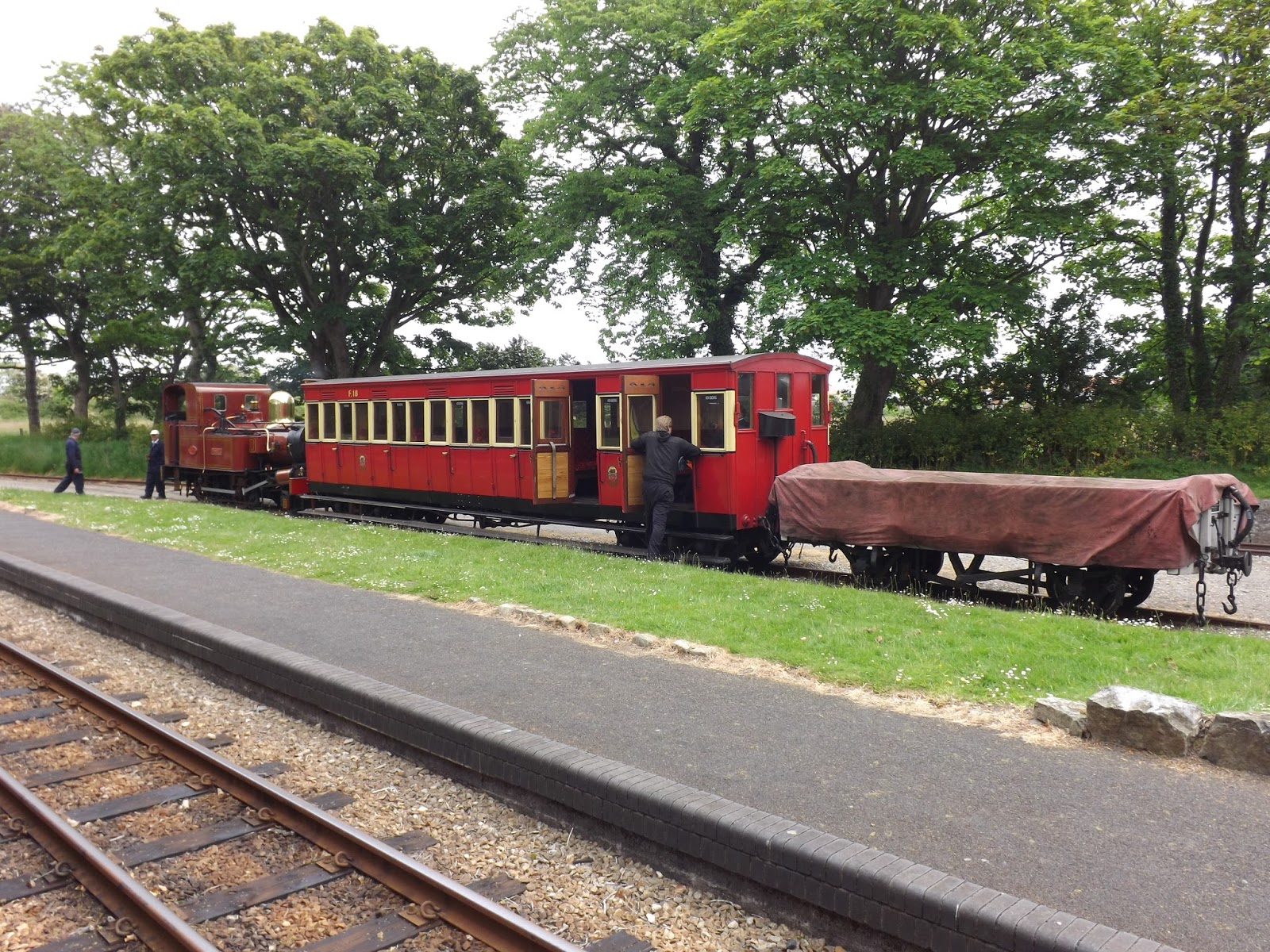
The Isle of Man Steam Railway locomotives were all built by Beyer Peacock of Manchester, between 1873 and 1926, resulting in 15 2-4-0s which were all pretty much of the same design. No15 "Caledonia" is the exception, an 0-6-0 tank and was built in 1885 for the Foxdale Railway, also on the island. This engine was built by Dubs & Co in Glasgow and when the two railways merged in 1905 the engine took up No15 in the Isle of Man fleet. The various engines of the fleet are, these days, in various locations and various states of repair. No6 "Peveril", of 1875, is currently a static exhibit in the Port Erin Railway Museum...
The last engine built by Beyer for the railway is No16 "Mannin", built in 1926. Also currently a static exhibit in the Port Erin museum, No16 has not been restored due to her 'non standard' design. She doesn't look completely like the original types admittedly, but was known as the most powerful of the 2-4-0s in the fleet, hauling the heavy Port Erin boat trains whilst in use, a job that used to be done by double-heading two of the original locos...
The Museum is well worth a look and has some very interesting photographs of various members of the fleet in action on all three of the original routes...
Leaving the museum, there was a chance to snap "Kissack" on shed. The engine returned to work in 2006 and has since been a regular performer on the railway. Boiler repairs were required in 2013, keeping her out of service until March this year. Her return to service has been successful and she is now earning her keep once more...
The stock for the 12:05 departure for Douglas waits patiently at Port Erin...
Ryton Tours operative Eddie then decided it was time to grab some breakfast so we headed off up the road in search of a café. On the way we passed through the impressive Port Erin Booking Hall, echoing days gone by...
Not to be outdone by us, 'Eddie the Late' then instigated a Breakfast Challenge. I'd already had a breakfast bap but, in the name of defeating the challenges, I had another! The breakfast was very pleasant and we returned to the station for our waiting departure...
A fed, watered and re-defeated 'Eddie the Late'...
No8 "Fenella" had now cleared the section with the Foot-Ex course and thus No13 could run round and get ready to leave...
With a right away from the Guard, "Kissack" got the 12:05 train underway with ease. The sharp bark on these antiquated 2-4-0s is really something to enjoy. The train then acted as a commuter working of yesteryear, accelerating sharply away from village station stops. The engine had a surprising turn of speed once again and was very impressive to listen to. The scenery was also a joy to behold...
At Castletown the engine pulled into the platform with No8 spotted in the bay with the Foot-Ex working. We would now await No4 from Douglas...
No4 "Loch" passes No13 "Kissack", watched by No8 "Fenella"...
No8 "Fenella" simmers away happily as sister No13 pulls us out of Castletown...
These engines are so pretty. They are very pleasing to the eye and also have cute little features such as the oil bottles riding on the front end, keeping themselves warm against the valve chest. The swinging front pony truck is also a pretty addition, the cylinders being inclined to allow the truck to swing into curves and points... The scenery continued to be spectacular, with even a sea view...
Me enjoying the ride on the Isle of Man Steam Railway...
"On The Run" (Pic by Eddie the Late)
All too soon, we arrived at the terminus of Douglas. No13 duly uncoupled to run round...
A final view of our engine, the beautiful 2-4-0 No13 "Kissack"...
The engine soon steamed off into the distance and it was time for us to press on. The impressive station building at Douglas is spotted as we make our way out to our Taxi...
So, that's one down, four to go. The entire experience on the Isle of Man Steam Railway had been fantastic. Its wonderful, just wonderful. The period engines, the stock, the run, the speed, the stations; it can't really be bettered. I'm so pleased I've now visited it, and seen the lovely Beyer's in action. Really good; a lovely place. So, into the Taxi, onto the next...
Hi everyone. So, here is the story. Last year sometime the idea floated around about doing a day trip to the Isle of Man. We had it all planned: flights, trains, trams - the lot. At the last minute however, such is our luck, the flights got changed and did not allow us to fly from Birmingham, which threw a spanner in the works. 'Eddie the Late', now of Ryton Tours, then created a second plan which would involve an overnight stay in Liverpool, using the city as a base. The excursion would involve flying out, doing four of the five main railways on the island, then flying back. Eddie then created an excursion timetable to follow which, if adhered to correctly, would get us around the island and back again in the allotted time. A final fifth railway addition, which I'll talk about in the following posts, came later and thus we would attempt to do all five in a day. Yesterday we met up in Coventry in the early afternoon before taking a diversion induced slightly longer route to Liverpool. The hotel, pretty much on the airport site, was reached by tea-time and beers were in order...
Naturally, as we were away, part of the evening would have to include a 'Three Course Challenge'. Tour Operator 'Eddie the Late' did his best to kill off the members of his tour group by subjecting them to the hideous over-filled stomachs resulting from the challenge. Ed has continually initiated these challenges whenever we have attended an eatery with him and their formidable reputation forever preceeds them. Wherever there is Eddie, there is always a Three Course Challenge. Myself & Arnold, I will admit, were triumphant in the challenge and managed to keep going despite Ed's continual attempts to defeat us. The ringleader of the challenges only managed two courses himself (disgraceful)...
Having enjoyed more beers and the unrelenting challenge, it was time to retire. I must commend Arnold, and indeed myself, for winning the challenge. 'Eddie the Late' won the commendable 'Two Course Rosette', whilst John took pride in the 'Single Course Medallion'. This Morning we met in the hotel lobby at 7am and proceeded on foot to the airport. Having passed through the appropriate checks and controls, we boarded our flight to the Isle of Man and are spotted before take-off...
The plane duly took-off and we travelled across the sea towards the island...
Having landed safely at Ronaldsway Airport we disembarked and found a café. A cup of tea was required and, in my case, a bacon & sausage bap...
"A Breakfast Catch" (Pic by Arnold)
As you see above, the mug-shots had already begun!...
Now on the island, our tour could really begin. The first stop was the Isle of Man Steam Railway. Access would be on foot from Ronaldsway, down the road to the picturesque station at Ballasalla. With our train due at 10:20am, we had plenty of time to saunter down there. Let the day begin...
Hi everyone. Today was a brief visit to the GWSR at Toddington. 4270 and 2807 were in steam, the latter of which is seen passing through Toddington's Platform 2 above. On the way home I also called in at Evesham. A quiet day with lots of driving in the rain. All the best all, Sam...
Hi everyone. Sometimes you have one of those days on the footplate where you think to yourself: "it really doesn't come much better than this" - this was one of those days! I have just had an absolutely brilliant day driving the wonderful Peckett "Harrogate" at Statfold Barn and what a day it was. So, without further ado, we'll begin. Having warmed the Peckett gently into steam yesterday afternoon, she would still be hot this morning. I arrived at the gates of the SBR at just before 6am and was immediately joined by many other crew members, including JB for one! Having been let in, we parked & unloaded our vehicles before proceeding to the signing on book. Signed in and ready to go, I met with my Fireman for the day: Mark. Mark was attending all the way from the Talyllyn Railway! Mark then went off to begin lighting preparations on "Harrogate" whilst I collected the oiling tools. The steam oil drum was in its usual lethargic state on this cool but sunny morning and so a short wait was inevitable. With full oil bottles eventually in hand, I wandered down to the high level railway where Mark was lighting the fire...
With a bag full of very dry wood spread across her fire grate, the Peckett started singing immediately as the sun climbed higher in the sky...
Mark was soon well underway with the fire and began cleaning whilst I started the oiling round. The Peckett follows the standard arrangement in terms of oiling, with the internal motion looking pretty much the same as our "Sir Gomer". Interestingly the Peckett has a flangeless centre axle, allowing tighter curves & point-work to be navigated with less protest. The axleboxes, cylinders and slide-bars are oiled by a very well thought out Wakefield lubricator which stands proudly on the running board. Having filled it with steam oil, the Wakefield was primed by turning the wheel a good few times. With oil evident at the slide bars, the turning could cease. The oiling was completed in around 20 minutes...
I don't always enjoy oiling up but this morning was different. Oiling up with only the sound of the crackling fire and the morning birdsong whilst the warm sun shines down is a lot more pleasant than oiling up in a shed while its raining condensation indoors (no names mentioned!). The Peckett was now coming around nicely and the pressure needle was rising around the clock. The engines had to be ready by 8:30, though others were stirring well before 8:00. At the rear of our 2-coach train, the beautiful Bagnall "Isibutu" was also getting ready. Two old rivals (Peckett & Bagnall) would join forces to operate one of the two 'high level railway' services in action today, whilst another 12 or so locomotives operated on the field railway and "Paddy" steamed around the garden. Put them all together and you've got yourself a great show, though we wouldn't expect anything less from the ever impressive SBR! After 8:00, myself & Mark went to get our breakfast before returning for the Safety Briefing on the lawn at bang on 8:30.
After the briefing, it was back to the simmering Peckett before "Isibutu" got us underway on the ECS set-up run. The Bagnall would take us to near the balloon loop at which point "Harrogate" would take over for the run to Oak Tree loop. Once there, the train staff would be split and the two service trains could commence safe operation. At Oak Tree loop after a good first slog up the steep bank, I am pictured on "Harrogate"...
"Me on the Peckett" (J.Cogan)
The Peckett now had a good fire in the box and, having been passed by the top & tailed "Fiji" and "Trangkil", we set off with the ECS for Statfold High Level. The dozen or so engines on the field railway were also now in action, providing an impressive display of power and variety. The high level line, from a drivers point of view, is a lot steeper again than the field railway. Indeed, the chug up into the high level station at Statfold is nothing short of chimney shaking! The engine had to go up there in full gear and 3/4 of the regulator - nothing less. A slight slip was quickly caught and the 0-6-0 marched into the platform proudly. I must admit, I was shaking a little but we'd done it and it could only get better with a few more goes. The engine was more than up to the job but the run was very, verysteep. After a good run, "Isibutu" got us underway...
"Harrogate Hangs On The Back" (M.Ranieri)
The day went on just like that. We pulled a trip, "Isibutu" pulled a trip. We would steam down the line, pass the other pair, around the balloon loop, pass the other pair again and then back to the top platform. It was one trip on, one trip off. The Peckett was steaming well and Mark had her singing to him. What a lovely engine to drive too. Here, a Shackerstone pass at speed: "Harrogate" (driven by me) passes 'Eddie the Late' (driving GP39) in the other direction on the field railway. This is the section between Statfold Jnc and Oak Tree...
"Passing Trains" (M.Ranieri)
With a dozen engines running on the field railway and two trains on the high level line, the balloon loop was a very busy place. The team down there were none stop all day and my hat off to them for their efforts. The Peckett is spotted here in the loop awaiting a path...
The engine then returned to Oak Tree to pass "Fiji"...
"A Pass by Fiji" (M.Ranieri)
The Peckett was making some great assaults of the car park bank into the top station and sounded beautiful. The field railway was a wash with trains and the intensity was just fab. I cannot complement the event more: it was just grand. The 1200+ guests certainly seemed to be enjoying themselves! One guest amongst them was Geoff Cryer, who has a great rail diary which you can see by clicking here. Geoff kindly sent in some of this posts images...
"Me Driving Harrogate" (G.Cryer)
The bottom straight is a good place to get a run up to the bank...
"Harrogate Pilots The Train" (G.Cryer)
Unfortunately we did encounter one problem: we ran a hot box on one of the coaches. The coach was duly removed and we ran a one-coach set but we did keep going and lost no time. For this move we did not go around the balloon loop but used it as a shunting tool. The Peckett was then dragged back, passing the Mallet (driven by JB) on route...
"Mallet and Peckett" (G.Cryer)
A popular feature of the event was "The Goose" replica: a railbus of some kind. It is seen here on the field line returning to Oak Tree as "Harrogate" descends the bank...
"Smoke & Steam" (G.Cryer)
Another of todays roving photographers was Malcolm Ranieri who has kindly also sent in some images. Malcolm is involved with the NGR at Toddington and reports for Old Glory magazine. He has been responsible for getting the MTEW report published in there the last few years: thanks Malcolm!...
"Peckett Portrait" (M.Ranieri)
The bank between the balloon loop and Oak Tree loop is shown in the image below. Luckily the Peckett has a traditional Peckett steam brake which is fab in operation...
"Descending The Hill" (M.Ranieri)
We were due to be relieved at 1300 hours and go onto the Corpet as Station Pilot but when the Corpet got called into service and did a good few miles, the plans changed. Phil asked if we would remain on the busy high level line with the Peckett for the rest of the day: suffice to say I don't think there could have been less resistance to this situation. The rest of the day was as great as the start; we had some brilliant runs, some great chugs and some very happy passengers. At around 4:15pm we began preparations for the end of the day cavalcade. The Peckett was removed from the train and chugged into the turntable area...
The Peckett watches "Jack Lane" take a turn...
Having had a short ride on the turntable, we were dropped at the shed road and steamed through the running shed and into the shed yard. 1944-built "Harrogate" is spotted here with shed-mates "Jack Lane", "Sybil Mary" and "Marchlyn" amongst others...
After the shot above, we steamed down to the cavalcade site in warm late afternoon sunshine. The engines stood in a line and did their usual whistle up & pose. Then, just like always, it was over. The engines blew their whistles one last time and returned to the shed for disposal and stabling. It had been an absolutely brilliant day. To see a great Youtube video of the action, click here. The SBR can always be highly recommended and if you haven't been, you need to go! The place is just so impressive and to drive there is a pleasure indeed. I must thank Mark for a great day on the footplate and the entire SBR team for allowing us to be part of such a great calendar of events. Thanks for reading all, Sam...
Hi all. Today I was at Statfold to help with preparations for tomorrows summer Open Day. I left work at Midday and proceeded to Tamworth along the A444. Once there and changed I walked around to find my rostered engine: Peckett 0-6-0ST "Harrogate". Built as works number 2050 of 1944 in the firms Bristol works, "Harrogate" spent her working life at Harrogate Gas Works. Acquired for preservation by the Ffestiniog Railway in 1957, the engine moved to Boston Lodge works. The engine was eventually deemed unsuitable for use on the FR in 1987, and a new home beckoned. The engine was moved to the Bredgar & Wormshill Railway and made it to full running condition. Unfortunately, once again, the Peckett was deemed unsuitable for their line and another ownership change was on the cards. This time, the then small Statfold Barn Railway stepped in and gave the engine a home. Since then, she has become a popular and reliable performer and has even returned to her original preservation haunt: the FR. I believe the engine had the flanges removed from her centre axle at the SBR which has greatly improved the way she copes with sharp curves and points...
I lit the engine up this afternoon to warm her through for tomorrow. She also received a good polish of her tank and cab side. Luckily, the engine was already pretty clean as she is, in effect, freshly painted. Her 10-year overhaul (which took just 2 months to complete!) was finished just weeks ago and the engine looks pristine. Tomorrow we are on the High Level Railway, sharing duties on one of the coach sets with Bagnall "Isibutu": it should be a great day. I left the SBR at just after 5pm in order to get home for tea. The loco was simmering away to herself and should be in good shape for tomorrow. Thanks for reading all, Sam...


 Ballasalla would be the starting point for our journey along the Isle of Man Steam Railway. I have read about this line many times, and spotted it on countless television programs. Built to provide the Isle of Man with regular rail services, the 15-mile long section we see today was part of a larger network which no longer survives. The original line ran from Douglas to Peel and opened in 1873, with the section from Douglas to Port Erin opening a year later, in 1874. The line is 3ft gauge and is, unusually, now nationalised and owned & operated by the government. Naturally, through the course of its life, the railway has suffered cutbacks, the main one being the reduction of the network from 46 miles to 15 miles, but these things do happen. The system originally closed in 1965, though Lord Ailsa did attempt to keep services running by obtaining a lease of the metals, reopening services on all three routes in 1967. It was however financially unviable and 1971 was his last year in control. Over the next couple of years services were somewhat curtailed until the government stepped in, returning full services to the Port Erin to Douglas section by 1977. The railway was nationalised in 1978 and now operates seasonally with original locomotives and rolling stock.