Wednesday, 17 June 2015

The Groudle Glen Railway...

Hello. Now, finally, the last one: No5. This was our visit to the Groudle Glen Railway, the final piece in our pentagon puzzle on the Isle of Man Adventure. To access this one, we alighted at Groudle Glen station on the MER, having rode in the toast-rack behind Tramcar No22 from Laxey. I was aware that getting from there to the railway isn't as easy as some railways but this was something else. What a fantastic place. The wooded footpath takes you along the glen, down the stream and past the lovely viaduct. The walk to the railway is actually quite spectacular, if a little off the beaten track!...
Five or ten minutes slogging through the wilderness was rewarded by the sight of Lhen Coan station, nestling like a treehouse up on the hill...
A final scramble up the steps to the station was rewarded by the sight of "Polar Bear", the railways replica battery electric. Now, you may be wondering how we got in as the GGR does not run on Tuesday's or even open on Tuesday's. Well, our kind contact at EVLR (Adrian), said that he knew the people at Groudle and would ask if we could have a quick visit during our big tour. Thankfully, the GGR kindly agreed but the amount of kindness we were shown during our short visit was over whelming. The sheds were open for us to look around and questions were happily answered, with "Polar Bear" actually being out with one coach ready to take us on a private tour of the 2ft gauge line...
The GGR was built in 1896 to serve the Zoo which was based down the line at Sea Lion Rocks. The run is around 0.9km in total. The Zoo was a popular feature of the area and housed not only Sea Lion's but also Polar Bear's. It even had one brown bear cub which, for a nominal fee, your child could take out on a lead for a walk along the cliffs. Health and safety would have three times a field day these days! The engine which opened the line, and still resident today, was the aptly named Bagnall 2-4-0 "Sea Lion", built in 1896 at the firms Staffordshire works. I've seen this engine on several programs and read about her quite a lot over the years and so it was a pleasure to finally see her at home...
The cab of the diminutive much-loved Bagnall...
As demand for the GGR grew and passenger traffic started to outdo "Sea Lion", a sister engine arrived in 1905 and was named "Polar Bear". This engine was built to a very similar design but slightly larger. The line ran successfully until World War I when it closed until the end of the conflict. The steamers returned, fully overhauled, after the war but by 1921 their place had been taken by battery electric engines. However, the battery engines didn't go down too well and further problems forced a return to steam for the Bagnall sisters. WWII saw the railway close again and the zoo closed for good. A landslide during the war also cut-off the original terminus of the line. The heyday of the line was over following the war, though services did return on an off and on basis. 1962 was the final season. "Polar Bear" was later purchased and found a home at the Amberley Museum in West Sussex. "Sea Lion" languished in Loughborough until 1987 when she was restored and brought home to run on the now preserved Groudle Glen Railway. In 1992, trains finally returned to Sea Lion Rocks, a location that had been inaccessible since before the second World War. Happily, "Sea Lion" and "Polar Bear" have since been reunited at Groudle on three occasions though it is doubted that "Polar Bear" will ever permanently return.
 
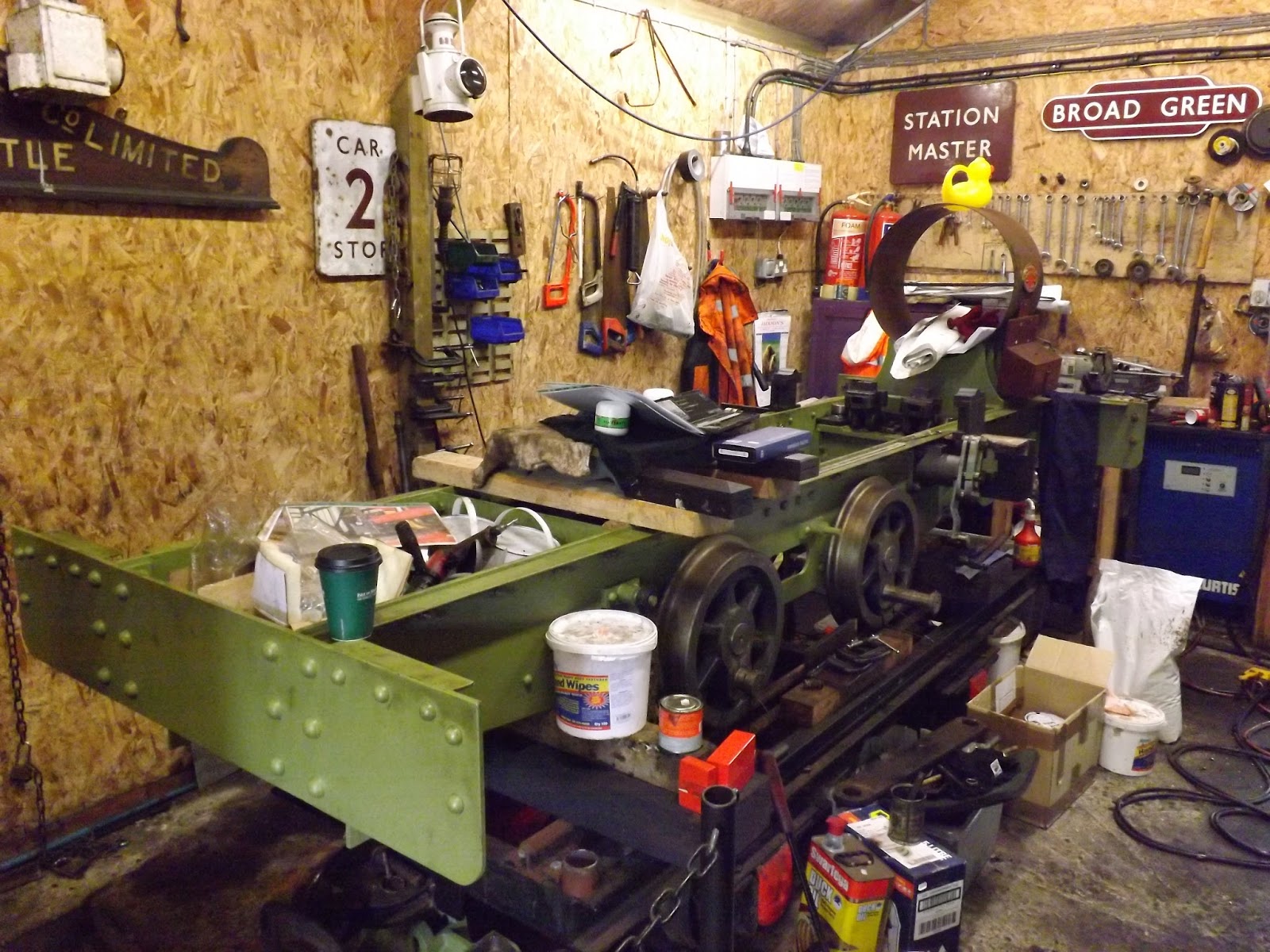
Due to "Polar Bear" now having a home in Sussex, the GGR has begun building a replica of the engines to become another sister for "Sea Lion". This engine will be named "Brown Bear" and is the subject of an on going appeal to get her into steam...
The team reckon they have enough there to make an air running chassis so far...
Another engine based on the line is replica Bagnall 0-4-2 "Annie" of 1998...
Having looked around the sheds for a while, we joined the replica of the electric loco "Polar Bear" for a run down the line. Despite its short length there are some stiff gradients in places, though with 1-coach the electric marched along with ease...
At the pretty terminus of Sea Lion Rocks you can view the remains of the zoo...
The now derelict animal pens of yesteryear, where Polar Bears once stood...
The battery electric "Polar Bear" then ran round the short train...
The station offers some wonderful views across the sea...
It was then time, with five railways accomplished in one day, for the inevitable crew photograph from our grand day out on the fantastic Isle of Man. Left to right: myself, John, 'Eddie the Late' and Arnold...
"Team Pic - GGR" (Pic by Eddie the Late)
With the crew photograph taken we climbed back on board the short train behind the electric for the run back to Lhen Coan...
'Eddie the Late' was plotting more 'Three Course Challenges'...
Once back at Lhen Coan it was time to say our thank you's and head off. We had a taxi booked for 5:30pm, and we were right on time so our brisk 45-minute or so visit to the GGR had been completed successfully. I've got to hand it to the guys there, they were great. They answered all of our questions, showed us every item of stock they had and even gave us guide books and a free train ride. The least we could do was give a good donation for "Brown Bear"s fund. Thanks very much Groudle Glen Railway...
Without the guys at Groudle Glen we wouldn't have made our five in a day and so thanks again, we loved it. From Lhen Coan station it was time for another meander back down through the Glen to find the road. The glen is just so impressive, its worth going just to walk down it! Now, back to the skies!...

Tuesday, 16 June 2015

The Snaefell Mountain Railway...

Hi everyone. Stop No4 on our Isle of Man Adventure: Snaefell Mountain Railway. The SMR meets with the MER at Laxey, allowing a cross-over between the two. Arriving aboard MER Winter Saloon No22 at 2:10pm, we swiftly boarded the 2:15pm departure for the summit of Snaefell. The railway is 3ft 6" gauge and runs for a distance of 5 miles up some pretty fearsome gradients. The tram cars are electrically powered but, rather than a trolley pole, bow collectors are used to receive the 550v DC current. The tram cars are very traditional inside. Ours was No6, of 1895 vintage...
The climb out of Laxey is pretty severe, once you've crossed the main road with bells sounding. The tramcar slowed down on the first section, allowing passengers to see and photograph the Laxey Wheel. This is the largest working water wheel in the world, built in 1854 to pump water from the local mines. Its quite a sight...
Having passed the Laxey Wheel, Tramcar No6 continued up the hill...
The gradients can be seen here as we climb further up. The mast in the very distance is the summit station where the SMR terminates...
The trams head up the hill using normal adhesion, which is amazing really on some of these gradients, some as steep as 1 in 12. However, the SMR is fitted with a 'Fell' centre rail, which aids braking on the way down. Runners beneath the car provide a sort of dynamic brake, whilst grips are also provided in case of emergency...
Bungalow Station is the intermediate stop, after which the trams continue on for the summit. The main road past the station must be alive during the TT races...
The journey to the summit took the usual 30 minutes, where tramcar No6 came into contact with sister tram No1. No1 was fully overhauled in 2011 and now carries the original colour scheme and lettering arrangement. Today it was on a school trip working...
The summit post is slightly higher than the SMR station, so a short walk beckoned...
I'm not quite sure what this walk is called...
At the top of the climb, well over 2000ft up, we surveyed the murky but impressive views. Eddie remarked that this was the first time he'd seen anything but fog from the top of Snaefell!...
Another view of the island...
The summit station can be seen below, at 2034 feet above sea level...
John & Eddie were trying to work out what they could see...
Tramcar No1 duly departed but before this could happen No6 had to shunt back out of the way. No1 is seen descending the first section of the hill...
Tramcar No6 stands at the top of Snaefell, ready to go back down...
During our 20-minute stop at the top there was a typical grumbling: 'Eddie the Cake' had purchased the most expensive cake in the world, or so he proclaimed. I think we are perhaps a captive audience 2000ft up a mountain! The tram soon departed back down towards Laxey with a good compliment of passengers aboard. One thing that was interesting about the tram was that, due to its completely wooden body, the whole thing was shaking in the mountain breeze. You could physically see the body revolving around the closed door in front of us! Wouldn't fancy this in a gale!...
Soon enough, after a pleasant descent, No6 brought us back into the pretty station area at Laxey. No1 was already there and waiting to head off for stabling...
The Snaefell is another very nice railway. The gradients are certainly formidable and yet the trams seem to cope with them no problem. Another great journey. At this point we joined the 3:55pm departure on the MER towards Derby Castle, as seen in the previous post. Onto the next!...

The Manx Electric Railway...

Hi all. Having glanced at the Douglas Horse Trams, we boarded our 1:40pm departure on the Manx Electric Railway. Described by 'Eddie the Late' as one of the wonders of the world, the MER is certainly very impressive. Electric it may be, but it is also unique and quite historic. A quick view of a chilly Douglas prom before we left...
The ornate ceiling inside Tram Car No22, delivered in 1899...
Rather than being trains, these are also trams, running on 3ft gauge tracks and powered by overhead wires. At 17 miles long, the MER is a considerable undertaking and takes in some wonderful scenery as well as having fascinating infrastructure. Leaving Derby Castle past the depot, the trams use their 550v DC to climb a considerable gradient with some interesting road-side running. The trams wind their way up hill on double track, passing over residential roads just by whistling and then going for it. Some crossings have lights, others just have signage: its like going back in time. These trams use trolley poles to collect the current, now provided by the Manx grid rather than the railways own power stations...
Sea views whilst departing Derby Castle on a sharp climb...
Arnold enjoys the ride aboard the 1899-built No22, with Eddie looking on...
Through the window, looking onward...
We enjoyed a 30-minute or so ride along the route, with the trams seeming completely integrated with the road transport. Whistling and squealing, they make their way up and down various gradients and over many bridges and road crossings. Its a fantastic piece of engineering. At the busy station of Laxey, we switched trams to join the Snaefell Mountain Railway (our fourth railway - see next post). No22, seen from the SMR, would continue onwards along the MER route to Ramsey...
We had a great time on the SMR which then duly returned us to Laxey. SMR tramcars No1 & No6 await their next turn...
The next tram from Laxey towards Derby Castle would be the 3:55pm, made up of tramcar No22 again. The tram is spotted here arriving with its toast-rack trailer...
Vintage tram No22 pulls into Laxey below. Unfortunately the bodywork is not original as the former body was completely destroyed by a fire in 1992. The coach has been lovingly rebuilt by the MER and now looks as good as new...
It was at this point that tour operator 'Eddie the Late' said we should try out the toast-rack experience, so we did. Then the ridiculous pictures started...
I don't really know what is happening here...
The toast-rack trailers are an experience all on their own. In order to increase capacity, the MER trams drag along trailers. The toast-rack trailer we travelled in, number 44 I think, dates from 1903. They offer unrivalled views of the Manx Electric Railway...
As well as the views, the toast-racks also allow you to experience more of what is going on. The wind in your hair, the sounds, the smells, the views: its great...
The MER, though I'm not an electric train or tram fan, is just brilliant. The entire engineering aspect of it is impressive to say the least and the trams are lovingly kept. The operation is slick and the trams generally provide a great service for getting around the island. Considering it is probably the islands 'most modern' railway and dates from the late 1800s, it just goes to show just how historical and untouched the Isle of Man is. Its fantastic and I'm so glad I've now experienced it. We rode the 3:55pm Laxey - Derby Castle service as far as Groudle Glen, where the conductor summoned the driver to stop the train so that we could alight. A great trip and a lovely railway...

The Douglas Horse Trams...

Hi all. Next stop on our Isle of Man adventure: Derby Castle. Our taxi ride from the steam railway's Douglas Station took us along the Promenade, passing one of the trams on route. The timetable did not allow for us to use the tram itself but we did photograph the system before departure via the Manx Electric Railway. The horse trams have been a feature of Douglas promenade since 1876, and operate over a distance of 1.6 miles. A service has operated in various forms since the tramway was built, with tramcars hauled by countless horses. A seasonal service has operated since 1927. Operating at 3ft gauge, just like the steam and electric railways, the tramway has over 20 cars and over 40 horses...
There is a tramcar storage shed at Derby Castle and the door was left ajar, allowing a quick snap through the door...
The cars range from open saloons and toast-rack types, to enclosed types used in the winter or the wet weather. As we boarded the Manx Electric Railway's 1:40pm service towards Ramsey, one of the horses out today arrived with a tram...
A close up of the 'horsepower' for the service: "Charles"...
Our MER service duly departed whilst "Charles" looked on, awaiting his own departure. The horse tramway is an important part of the history of Douglas and I hope that they are not too affected by the upcoming road-works dispute. The promenade roadway is in quite a state and requires a complete resurface. However, due to the trams having to be suspended and the rails removed whilst the job is done, opposition has prevented a final plan being completed. The trams were due to end last year so the work could start, but the dispute has led to a year of reprieve, allowing the horse trams to continue for this season. We wish them well and hope that whatever happens, the horse trams return to Douglas Promenade. With a buzz from the conductor, away we went on the MER...