Tuesday, 3 April 2018

North Norfolk Railway Delight...

Today, during a couple of days over in Norfolk with good friend and well known bringer of lateness 'Eddie the Late', we took in a return visit to the North Norfolk Railway. Ed now lives in Sheringham and the NNR's base is only a short ride down the road so I couldn't really miss it. Strolling up to the station from the sea front, we were just in time to see our train roll in behind the huge WD 2-10-0 No90775, now named "Royal Norfolk Regiment". This was the first time I'd seen a Riddles Austerity in steam: what a brute of an engine! The loco was uncoupled from the train before running round to take on water at the column in anticipation of the 12:10 departure for Holt...
We boarded the Mk1 coaches behind the 2-10-0 and settled in for the journey of just over 5 miles. Right on time, the Guard gave the "Right Away" and the big black engine hissed into life. Moving cautiously away, the engine barely muttered as she picked up the train and strolled out of Sheringham towards Weybourne. It was a pleasure to look out from the droplight and listen to the engine casually steaming along with barely 50psi in the chests. Any engine of this size is really overkill in regular preserved railway settings but it certainly saves them being overworked...
At the attractive intermediate station of Weybourne the fireman surrendered the token to the signalman and awaited the 'down' train from Holt. Crossing over with us was the wonderful sole-surviving B12 4-6-0 No8572...
With the B12 clear of the section, 90775 received the appropriate token and the road. With an all clear from the Guard, the 2-10-0 departed Weybourne for Holt. The climb out of Weybourne is the steepest part of the line and the driver did give her a bit more stick up there. You could hear the engine digging in as the reverser was wound in; no doubt to give her something to do. Myself & Eddie both commented that you really did just want a few more miles of that! All too soon, the regulator was closed as the train slowed for arrival at the terminus station at Holt...
These powerful engines were designed by R.A.Riddles for service during World War II as a cost effective but useful machine. The original design was a 2-8-0, with the 2-10-0 variant joining later so as to provide the same power output but a lighter axle loading for use on secondary routes. Surprisingly, the tractive effort is slightly lower than the GWR 2800 Class 2-8-0s, despite the huge proportions. They were known as the "Austerity" and a total of 150 of the 2-10-0 version were built during 1943-1945. 90775 never actually saw BR service (the last BR example was 90774). She was built in Glasgow in 1943 by North British and was, I believe, exported to Greece from new. Repatriated in 1984, the engine first worked on the North Norfolk in 2003. Having not long returned to service from a heavy overhaul, the engine looks and sounds lovely. She was named "Royal Norfolk Regiment" last year. At Holt, the driver kindly invited me onto the footplate for a ride during the run round, much to Eddie's irritation...
As the driver opened the regulator you could feel the engine come to life as its 19" cylinders got it on the move. It's quite a beast, it really is - I'd love a go on something like this! The driver commented that he preferred the WD over the BR 9F which surprised us as Riddles was never a fan of the Austerity. In fact, their designer was quoted as saying that "they could all be pushed into the sea once the war was won". To the surprise of all, they survived long after World War II and 10 of the 2-10-0 type still live on today, although only 3 are in the UK. What a fine engine...
"On The Footplate of Austerity 90775"
Once the driver had gently settled 90775 onto the train, I thanked the crew for my ride and returned to Eddie on the platform. The Fireman then jumped down to couple the loco up to the train. A nice touch I think at the NNR is the addition of a parcels van within the rake to carry pushchairs and other items that require storage: much nicer than storing them in the corridors or vestibules...
Holt station has a refreshment room, museum and miniature railway. After a wander around the museum we spotted a little 5" 3F simmering away on the raised track. The miniature railway runs up the yard and around again in a loop...
It wasn't long before departure time was near and so we boarded the train at the opposite end. Leaving Holt, 90775 drifted gently downgrade back towards Weybourne where we alighted for a cuppa' on the platform...
Another grab shot of 90775 as she prepared to depart Weybourne...
With the train gone we walked over the footbridge to see the attractive signalbox. The friendly signalman kindly invited us in and the high standard of restoration was clear throughout the box. It's lovely to see the appropriate bells, indicators and token machines working as they should: the hallmark of a well restored signalbox. Wandering back over the bridge we visited the refreshment room for a cake and a cuppa' before the Austerity was heard climbing in from Sheringham...
Over in the yard, BR Standard 4 No76084 was undergoing a steam test. This engine is main line registered and is used to work the NNR's Cromer dining trains over Network Rail. I like the Standard 4: a workable engine for any purpose...
With the Austerity waiting patiently in the platform on route to Holt, it wasn't long before the B12 arrived with the Sheringham train...
With a "Right Away" from the Guard we departed Weybourne behind the elderly B12. It sounds just like the T9 - but bigger! Once out of Weybourne the engine drifted steadily back towards Sheringham where we arrived right on time. Having alighted from the train I walked over the footbridge in an attempt to get some shots of the B12 as I missed out on her during her January visit to the Great Central...
Built to a Great Eastern design in 1928, this LNER Apple Green beauty employs a 180psi boiler and 20" cylinders. What a lovely old engine. You can't beat an inside cylindered express engine. The LSWR T9 was wonderful and the B12 looks very much along the same antique lines...
Once uncoupled from the train the engine ran round...
Having watered on the column she was placed at the head of the train...
All in all this was a great second visit to the North Norfolk Railway with two fantastic locomotives in action. Thanks Eddie for the company and thanks to the crew on 90775 for the ride during the run round - it was much appreciated! The NNR is a great set up and well worth a visit. Although only 5 miles long, the line boasts many well restored locomotives, coaches and stations in an attractive seaside setting - what can be better? Now it's off to the Bure Valley Railway! Thanks all, Sam...

Shack: A Quick Call In For "Cumbria"...

Hi all. On this bleak Easter Monday I had nipped over to David's in Austrey to pick up a book and on the way back decided to nip into Shack to see Mr Simmons. Chris brings his layout to "GMW" at Statfold and so always kindly gives out some event leaflets for me. The rain was falling as I arrived at a gloomy Shackerstone. Up on the loading ramp stood the recent stalwart of Battlefield Line steam services: 1953-built Hunslet Austerity "Cumbria". It really was a miserable day, with the dampness congealing the mass of coal dust, ash and ballast so that the yard gave off some very much NCB vibes. As "Cumbria" was coaled for the days passenger services, a couple of chaps in wax coats and mining helmets would have completed the scene...
Wandering down towards the station, I signed in (just in case) and then stood on Platform 2 road awaiting the Austerity. As the rain continued to fall, the red saddle tank drifted cautiously down onto the waiting stock before taking water at the column. It was certainly not a "nice day for it" in these conditions...
Watered and hooked on, "Cumbria" departed Shackerstone on time with the 11am train. After many years the 11:15 has become the 11:00, allowing a lunch break of 15-minutes after the second round trip: luxury. As I chatted to Mark on the pretty much empty train, the Hunslet plodded through the saturated Leicestershire countryside. What a miserable year it's been so far weather-wise: we could do with some sun! It was chilly and depressing as the train slipped past muddy fields, leafless trees and the flooded fen lanes on route to Shenton. Once at the terminus, "Cumbria" ran round and assumed her place at the head of the train ready for the 11:35 departure...
I was glad to have seen "Cumbria" in use for a final time as I believe she only has a week or two left at Shack following a 2.5 year hire period. Whenever I've been on it I've found her a useful and willing engine, perfectly capable of anything Shack can throw at it. These 18" industrials have always been popular in preservation, simply because of their strength and versatility. Equally at home on passenger trains or slogging up and down with mineral wagons in a colliery, the Hunslet Austerity is a marvellous tool and Shack would certainly do well to own one in the future. After a ride back to Shack on the train and a cuppa' with Chris in the shop, I headed for home through the filthy lanes. Maybe we'll do a few Shack jobs this year? - we'll see. Cheers, Sam...

Sunday, 1 April 2018

Liverpool: Back In The Lions' Den...

"She'll Move, She's As Good As Ever She Was" (Titfield Thunderbolt, 1953)
Hi all. During another weekend in the lovely city of Liverpool myself & Maisie took in a return visit to the Museum of Liverpool on the docks. The prize exhibit (in my opinion at least) is 0-4-2 "Lion" - a real piece of railway history. We saw her during our last visit a couple of years ago and so, at the risk of totally repeating myself, I've added the paragraph below from the post I wrote back then. Little has changed since then, with "Lion" remaining centre stage in the ground floor area of the museum, surrounded by other displays and film reels of her previous operations...
Built in 1838 as Liverpool & Manchester Railway No57, "Lion" was capable of hauling trains of up to 200 tons and remained in service until around 1858. In 1859 it became a stationary boiler for the Mersey Docks & Harbour Board, a role it retained until becoming surplus to requirements in 1928. Thankfully, interest in "Lion" had grown by this point and she was saved from the scrapyard forever. She took part: in steam I might add: in the 1938 London & Birmingham Railway Centenary. Most famously perhaps, she starred in the 1953 Ealing Comedy "The Titfield Thunderbolt", playing the role of the heritage steam engine brought out of the local museum to help save a country branch line from closure. "Lion" moved to Liverpool in 2007 to the then new museum and now sits centre stage. Looking down across the elderly "Lion"...
It was very nice to see "Lion" again. I think its great that she now has a stable home and can be enjoyed by thousands of visitors every year. As the Museum of Liverpool is free, it makes for an interesting and value for money hour or so walking round so I do recommend a visit. Talking of history, during our stay we were booked into the Titanic hotel again - a converted rum warehouse on Stanley Dock. The rooms are huge, the atmosphere great and the hotel is full of reminders, artwork and photographs of the historic liner "Titanic" lost in 1912. For someone like me who is interested in the ship and its tragic demise anyway, the Titanic hotel in Liverpool is a must do: give it a try, you won't be disappointed. Cheers all, Sam...

Sunday, 25 March 2018

Driving "Howard" at Statfold: A Brazil Day...

"Tailing With 'Howard' On The Lynton Set" (Pic - G.Cryer)
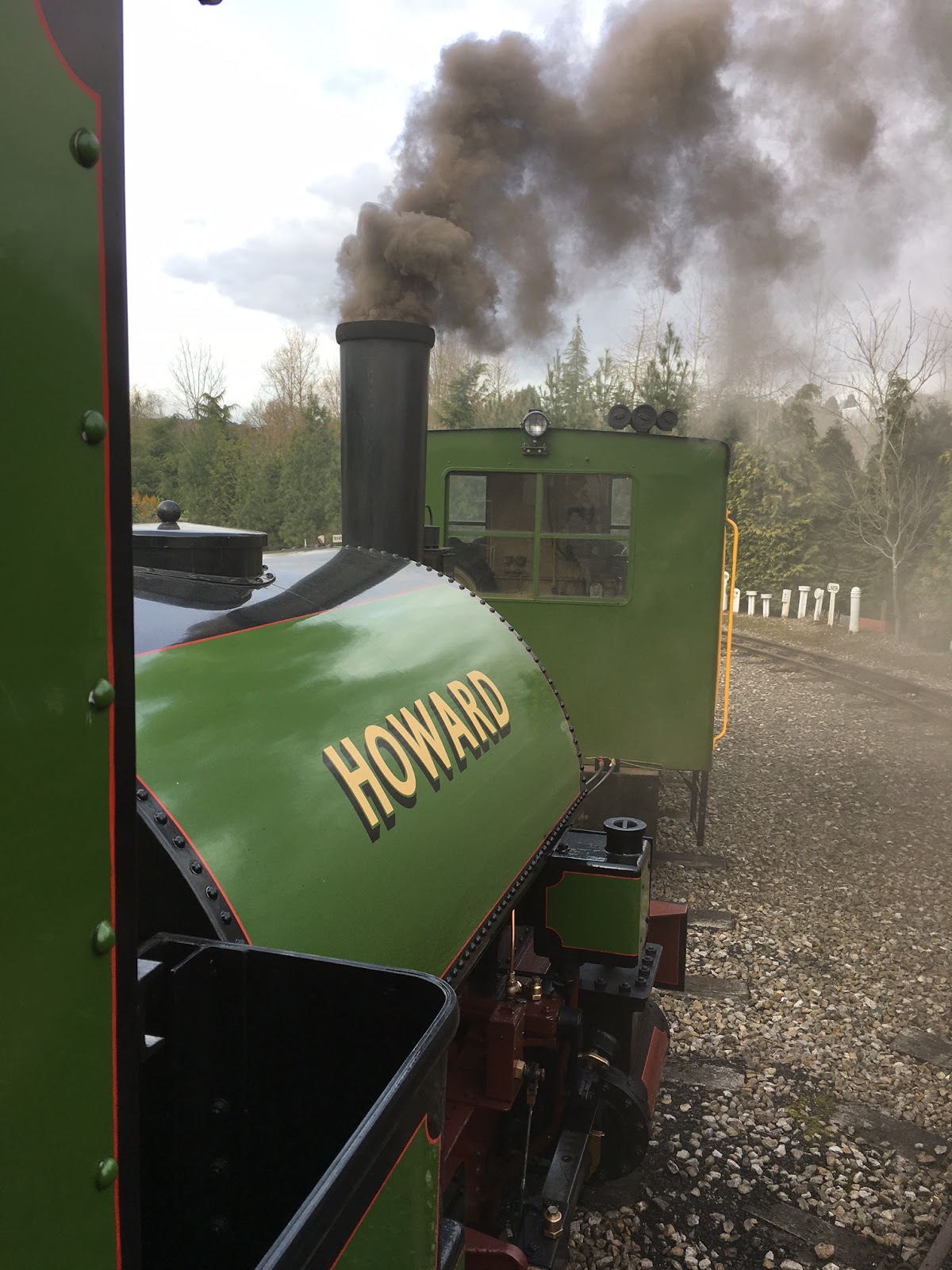
Today, at last, my Cold Firebox Syndrome was cured at the regulator of "Howard" during an eventful day at the Statfold Barn Railway. After my usual McDonalds stop on route, I arrived at a dimly lit Statfold at just before 6am. In the muddy car park field the overnight drizzle had succeeded in its relentless work and Andy was already stuck in his Mercedes! Content not to be, I tore past Will repeating "don't stop me!". Car parked and unloaded, a gaggle of us wandered across to the lamp hut to sign on and find our engines for the day. I soon met up with Fireman Ben who joined me aboard the Hunslet 0-4-2 as we made preparations to light the embryo fire. "Howard" was still hot after yesterdays warming fire and the general opinion was that she wouldn't take long to come into steam - how wrong we were!...
With smoke rising steadily from the chimney, I set about oiling "Howard" up for the days work. Almost all of her oiling points feature wick-feed pots with screw lids and so an adjustable is necessary to get the job done. The engine carries Stephenson's valve gear and the valve movement is transferred outside the frames via a rocking arm. Its a nice workable engine to prepare of a morning...
I'd done the steam brake oiler yesterday as well as the mechanical lubricator and the two steam chest mounted lubricators so there was nothing on the cylinder oil front left to do. The motion oil portion of the preparation was completed with the filling of the axleboxes and the truck boxes which guzzled a surprising amount after a few weeks stood idle. As the light came up, all around us the other Statfold engines were coming to life on the always atmospheric shed frontage...
"Howard" however was very sluggish to make steam. She'd been singing well for a good hour and yet nothing was registering on the clock, despite a fair amount of steam from the passing whistle valve. An examination of the fire and the smokebox revealed that the tubes had become a little furred up, in part due to the very smoky coal we use. So, with other engines blowing off around us we had to play the waiting game. The usual jokes were enjoyed as many fingers pointed towards our seemingly unrequired pressure gauge - it isn't so funny on the receiving end! The old saying "a watched pot never boils" is forever apt with steam engines and eventually you find yourself tapping the gauge going "its broken...this ones broken!". The engine did however eventually summon enough steam to provide some blower and the torrent of muck which rained down upon the freshly polished saddle tank was followed by some life in the needle which rose increasingly rapidly. Sure enough the panic was over and "Howard" was ready for her duties once she was required...
"Waiting Outside The Signalbox"
Once given the road, I drove "Howard" from the yard to Platform 1 road to back onto the waiting freight. The freight train is the heaviest rake in use on SBR open days and always provides some shout from the chimney. Coupled up, we awaited the road. "Liassic" and "Statfold" soon stormed in on a passenger working, freeing up the section for "Howard" to depart. With a "Right Away" from the Guard and a pip on "Howard"s extremely shrill whistle, I released the steam brake and the gradient took us away. Ben grabbed the token from the signalbox as we passed and we drifted towards the section board. Condensate hissed from the drains as we approached the tram shed bend and once they were closed I opened up the regulator and "Howard"s exhaust turned black as the remaining muck in the tubes found its way skyward!...
"On The Freight" (Pic - G.Lightfoot)
With the token having been surrendered we continued into the balloon loop to come to a stand at the stop board at the end of the Cogan Halt platform...
Screwed down and feathering, "Howard" awaited a path back towards Oak Tree whilst running repairs were effected on the "Goose"...
I tell you what we had a storming run back to Statfold. It was not even like the engine was being overworked: the freight is deceptively heavy and you have to work up the gradients. "Howard" proved no trouble with the needle hugging the red line and plenty of power under your hand. I could literally feel my CFS departing! A brief stop at Oak Tree for some water and a nice cuppa' whilst we waited for the next down train was followed by an equally pleasant ascent back up to Statfold where the climb into the old bay platform (now Platform 1 road) turned heads as the Hunslet dug into the gradient - it was poetry in motion! Unfortunately (I shouldn't say that but we were having a great time solo!) we were then asked to couple up to "Trangkil No4" to provide a double Brazil combo for the rest of the day. Happily however our next departure was pretty much imminent, hauling the Lynton set tailed by GP39 & the Davenport...
"A Brazil Double Act" (Pic - G.Lightfoot)
Here we are departing Statfold with Driver Paul getting "Trangkil" on the move...
"The Brazil's Make A Volcanic Departure" (G.Lightfoot)
Its probably best to round off the following events with the quote "oh look cried Ned...and then the Kingdom was his forever the end!" and move on to our departure from the balloon loop with the two Brazil's...
Its nice to see the two Brazil's together and compare their differences. "Howard" was built in 1936 whilst "Trangkil" was the final steam locomotive built in Britain for industrial purposes as late as 1971. Both carry marine style rods, although "Howard" carries Stephenson's valve gear versus her younger sisters Hackworth variant. Both are powerful tank engines and very capable machines, although "Howard"s responsive steam brake makes her an easier contender for shunting. "Trangkil" worked on the sugar plant of her namesake in Java, working in revenue earning service until as late as 2004 I believe. "Howard" on the other hand was far more local in comparison, operating at the North British Aluminium Company in Scotland. In preservation she was named "Josephine" and had been converted to a side tank by the time Statfold got hold of her. I drove her in her unusual form as "Josephine" and found it weird but quirky all the same - see post here. She later received a dramatic sex change and was restored in original form as "Howard" a few years ago. A good all round machine, this Hunslet product is a wonderful tool.

Upon arrival back at Statfold station "Trangkil" was uncoupled, turned and then put on the other end of the set so that we could top & tail for the rest of the day...
"On The Tail Of The Train" (Pic - G.Cryer)
We had two more trips doing the work: one in reverse, one going forwards. Our run going backwards was most enjoyable with "Howard" in good voice and really pulling for all she was worth. The image below shows us travelling towards Statfold on the way back: the exhaust appearing over the train is from the snorting Mallet which is doing its best to catch up on the adjacent high level line...
"Chugging Back to Statfold" (Pic - G.Cryer)
After our reverse run we had time between trains to turn "Howard" on the table so that our final run on the front would be chimney first...
I can't lie, today made my respect for "Howard" grow considerably more. I found her even more free steaming and powerful than normal and she was certainly not afraid to shout out her voice at the chimney. Apart from the mishaps earlier in the day, myself & Ben had a great time aboard the 1936-built 0-4-2...
"Steaming Along With A Brazil" (Pic - G.Cryer)
As is typical with Statfold open days, our last train was joined by the rain. Just as we reached the balloon loop on the tail of "Trangkil" it started to come down, steady at first but then heavier. We had to wait here until No19 arrived with the token, ready to join us for a three-loco trip back to Oak Tree. Ben meanwhile was relaxed in his work and sat contemplating life on the cab steps...
Bagnall 4-4-0 "Isibutu" soon passed us hauling the final high level train. She's still my favourite: what a fine old machine she is...
Our final run back to Statfold was a little more eventful, with "Trangkil" feeling the weight of the train on the now dampened rails. "Howard" and No19 gave assistance on the ascent of the bank before the ensemble was joined by "Harrogate" at Oak Tree. The four-loco passenger train then continued back to Statfold to join the rest of the fleet as they lined up for the cavalcade. Having been uncoupled from the rear of the L & B set, our trio of steamers descended into the yard area to join the rest of the loco's. The blue Mallet soon sidled up behind us prior to the usual 'Whistle Up'...
We all began bedding our engines down whilst the final machines joined the line-up. "Howard"s fire was raked and deadened, the boiler filled and fittings isolated as normal. The team of shunters would come tomorrow to put the engines back in the roundhouse. After the screeching chorus of whistles and bells, the public began to retire from the site whilst we did our final checks and left the engines to settle for the night. A jacket potato and a beer was very much deserved now after an eventful day! It was great to be driving again today - I really enjoyed it...I always love the Statfold open days. Thank you to Ben for doing the firing, Paul & Joey for their company with "Trangkil No4" and to Alex for rostering us. Also thanks to Geoff Cryer and Graham Lightfoot for sending in the much appreciated images used in this post. Many thanks indeed for reading everyone - the CFS is gone. Thanks all, Sam...

Saturday, 24 March 2018

Prepping "Howard" at Statfold...

Hi all. At last the Statfold March open day is finally here and today I called in on my way home from work to make sure all was well with our rostered locomotive: "Howard". I arrived at the SBR at around 3pm and as usual engines were dotted around the site in readiness for tomorrows operations. "Howard" was standing in front of "Fiji" on the shed with a little plume of smoke rising steadily from her chimney. Climbing up onto the footplate and opening the firehole doors, I found a little mound of wood smouldering quietly against the tubeplate. With more wood to hand, I piled in some more blocks before adding coal on top and leaving the fire to get on with it. The smoke at the chimney grew darker during the next few minutes and the reassuring crackle from the firebox instilled vital confidence that everything was taking well...
All around, the other members of the Statfold fleet were also being warmed. Even the smaller engines tend to have a warming fire put in as it simply stops them being rushed into steam in the morning. The various components and materials which make up the steam locomotive boiler aren't fans of sudden expansion and so a gentle warm through is the best way forward. I stayed with "Howard" for around 2 hours, leaving her with some burning embers and 60psi on the clock. I'd also piled some wood into the cab for lighting up and got the necessary tools together for tomorrows preparation. I tell you what I am so looking forward to tomorrow!...

Tuesday, 20 March 2018

Statfold Comes Alive Again...

This afternoon after work I was on my way to Statfold for one of our regular meetings regarding the upcoming Giant Miniature Weekend. With the meeting planned for 5pm, I found myself arriving a little early and so headed on down to the roundhouse where I knew boiler tests were taking place. Sure enough, having parked up, I was greeted by the sight of O & K "Max" (ex-Sragi 14) outside in the evening sun. Alex soon jumped aboard to drive the red 0-6-0 cautiously inside after a successful steam test...
I believe that 8 of the shining fleet were in steam today to go through their annual steam tests in readiness for the upcoming March open day next Saturday. Once "Max" was back in place, former Sragi partner No1: the 1899-built Krauss: followed...
As "Isibutu" and the Davenport followed suit, Will kindly offered me a quick ride on the blue Mallet which was stood simmering in the Oak Tree platform. The Mallet returned to use last September after a spell out of action and it is quite an unusual thing to look at as well as being an imposing beast on 2ft gauge tracks...
This large 0-4-4-0 Jung Mallet was built in 1930 for the Jatibarang Sugar Mill in Java and became No9 in the fleet there. When the regulator is opened, steam is first admitted to the rear wheel-sets via the high pressure cylinders before being exhausted into the front bogie and its low pressure cylinders. These compound locomotives were popular abroad and indeed Java had quite an abundance of Mallets. The Driver also has a starting valve whereby you can provide live steam direct to the low pressure cylinders for use when starting a heavy train away, taking away the delay in waiting for exhaust steam from the high pressure cylinders. All in all its an interesting machine to watch in action and I believe highly important to the Statfold Barn collection...
"On The Footplate of Jung Mallet Jatibarang No9 of 1930"
After thanking Will for my short ride on No9 it was time to jump back in the car and head up the top for the meeting. "Giant Miniature Weekend" is now only a matter of weeks away and tickets are going well via the SBR website. We are planning to have over 100 miniature engines in steam in 2" - 9" scales as well as many other attractions so please don't miss out - get your tickets now!...
Cheers All - Sam

Sunday, 18 March 2018

Tyseley: A Few Hours With The "Earl"...

Hi all. Today was a chilly day spent at the former 84E at Tyseley Loco Works, amongst its resting fleet of main line express engines. Myself & Andrew were tasked with working on the wonderful Castle Class 4-6-0 No5043 "Earl of Mount Edgcumbe", continuing with her winter maintenance work. Later in the afternoon the weather turned to heavy snow which, thanks to an overactive wind, kindly blew through the shed vents to bring itself indoors! I left at around 4pm for home, ready to curl up by the fire with a whiskey. With the forecast for tomorrow in mind I believe my booked Evesham turn will be snowed off so perhaps my CFS (Cold Firebox Syndrome) will plague me for yet another week! Cheers all, Sam...