Thursday, 11 July 2019

RHDR: A Dungeness Return...

Hi all. After a good night sleep in my Premier Inn, I headed down for breakfast with high hopes for the day ahead. Myself and Eddie had planned our movements for today over a pint last night and our aim was the 10am departure from New Romney. Once I'd breakfasted, I grabbed my bag and checked out of the hotel, on route to meet up with Eddie and Lynne in order for us to convoy across the marsh. We arrived at the RHDR base of New Romney Station at around 09:20am, in good time for our upcoming departure for Dungeness. Having purchased our tickets: mine was free on production of my footplate pass for later on: we proceeded down towards the shed. On the apron stood two of the pacific fleet: Nos2 and 9 respectively... 
It wasn't long before No9 "Winston Churchill" hissed steadily off shed, leaving just No2 "Northern Chief". No2 was built in 1925 and was just having her superheater flues blown out. Talking to one of the staff, I learned that the Romney engines have their tubes cleaned each night but the superheater flues blown through of a morning prior to leaving shed. The blankets over the boiler go a long way to protecting the shining livery whilst the departing soot is ejected violently skyward...
With another whistle blast heard, No1 "Green Goddess" was spotted leaving the bay platform with a lengthy rake of coaches. This formed the 09:35am departure for Hythe. With steam roaring from her drain cocks, No1 made a steady departure as the driver kept a firm hand on the regulator to guard against any slips...
New Romney certainly is a hive of activity of a summer morning, with various locomotive and train movements to take place to set the railway up for the day! As No1 departed into the distance, No2 cautiously moved off shed for coaling...
No9, built in 1931 by the Yorkshire Engine Company, was now waiting for the road to cross-over onto the green rake which would form our 10am departure...
With departure time nearing, we boarded the train towards the rear. Right on time, No9 gave a blast on her Crosby whistle before starting the train away towards Romney Sands. It's a totally different feeling on the RHDR. Once you're on the move it feels like you're riding an express train, simply because of the smaller scale. Looking out from the train, I could see a trail of white steam and then the radius rod and return crank flying around as No9 strode onward. Heading out towards Dungeness, the landscape opens up into shingle beaches and desolate marshes. Nearing the terminus, the train crosses a facing point which signals the start of the huge balloon loop. Upon arrival at Dungeness we alighted from the train to examine No9 a little more...
Nos9 and 10 were built to an American outline with larger cabs. The railways founder: Captain Howey: believed that the larger cab would afford better weather protection for the crews. Despite looking slightly stronger than their Eastern region-style sisters, the American twins retain the same basic design. As No9 disappeared off into the distance, we took the time to grab a quick cuppa' in the impressive station café before visiting the Dungeness lighthouse. The current lighthouse which protects Dungeness dates from 1961, with the one that is open to the public being one of its predecessors. This one was first lit in 1904 and myself and Eddie reached the top level after climbing its 169 steps. The top of the lighthouse affords great views of the area...
As usual, there's always time for a daft shot of Eddie the Late...
Having descended from the lighthouse, we wandered towards the sea across the headland. It's an unusual place, quite moving in its own way. Behind the 1904 lighthouse stands Dungeness nuclear power station. Dungeness A was commissioned in 1965 and ceased power production in 2006. Dungeness B was commissioned in 1983 and is still operational, featuring two reactors...
At the end of a boarded path above the shingle beach, we reached the sea. It's so peaceful and quiet out here. Dungeness must surely be one of the wonders of the world. It's quite an experience on its own...
With a chime whistle heard on the breeze, No1 "Green Goddess" came into view in the distance. We wandered back towards Dungeness station ready to catch the 11:45am departure for Hythe via New Romney. As we reached the platform, No1 was just pulling in. The 1961 lighthouse can be seen in the background...
Once stationary, the driver was out refilling the lubricators on the immaculate No1. The engine hasn't long been back in service following a collision with a tractor in summer 2016. Her Apple Green livery was absolutely glistening...
As we left Dungeness behind, the sun finally broke through the clouds. No1 was well on her way to Romney sands, leaving only her crisp voice on the breeze...
Romney Sands provides the railway with a passing point in the 5.5-mile single line between New Romney and Dungeness. Once the level crossing barriers had descended, No2 "Northern Chief" arrived and the drivers exchanged tokens...
From there it was the final sprint to New Romney, from where Eddie and Lynne would continue with the train to Hythe whilst I stayed behind. My footplate pass was booked for the 1:15pm departure and so I would grab some lunch before continuing on. Alighting from the train, No1 had been given the road to pull forward to allow No9 to take over. No1, and her driver, would go 'on lunch'...
The seating position for RHDR drivers is seen clearly in this shot of No9 "Winston Churchill". Note the larger cab, offering slightly better weather protection...
With the engines switched, No9 departed towards Hythe whilst No1 settled down for a break of just under an hour. I had now worked out that No1 would be the chosen engine for my footplate ride and so, having grabbed a sandwich, I waited nearby with my bib and brace at the ready. It was then time to play the waiting game...

A Return To The Romney Hythe & Dymchurch Railway...

Following on from our visit this morning to the nearby KESR, myself and Eddie had a brisk drive across the marsh to reach New Romney Station. New Romney is of course home to the headquarters of the UK's mainline in miniature: the Romney Hythe and Dymchurch Railway. My last visit to the RHDR was over 10 years ago and, since then, I've been looking forward to a return. Tomorrow I'm on a very special mission: I have a footplate pass to complete the full 27-mile round trip aboard one of the fabulous locomotives based here...I can't wait! Having parked in the adjacent station car park, we wandered through the ticket office and out onto the station concourse. With no trains due yet, there was then time for a visit to the impressive model railway exhibition upstairs. I must admit, it is well worth a look...
The layout has trains of varying origins moving about all over the place, programmed to wait at various signals and allow other trains to pass. There is certainly a lot of activity, more than enough to keep the attention of the enthused spectator...
With a hooter heard on the summer breeze, it wasn't long before pioneer pacific No1 "Green Goddess" strode into sight. Rattling over the point work, No1s driver duly accepted the Dungeness token from the New Romney signalman...
No1 "Green Goddess" is a fabulous Davey Paxman pacific built in 1925. She was the lines first locomotive and is still going strong to this day, resplendent in her shining LNER Apple Green livery. She was a real picture today as she stood glistening in the July sunshine: a credit to the staff and volunteers of the RHDR...
Down the platform, under the impressive station roof, stood No6 "Samson". No6 is one of two mountain class 4-8-2s based on the railway, built in 1927 to cope with heavier train loads. Though they have the smaller wheels of a freight engine, they still retain the overall design characteristics of their pacific shed mates. One of the diesel engines soon arrived from Romney Sands with a Hythe-bound service, which was to be taken over by "Samson". Once the diesel was clear, No6 was given the road to crossover onto the waiting stock. The road was then set for an imminent departure...
Following a sharp blast of her US Crosby whistle, No6 summoned her strength to haul the train away from New Romney. As she rattled off into the distance, we decided it was time to head back towards our accommodation. I'm staying in Ashford, so not too far from the RHDR. I can't wait until tomorrow: I'm really looking forward to finally sampling the footplate of a Romney engine! Cheers all, Sam...

Wednesday, 10 July 2019

The Kent & East Sussex Railway...

Hi all. This morning, bright and early, I was on the M40 making my way south. My destination was, ultimately, the Romney Hythe & Dymchurch Railway. Eddie was already down there, having taken a weeks holiday as part of our visit to the famous miniature mainline. However, whilst in the area, we couldn't pass up the opportunity of visiting the nearby Kent & East Sussex Railway. Having collected Ed from our new southern base at Ashford, we meandered through the country lanes and soon reached the pretty little town of Tenterden. At the bottom of a small road just a few hundred yards from the town centre, we discovered the KESR station. Car parked, we ambled over the level crossing and towards the booking office. The first departure of the day, the 10:40, was waiting patiently in the platform with Pannier Tank No1638 at its head. With a few minutes still to spare, it gave us time to admire the loco.

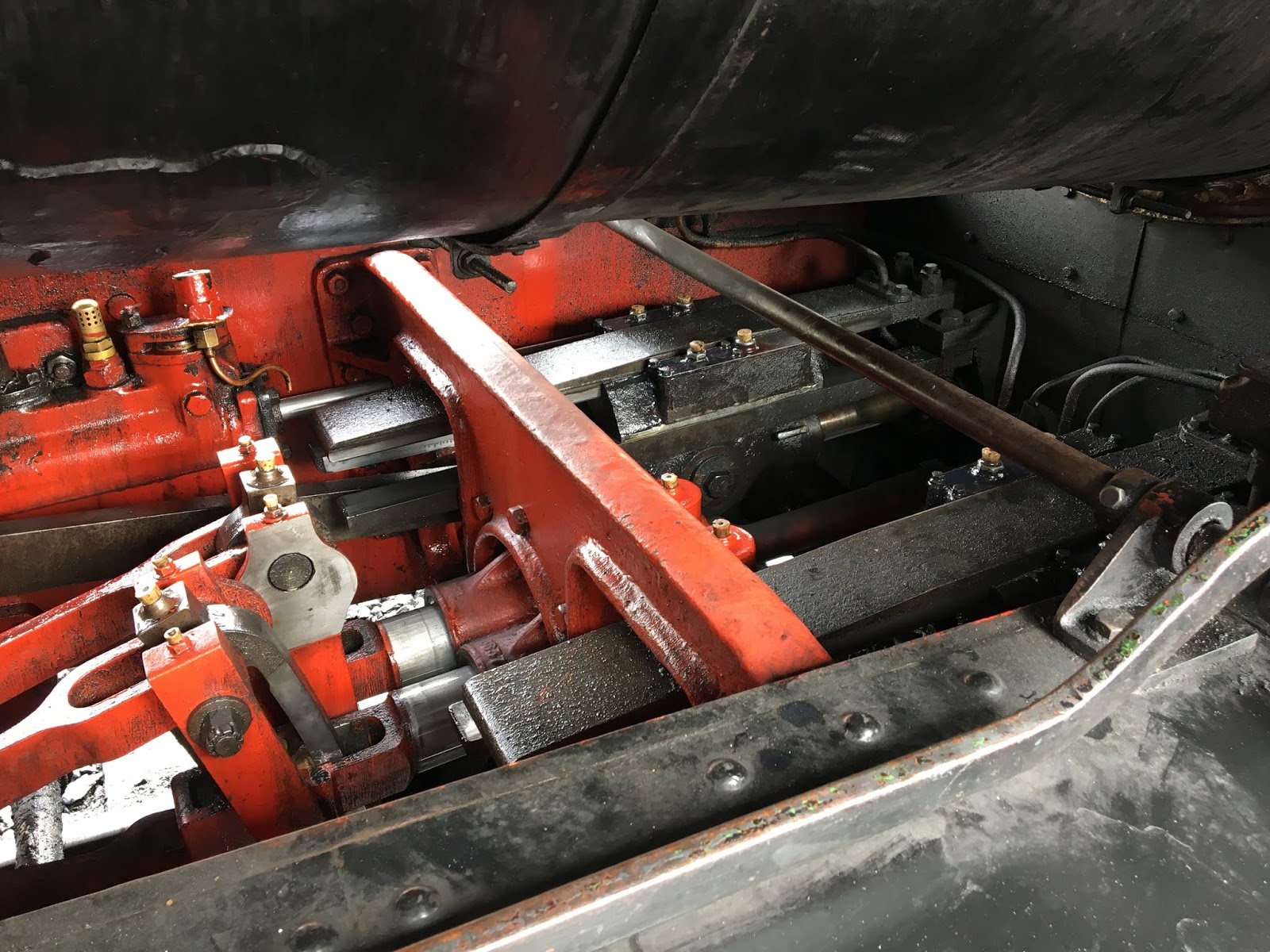
I was very pleased to see the Pannier as I had sort of unfinished business with her in a way. Years ago she was booked to attend a gala at Shackerstone and I was rostered to fire her on one of the days. Sadly, she failed just before her visit and so we missed out on her. It was a pleasure to see her today, if a few years late! Built at Swindon in 1951, 1638 is the sole survivor of the once 70-strong 1600 Class. A true GWR design, these engines were actually built under Hawksworth as BR Western Region locos. With a 165psi boiler plumbed up to 16.5" cylinders, power output isn't far removed from the 6400 variant, with both types being a little more subtle than their stronger sisters of the 5700 Class. Looking beneath the tanks, the differences in slide bar and crosshead design are noticeable on this slightly younger Pannier...
As departure time neared, we opted to board the coaches. Ed: having saved some money with his HRA Pass: was feeling a little frivolous so we decided to pay the supplement for First Class on the 11.5-mile journey to Bodiam. The comfortable surroundings of this Southern region coach were very welcome as we enjoyed the sounds of 1638 hissing out of Tenterden. The trolley service was a pleasant addition to proceedings and a hot cuppa' was just what the doctor ordered...
The history of the KESR is a long and interesting one. It owes a lot to one Holman Fred Stephens who was brought in to engineer the line as a light railway. Essentially the railway was to be built on a budget and the track bed followed the lay of the land. Stations and buildings were constructed cheaply and in a minimalist fashion, as befitted the rural landscape the line passes through. Even today, the light railway aspect is evident with the varying gradients as the train chugs uphill and down dale. An early starter in preservation, the KESR was taken over by a charity in 1973 and since then has gone from strength to strength. Having descended the main bank on the line, we arrived at Rolvenden: home of the locomotive shed. Here we passed the KESR's tender engine: a Norwegian Mogul built in 1919...
The KESR travels through a lot of unspoilt countryside, with the train gently easing its way up and over the hills. 1638 was chugging along beautifully, with her crisp voice echoing through the trees as we enjoyed our tea. Soon enough, there was a short water stop at Northiam to replenish the 875-gallon tanks...
From Northiam, 1638 took us on another steady amble to reach the terminus of the preserved KESR at Bodiam. Passengers can break the journey here to visit the nearby Bodiam Castle, which dates back to 1385. The Pannier was uncoupled from the stock prior to running round in preparation for an 11:43 departure...
I like the lines of this engine. All of the typical Pannier features are there but she just looks a little more compact. It's a shame there's only one left...
Soon enough the engine was sitting pretty at the head of the returning service...
With a "Right Away" from the Guard, 1638 barked out of Bodiam right on time with her coaches in tow. I managed to catch a quick shot of the castle in the distance...
On the return run there was a pathing stop at Northiam and so 1638 sat simmering away happily to herself, staring at the closed crossing gates ahead...
I managed to catch the driver for a quick chat at Northiam. When he got talking it turned out he was, like myself, a bit of a Pannier fan. He'd been on Tyseley's own 7752 during her visit to the KESR some years ago and raved about the go anywhere durability of the 5700's. He explained that 1638 had recently returned to service following axlebox repairs as she had a tendency to run hot. Today she was in fine fettle and had no trouble pulling our train over the gradients. Leaving Northiam behind, it was interesting to listen to the 0-6-0 at work. She was really being worked properly, using the gradients to her advantage whether up or down, reducing the effort required. As the old saying goes: "momentum is your friend". At Rolvenden, the engine was halted just before the platform to take water again prior to the ascent of Tenterden bank...
1638 sets out from Rolvenden and onto the rising gradient...
After a very vocal climb back to Tenterden, 1638 came to rest at the end of the platform. What a very nice run with this plucky little Pannier...
Train ride completed, it was time for a spot of lunch. Well known destroyer of menus 'Eddie the Late' was primed and ready for a Three Course Challenge! However, with a pub meal booked for this evening, I managed to persuade him that a simple breakfast roll might be the safer option for now...
I think we were both impressed by the whole set-up of the KESR. The engine and coaches were tidy, the stations well maintained, staff smart and friendly, catering facilities up to scratch...you name it! It just has all the hallmarks of a well run organisation and, dare I say, business. The passenger loadings on a simple midweek service certainly seemed strong and there were plenty of people milling about the stations. In the main forecourt, a very smartly turned out Pullman car caught my eye as we made our way to the souvenir shop...
By now 1638 was back at the head of the train, feathering at the safety valves as the needle neared the red line. What a nice old gal'...
Wandering back across the level crossing, we waited to see 1638 depart on her 13:15 train before visiting the impressive railway museum...
When the time came, with barely a hiss, 1638 hauled the train gently backwards in the direction of Bodiam. With her vacuum pump ticking away, she gradually disappeared from view. After our look in the railway museum we ambled back towards the car to plan our next move...New Romney bound! What a very pleasant first visit to the KESR: a lovely little railway with nothing but good to offer. Cheers all, Sam...

Monday, 8 July 2019

A Statfold Summer Sunday with "Howard"...

There was a time when footplate turns at the award winning Statfold Barn Railway near Tamworth were few and far between. When I started crewing there the railway only held three very private enthusiast-based events each year and, depending on which engines were required, we weren't always needed. Nowadays it's an entirely different story, with many family based events following in the wake of our pioneering Giant Miniature Weekend. Today I was rostered to drive one of the six locomotives performing at the Family Fun Weekend and had been looking forward to another taste of the handle. My name was originally penned to the elderly French Corpet but, nice as she is, I wasn't disappointed to see her exchanged yesterday for "Howard". Don't get me wrong, the Paris-built Pannier is a very nice engine, but you can't really beat a Brazil. I arrived at Statfold this morning a little before 06:30...
Two day events such as this one obviously require double the crew and Max (who had been driving yesterday) had kindly offered to be my Fireman today. To give him a hand, I decided to light the engine up. Having cleared the grate and performed all of the usual checks, I lit some rags on the shovel to get us started...
With the rags blazing away on the grate, I added a strong helping of dry wood blocks before a layer of coal. The encouraging crackling which followed assured me that all was well and a dark plume of smoke was soon climbing skyward from "Howard"s chimney. Max soon appeared and began ashing out whilst I made my way around with the oil cans. "Howard" features marine-type rods with inside Stephenson's valve gear and, although the eccentrics require an arm like Mr Tickle to reach, she isn't really a problem to lubricate. As I worked, it was lovely to look up and take in the spectacle of several chimneys smoking away on the shed frontage...
As she was still so hot from yesterdays efforts, "Howard" took no time at all to begin making steam. In fact she began singing almost as soon as I'd dropped the rags onto the bars! Whilst I finished the oiling, Max gave the engine a wipe over before Chris arrived to take our breakfast orders: good man!...
Just before 09:00, as the warm sun began to shine down on us, we were given the board to leave the shed. We were now coupled to the Peckett "Harrogate" and our green duo would form the first empty stock move of the day. Soon enough, with drain cocks hissing loudly, we were steaming out into the fields bound for Oak Tree via Cogan Halt. Having made a fair assault on the bank, the pair are seen together at Oak Tree at around 09:20. "Howard" had been uncoupled and we were awaiting permission to proceed light engine back to Statfold on the token run...
Leaving Oak Tree behind, it felt kind of unusual to be thrashing along with no train to pull! Arriving back into Statfold we were signalled into the headshunt to await the next inbound service, which would of course be "Harrogate". This train would form our first passenger train of the day: the first of many...
When the time came, I gently backed "Howard" up into the old bay platform to couple onto the waiting coaches. Chris, with perfect timing, then arrived with breakfast and we enjoyed our cob with time to spare before our departure...
The weather conditions were already fantastic and it wasn't even 10:00. "Howard" was basking in the warm July sunshine as we awaited the road...
Soon enough, with a "Right Away" from the Guard, off we went. Max had "Howard" singing to him as we steamed out into the fields with our coaches following steadily behind. I don't mind double heading on the open days but it's certainly nice to be out on your own with the engine now and again; you just have so much more control. There were three train rakes in operation today, with trains passing at Oak Tree and Statfold (much like GMW practise). After a very pleasant first run, we turned "Howard" on the turntable before awaiting the shunt signal...
From then on it was just a steady procession of more of the same. We steamed out, came back, turned the engine, had a few minutes in the headshunt and then took another train out. I believe we did 9 trips in the end but I must admit my memory escapes me! "Howard" was on top form all day...
Here, with the sun taking a break, "Howard" waits at Oak Tree...
In a very rare state of Statfold affairs we ended up being "first off, last back" and hauled the final passenger train at 17:00. The almost continuous sunshine had kept the visitors out right up until closing time and so we picked up the final returnees on our homeward run. Here, "Howard" waits at the balloon loop...
Returning to Statfold with the last train, I reflected on a very enjoyable and carefree day. Once safely stabled in Platform 2, we were shunt released by "Alpha" before I drove "Howard" back up onto the shed frontage ready for disposal...
With a nice level fire and a full boiler, we left the 1936-built Brazil with her chimney cap fitted. "Howard" (formerly "Josephine"), despite having many miles under her belt, continues to give good, reliable service and is as plucky and willing an engine as ever I've driven. It was a pleasure to crew her again today and I must thank Max for his company and assistance. Another very pleasant seven trips on the regulator: Max drove the other two. Many thanks all for reading, cheers, Sam...

Friday, 5 July 2019

A Marston Jabbett Merchant Navy...

Living so near to the West Coast Main Line, it's quite often that locomotive moves take place between West Coast Railway's depot in Carnforth and their London outpost at Southall. Most of these runs take place during the working day and therefore I usually miss them. However, occasionally, the timings work out perfectly. This afternoon, in warm and breezy conditions, West Coast's Merchant Navy Pacific was working southbound with her support coach not long after I got in from work. Therefore, with minutes to spare, I headed out to spot her. 35018 "British India Line" was withdrawn from BR service in 1964 and, like so many of her Bulleid sisters, ended up at Barry Scrapyard in South Wales. Rescued in 1979, her painstaking restoration to main line standards began in 2012. Finally, after countless hours work by the team at Carnforth, 35018 returned to the main line under her own steam in May 2017. The Merchant Navy's make for a lovely big engine and it was a pleasure to see 35018 slip effortlessly through the Warwickshire countryside heading to the big smoke. This was the first time, however briefly, that I'd seen her 'in the metal'. Thanks all, Sam...