Hello. This is Post No3 regarding my visit to the famous National Railway Museum in York. This post documents 'Station Hall', the museum's second largest locomotive display area. Walking through from the Great Hall, visitors pass under the museum's own private subway before entering the second Entrance area, located right next to the Souvenir Shop. The NRM's massive Gift Shop is well worth a look and you can buy anything from Hornby model's right down to keyrings and stationary. Leaving the gift shop, visitors pass down a small corridor before entering 'Station Hall'. 'Station Hall' is the museum's former Goods Shed display and now hosts the beautiful Royal Train collection. The Hall is laid out into a 'Train & Platform' format, meaning that it's just like 'Real Life' as it were. The trains are positioned against the platform edge with the usual 'gap' covered by plastic boarding. This boarding is probably a good idea with the huge amount of small children which approach the vehicles each day. As visitors enter Station Hall, good's wagons are positioned on the nearest tracks. There are also some railway-related road vehicles to see and a few relevant artifacts and displays. In total, there are three Platforms in Station Hall, served by four tracks, making all three of the platforms "Island Platforms". The first loco we came across was the lovely LSWR 0-4-4T, No245 of 1897 (seen above). Below, the quaint Midland 'Spinner' 4-2-2 No673 of 1899 is seen stationed between Platform's 2 & 3...
The 'Spinner's were built under Johnson by the Midland Railway. No673 is a static exhibit within the National Collection and so can always be found at York. The 'Spinner's, with their large driving wheels, were said to be able to travel at high speed with primitive lubrication. Obviously, the law is that a large wheel travelling at 60mph will rotate much slower than a smaller wheel travelling at the same speed. Therefore, the pistons will be entering the cylinder at a slower speed, reducing the risk of 'running hot'. This idea also linked to the loco and tender axleboxes. However, though the 'Spinner's were very fast, they lacked necessary adhesion; hence their nickname! Legend has it that 'Spinner's could be seen running at speeds of up to 90mph whilst their huge driving wheel set seemed to be travelling much slower! (I wouldn't fancy 90mph on one of these old girls!). However, though 15 engines were built in this class (the 115 class), only No673 survives. Moving on from the 'Spinner', I discovered another Stanier gem at the head of a rake of King Edward VII's Royal Train carriages; Stanier Black 5 No5000, the first of his fabulous 5MT's...
The Royal Train carriages stand alongside Platform 3's far side. King Edward VII's rake are headed by the Black 5 and are spotted below...
It's very, very unusual to see a Royal Train, let alone up close! Below, we see one of King Edward's coaches from the other side, note the triple-axle bogie...
Behind King Edward's coaches are the beautiful (yet very dark) coaches of Queen Victoria. Her Saloon is very old fashioned and echoes the era of the 1800s. The interiors of all of the NRM's Royal Train coaches have been lovingly restored to their former luxury for all to enjoy. You can have a look through the windows into Royalty throughout the year and, best of all, it's still FREE (like the rest of this 5* museum!). 'Station Hall' contains locomotives such as No5000, the 'Spinner', a 28xx 2-8-0, a large 4-4-0, the LSWR 0-4-4, a 'Coppernob' 0-4-0 and the famous Bullied Battle of Britain pacific "Winston Churchill"; the engine which hauled the famous Wartime PM's funeral train. There is also a carriage from the Orient Express. As well as the loco's, wagons and Royal Train coaches, 'Station Hall' also has a large cafe area where many visitors can often be found enjoying a bite to eat...
'Station Hall' is very well laid out and is another fantastic part of the National Railway Museum. Want to see more? Why not go along and visit for yourself; you won't be dissapointed! The 4th and final NRM post; regarding operations in the museum's South Yard; is coming soon! Thank you all. Good Evening...
Hi all. This is Post TWO of FOUR regarding my trip to the wonderful National Railway Museum in York today. This post talks about two more sections of the NRM; The Warehouse and The Works. I'll begin with the Warehouse. Situated just off the Great Hall, the Warehouse is a Rail-lovers dream. Within the confines of this huge building you can find everything you would ever need to run a railway. From totems to lamps, from magnificent 7.25" gauge working models to benches and from station toilets and directors tables and chairs right up to a huge station statue; the Warehouse has it all! Also, there are signal arms, signal frames, lanterns, lamposts, uniforms, mirrors, orniments, models, headboards, signs, electric lights, nameplates, worksplates; EVERYTHING! This was probably one of my favourite points of the day; there was just so much stuff to see! (The pictures can't really do the building justice; you'll have to go along and see it for yourself'; you won't be disssapointed). There is also a large exhibition named "The Flying Scotsman Story"; documenting the turbulent life of the World's most famous steam locomotive. In amongst the other treasures were many models, ranging from 'O' Gauge through 3.5", 5" and even up to 7.25" gauge. Below, on one of the shelves (as if it was a 00 gauge loco!) stood a beautiful 7.25" gauge GWR 4-4-0 Bulldog loco...
I must have counted at least 20 steam models of gauges ranging between 3.5" and 7.25", and thats not counting the ones that were only half finished! The NRM must have had countless pieces donated; they have everything. There is no way to name everything, it would be impossible. The place just echoes "Railway", it's great. Below, I try and capture just a small part of The Warehouse, there is stuff crammed everywhere...
From the fantastic Warehouse, visitors can take a lift or a flight of stairs to an Upper Level. Here, there is a Signalling Display and even a Balcony overlooking the busy, present day York Station. Why not stop off and watch a few modern trains go by?! The next section is The Works. The Works is generally what it sounds like; the engineering base of the NRM. However, unlike normal workshops, where work would often be hidden from public gaze due to health and safety and one thing or another, the NRM has created the upper floor as a Viewing Gallery. Therefore, visitors can see any work going on at any time by the NRM's skilled engineering staff. Below the Gallery stand any loco's or stock that require attention and of course the machines (i.e. lathes and the Wheel-Drop pit) which help restore and maintain them. The main project for The Works at the minute is the sole surviving Gresley A3 Pacific; known as the World's Most Famous Steam locomotive; No4472 "Flying Scotsman". 4472 has been in bits at the NRM since early 2006 and is still undergoing a full overhaul back to Main Line running condition. Therefore, the general non-engineering visitor can expect only to find a pile of bits which mean nothing to them, alongside nameplates which read; "Flying Scotsman"! In fact, even today, the much worked upon frames of 4472 were not in attendence. They had been moved to the East Lancs Railway at Bury, most likely into Ian Riley's works, for fitment of Air Brake equipment ready for 75mph Main Line running in the near future. Therefore, in The Works were Class 20 (Chopper), 52 (Western) and 37 (Growler) diesels, behind 4472's tender. The 5000-gallon Corridor Tender was also off its wheels...
Below the deck, I was surprised to see 4472's main driving wheels, freshly renovated...
"Flying Scotsman" should be done in the near future but, if you're interested in her overhaul, you can keep track of it in the railway press (4472 almost always gets a mention!). Whilst in The Works, I took an oppotunity to check out the various machines on show. The Wheel Drop pit in particular was very impressive, allowing the wheels to simply 'Drop' from an engine which stands above (it's as easy as that!). If you did it the "old fashioned way" like the LMS used to then, you'd generally lift the entire engine off the wheels. Using the pit, the engine can remain on the ground, leaving the much lighter wheels to 'fall' from the chassis independently. From The Works, it's only a short walk back into the Great Hall before descending a few more steps to the ground. The Warehouse and The Works are both well worth a look and are just two more sections of the fabulous NRM. Thanks for reading folks. Post III will document the visit to the NRM's second main building; Station Hall (coming soon). Good Evening...
Hello everyone. Now, firstly, I make no apologies for the prospective lengths of the following FOUR post's on this blog. All four posts will document my fantastic visit to the fabulous National Railway Museum in York, undertaken today. This is Post No1, documenting the goings-on in the museum's jewel; The Great Hall. So, without further delay, here we go! After leaving home at around 7am we made it to the NRM, following a full english breakfast, just before opening time at 10am. Already there were a few other visitors waiting outside and so, naturally, we joined the queue. The NRM was opened in 1975 by Prince Philip; the Duke of Edinburgh. Since then, the collection has continued to grow and the 20-acre museum site is crammed with all kinds of railway relics, ranging from huge locomotive's right down to cutlery which was used on BR's Dining Trains! Admission to the museum is FREE, "Yes, you heard me right!"; FREE. In my opinion, it is by far the best museum of its kind that I have ever visited and is well worth a few hours of anybody's time! The museum, now one of Yorkshire's No1 attractions, hosts thousands of happy visitors per year, whether these are enthusiasts or general member's of the public. The museum is truly fantastic and I would recommend it to anybody at all. At 10am, right on time, the museum opened and we entered. Though the museum is free, they do like you to 'register' at Reception, therefore allowing them to know how many people visit the museum each day. Once past Reception, visitors descend a short flight of stairs before entering The Great Hall. Immediately, huge locomotives are within touching distance and even the tallest visitors are substantially dwarfed by the many prized pieces inside the Hall! The Turntable is in the centre of the Hall and many locomotives stand around it. Further away from the turntable, locomotive's face out into the light and towards the City of York. Below, we see the beautiful SECR 4-4-0 No737, standing on one of the sidings...
Wainwright D Class No737 is currently part of an exhibition known as "737 & Topaz". "Topaz", which is coupled up behind 737, is a beautifully restored Pullman Car, used on Britain's rails right up until the early 1960s. 737 claims fame in the 1981 film "Chariot's of Fire" and is beautifully kept. Though, like many NRM loco's, she may never run again, her preserved condition and security inside the Great Hall is admirable to say the least. 737 is filling a 'huge gap' in the Great Hall in my opinion; she stands where A4 No4468 "Mallard" once stood, with 4468 now having moved to the NRM's 2nd museum at Shildon (a bad move for the world's fastest steam locomotive in my opinion but, what can you say!). Below, we take a look inside the cab of 737. As you can see, the silver is burnished, the brass is polished, the backhead is painted and the cab is spotless; the NRM really know how to keep their engines...
Moving away from "Topaz" and 737, we moved around the sidings which run off the turntable and discovered the locomotive which the whole day had been about finding; streamlined Princess Coronation Pacific No6229 "Duchess of Hamilton". The Duchess is a striking locomotive, one of Stanier's masterpieces, much like smaller Princess Royal No6201 "Princess Elizabeth". 6229 was built at Crewe in 1938, forming the 10th member of the Princess Coronation Class. She was built as a "Bathtub" (a streamlined Duchess) and did many miles on LMS rails. In 1944, 6229 was repainted into LMS Wartime Black, a stark contrast from the "Days of Red & Gold" that had gone before. In 1947, due to maintainence, the streamlined casing was removed and the Duchess reappeared in rebuilt form; as did her classmates. In 1948, BR took over and 6229 became 46229. In 1950, the Duchess wore BR blue but this was repainted by 1952 into Brunswick Green. Finally, in 1958, she was painted maroon. Withdrawn in the 1960s, Billy Butlin bought the engine as a 'climbing frame' for his Minehead holiday park (a bit of a shame don't you think?!). In 1987, after running for the NRM on loan from Butlin's between 1980 and 1985, the NRM purchased the loco. In 1989, she returned to work on the main line as one of the NRM's flagship loco's; of course in rebuilt form still. In 1996, the loco's 7-year boiler ticket expired and she hasn't ran since. In late 2005, it was announced that 46229 would be restreamlined at Tyseley and, sure enough, in May 2009, she returned to the NRM looking like this...
"Wow"...
The beautiful "Duchess of Hamilton" takes pride of place in her own exhibition area in the Great Hall named; "Streamlined". There are many opinions surrounding the restreamlining but I feel it looks great. After all, she was built like that; it isn't a mock up! Well done Mr Stanier, you did a great job! There is talk of 6229 being steamed again in a year or two and returning to the Main Line in Streamlined form. I'd pay to see that; let's hope it happens! From this LMS giant we moved across to an even bigger monster; the Chinese locomotive. I make no excuses for not knowing what class of engine this is; I mainly know of British types! This huge 8-legged steam locomotive is a Chinese monster and was used on Freight trains. To put the following picture into perspective, she holds 25,000 gallons of water in the tender ("Mayflower" only holds 5000) and, I am 6ft 1" and, if I stand next to the loco, my head doesn't even reach the top of the cylinder! On top of this, she isn't even one of the biggest engines(!) on Chinese rails, she's just a simple freight engine. However, she's so big that she has an Automatic Stoker and Steam Operated Firehole Door's. You can also visit the footplate of this engine. It's always nice to do things like that on engines you are not familiar with. Looking at the size of it, I bet you'd get 80mph out of this easily! Below, the Chinese engine dwarfs the little Southern Q1 parked next to her...
Though it isn't actually a Roundhouse, the NRM's Great Hall has the beautiful Turntable at it's centre. As well as allowing locomotive's to be easily displayed for the public, the turntable serves the purpose of turning engines as well as allowing them to be shunted to their various roads with ease. Below, we can see (from left), School's Class 4-4-0 "Cheltenham", 0-4-4 "Gladstone", 2-4-2 L & Y Tank, an unusual freight loco (don't know much about that oldie!), a Diesel Shunter and a Class 87 Electric. The height of the overall roof can be appreciated...
Across the turntable in a dark corner stood none other than the beautiful 4-6-0 Star Class "Lode Star". This is another engine that I wanted to see and is also one of my point's of "ranting"! "Lode Star" was built in 1907 and was part of a production run of 73 Star Class engines that were built by the GWR under Churchward. The Star's were powerful 4-cylinder 4-6-0s with the outside cylinders driving the centre axle and the inside cylinders driving onto the lead axle. Valve gear consisted of two set's of Walschaerts, contained between the frames, the outside cylinders being driven by Rocking Levers. They were the fore runners of the Castle Class and performed well on GWR metals with a Tractive effort of 27, 800lbs. No4003 is the sole surviving member of the Class and was withdrawn in the early BR days, leaving service in 1951. Upon her withdrawal, "Lode Star" had covered 2, 005, 898 miles! Can you believe that?! The Great Western Museum in Swindon has had the engine since 1962, the loco being moved to the NRM in 1992...
Now, here comes the ranting! No4003 is a static exhibit at the NRM yes. Well, throughout preservation, the Castle class survivors (which followed the Star's) have been restored one after the other. Recently in fact, No5043 "Earl of Mount Edgcumbe" returned to steam at Tyseley and now runs regularly on the main line. Also, all examples of the County Class, built by Hawksworth, were lost under the cutter's torch. However, a brand new County is being built at Didcot. On top of this, a brand new GWR Saint Class 4-6-0 is being built at Didcot. Finally, to top it all, a brand new Grange is being built at Llangollen by the 'Betton Grange' group. SO, with all this in consideration, I find it very hard to see why people would want to built brand new engines such as the Saint, the Grange and the County when, lurking in the background, beautiful ORIGINAL machines such as "Lode Star" stand unsteamed and forgotten. "Lode Star" is a beautiful piece of engineering and should be steamed in my opinion but, at the present, there are no plans to steam the beautiful Star. Below, the Star's perfectly kept cab can be seen...
"Come on NRM, Steam Lode Star!"; I'd pay to see her move under her own steam again! Behind "Lode Star" we saw just a small section of the NRM's huge collection of train Headboards. Spot any you know of in there?...It's not just oldies either; the NRM even cater's for modern trains. In front of the museum's 'section of the Channel Tunnel' stands "Shinkansen"; the Bullet Train. "Shinkansen" is a Japanese electric train used their High Speed Railway Network's. This car is one of the "0 Series", the oldest of the Shinkansen trains. The "0 Series" was introduced in 1964 and the last trains left service in 2008, being replaced by much newer and faster models. Some trains, such as Maglev, run at speeds of up to 364mph. The first Shinkansen trains only ran at 130mph, back in 1964, but modernisation of tracks and expansion of networks has resulted in higher speeds of up to 186mph, though test trains have reached 275mph on conventional tracks! "Wow"! At the NRM, you can sit inside their Shinkansen car and watch films of other Bullet Trains running in Japan. I must admit, it is very interesting, even for an electric train! To me, it bares a stark resemblence to the nose of an aircraft...
The newest addition to the Great Hall, though dirty from top to bottom, was the Harry Potter star; GWR 4-6-0 Hall No5972 "Hogwarts Castle" (really "Olton Hall") which is on a flying visit. 5972 was the first engine we saw upon entering the Great Hall but, to be honest, she was a right state! The engine had arrived at the NRM on the Monday and, for some reason, had still not been cleaned up. As admirers gathered and began to comment on the loco's state, all of a sudden, a gang of cleaners appeared, all clad in white boilersuits, carrying buckets, scrapers, rags and spray guns! Good show! However, they really were cleaning the engine non stop all day to little avail; she was filthy; a far cry from the NRM's beautiful locomotives. However, it is necessary to remember that this is a hard working engine that earns her keep regularly on the Main Line. Below, the cleaners attack 5972...
At least 5972's dummy nameplates look nice...
Regular readers will remember that we dined on the "Shakespeare Express", hauled by No5972, last July (see seperate post). Below, check out video footage from inside the NRM's Great Hall and Station Hall. In the video you will see many engines from the NRM collection, as well as 5972, and I hope you enjoy it. I tried to keep it as steady as possible. Simply click "Play" to view...
As well as locomotives of the full size type, there are miniature engines, narrow gauge engines, model engines, headboards, signals, benches, a footbridge, a signal gantry, many photographs and activities as well as a very nice automated Model Railway, all within the confines of the Great Hall. On top of this, you can walk under a huge steam locomotive (on our visit No6000 "King George V") in a large, lit Inspection Pit and see a huge "Cutaway" engine (Merchant Navy "Ellerman Lines"), allowing you to see just how a locomotive works, piece by piece. Next time, Post No2 will describe the Warehouse and The Works. Look out for Post TWO coming soon! I hope you have enjoyed this post folks (apologies for its lateness; I have been busy). Good Evening...
Hi all. Today was my 3rd and final rostered Crew Turn of 2010 at my 5" gauge concern; Ryton Pool Miniature Railway. I arrived on site at just before 12 Midday and found the Member in Charge for the day; Peter; already on site getting out the stock with the Class 37 electric. After we shunted the stock into the correct 4-car format, Emma and David arrived and we set about organising ourselves. Myself and Emma then headed off to find the steam engine; Sweet Pea No499 "John H Owen"; whilst Peter and David made two test laps with the Class 37. They also set about putting the many Signals out onto their posts ready for the running. With the steamer now out on the Steaming Bay I set about checking her over. She seemed in good nick, considering she had had a mammoth running session the weekend before during the Night Run (see seperate post). However, Emma discovered a pile of ash at the back of the smokebox, leaning up against the tubeplate. This ash was actually covering the bottom two boiler tubes and this told me to check behind the Firebox Baffle as well; just in case. Luckily, on removal of the firebox (good old Marine boiler's!) I discovered no ash and the tubes seemed perfectly clean; even the bottom two. We came to the conclusion that the ash must have dropped down from atop the spark arrestor during the week when the loco was shunted about. Whilst Emma continued to clean the smokebox, I oiled the loco up and laid a thick wood fire in the box. As soon as Emma had finished, I lit the engine up and turned on the Blower. Within 20 minutes or so, "John H Owen" was ready to go and had 70psi on the clock. Therefore, Emma went around to Ryton Halt to reverse the main train around with the 37 before we swapped the loco's over...
Now coupled up, I placed the engine into Reverse gear and carefully opened the regulator. Nothing. Therefore, I 'shut off' before placing the loco into Forward gear and trying again. This engine is fitted with Automatic Drain Cocks and therefore any water in the cylinders is trapped until the Drains decide to open. Therefore, it is necessary to go 'carefully' when starting the loco off so as not to force the water out through the chimney (it isn't pleasant!). With a bit of hissing, the loco's Drain Cocks opened and vast amounts of water and oil spilt out, freeing off the engine's pistons. With the water out, 'JHO' began to roll forward, telling me that I could now 'open up' and chug around to the station with the 4-coach train. The Station Approach Signal rose and we whistled through the Arrivals Platform into the Departure Platform, coming to a stand alongside the Water Column. I took on water here whilst the passengers boarded ready for the first steam hauled trip. With a blast on the Guard's whistle, off we went. I drove the first three trips before handing over to Peter who fancied trying his hand on the regulator again after a good break away from steam driving. As expected, it came back to him just like riding a bike and he did a good few trips before handing over to David. David had also not driven for a while but seemed to return in good time though, rather unusually, he'd lost the shovel half way round! I then looked after the engine whilst Dave went to look for the shovel. I must admit, hand firing a Sweet Pea is NOT easy at all, particularly when there is a hole at the front of the fire! In the end, the passengers had been loaded and Emma asked me to drive the loco whilst she acted as Guard. I wasn't confident when we left, even though the fire was pretty good, as firing on the run with no shovel would be very difficult indeed. However, luckily, as we made it to the bridge on the outward run, Dave appeared with the shovel and I stopped to collect it before continuing with the run, banking up the fire ready for attack on the 1 in 70 incline on the return journey. After arriving back at Ryton Halt successfully, I handed the loco over to Driver Emma...
"JHO" continued to run very well throughout the afternoon. However, when Emma reported a bit of poor steaming we did a quick "Pit Stop" (myself and Emma are very good at these now!). Whilst Emma had the smokebox open (cleaning the arrestor and sweeping out the char), I had the Marine Firebox out so that I could clean behind the Baffle and check the tubes. The smokebox door is then shut and the Firebox replaced; still with the fire lit of course! It is then time to put the Blower back on and to either rake the fire through or add more coal; this depends on the condition of the fire following the "Pit Stop"; it's all a matter of time! Below, Emma is ready to depart with another full train. You will notice the 45-degree Deflector Pipe in the chimney, allowing any sparks or ash to be thrown to the Right Hand side of the train rather than back over the Driver's head and onto the passengers (Well, thats the idea anyway!)...
After Emma had done a good few trips she handed the loco over to David again who did even more good runs with varying loads. As ususal, the loco steamed and ran beautifully with no reported problems. At 3:45pm, David handed me back the regulator and I drove the final two steam hauled passenger runs, allowing us to take "JHO" off the track before 4pm ready for a quick blowdown and clean up. With "JHO" off the track I set about Blowing Down whilst Emma got the 37 coupled up to the train again. Emma then took the final few passengers around the track with the powerful 37. Meanwhile, I had Blown-down "JHO" and emptied the Grate and Ashpan. Also, "JHO" had begun to contract following the Blow Down and had sucked two full water tanks worth of H20 through into her boiler ready for the next user; whoever that may be. Emma then arrived and swept the smokebox whilst I used the Flue brush to sweep the tubes. We then cleaned up the engine before putting her away. In the meantime, David and Peter were busy shunting the stock and putting the Signals away. With everything away, we all retired to the Clubhouse to wash our hands before departing for home. I thanked everyone before departing for home myself at about 5:15pm. Thank you to my other three crew members for such a nice afternoon of steam running on the RPMR with "JHO". Admittedly, the "best" (in some ways!) part of the afternoon was when I had to restart "JHO" from the foot of the steep bank with a very heavy full train. The loco, with much slipping and hissing, roared into life and the accent up the 1 in 70 was particularly loud! (Not my fault honestly! ^_^ ). Thanks for reading folks, Good Evening...
Hello everybody. I hope all of my reader's are well and enjoying their summer's as I am. Today was another invitation from my friend Dave and it was again to the 7.25" gauge Echills Wood Railway at Kingsbury Water Park. I must admit, even since I last came to drive here back in May (see seperate post) the railway has changed so much. Even around the yard area, huge changes have been made including the building of new storage roads for one! Anyway, after arriving at Dave's house at around 8:30am in heavy rain, I jumped quickly into the Range Rover before we set off for Kingsbury. We were taking along Dave's 14xx 0-4-2 No1401 as well as two LMS Coaches, a Box Van and a GWR Toad Brake Van (1401's Driving Truck). Once at Kingsbury we joined the queue to unload. Already on the Hydraulic Loading Ramp was a huge 4-8-8-4 American 'Big Boy', adorning two huge tenders which, in full size terms, would hold around 25,000 gallons each!! Once the mammoth 'Big Boy' was unloaded, we got 1401 out of the Range Rover and also got her stock off the trailer. The smart looking 14xx was then pushed around to the turntable at the Roundhouse before being turned. We then pushed her back onto one of the steaming bays, alongside a beautiful model of A1 Pacific "Great Northern". Dave soon had 1401's boiler filled up (through the Blowdown fitting) whilst I prepared the tools. I then set about oiling the engine up; not the easiest task, particularly with such confined inside Stephenson's Valve Gear (I wouldn't want to oil up a full-size one!). Once oiled it was time to light up (it was a bit smokey mind')...
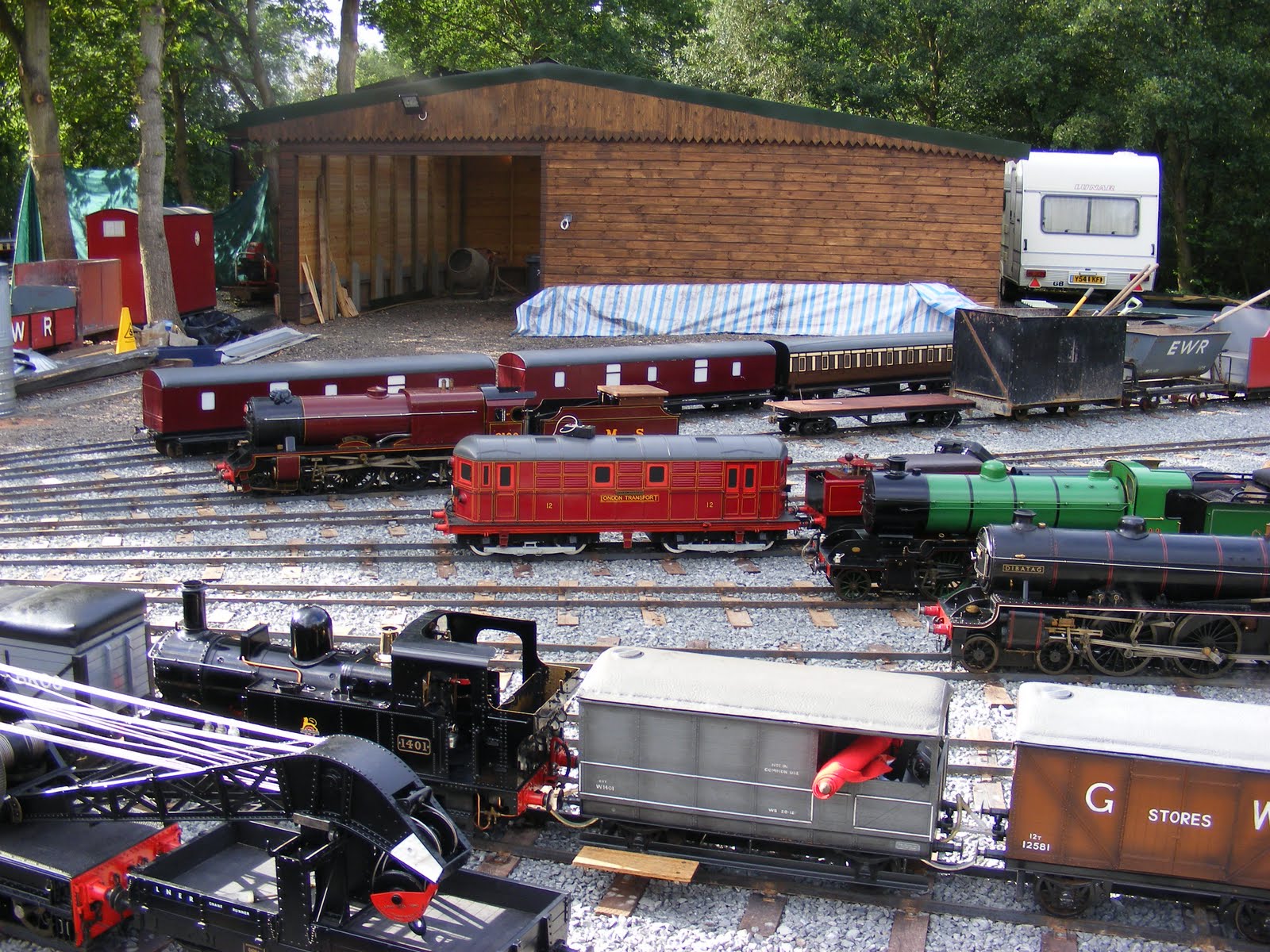
Lighting up took the usual course of starting with Parrafin soaked wood before moving on to coal. Today was the first day of the EWR's annual Standard Gauge Weekend during which, for one weekend only, all Narrow Gauge engine's were banned and scale engine's took over. There were some really impressive bits of kit in attendence. I particularly liked the model of the double-chimney 9F "Evening Star" which carried a price tag of around £70, 000. ("I'll have two please, sir!"). Meanwhile, whilst I got 1401 ready, an impressive line-up was forming on the new storage roads opposite. Below, you can see a Midland 2P 4-4-0, a Thompson B1 4-6-0, a K4 2-6-0 and two beautiful Royal Scot Class 4-6-0s...
Soon, 1401 was ready and we trundled off shed before coupling up to the two very nice LMS Coaches. The Brake Van (1401's Driving Truck) and the Box Van were then sandwiched between the loco and the coaches. Both Van's contain Water Tanks to feed the twin Injectors and, whilst running together, provided massive water capacity which was more than ample for the 1.5-mile or so round trip to Far Leys and back behind 1401. Once coupled, off we set for Far Leys. With Drain Taps hissing and wheels spinning, we edged out of the siding from the Roundhouse which is set on a 1 in 40 upgrade; no easy task with a 4-coupled engine on oily rails! Even so, 1401 chugged out of the siding before Dave jumped on the front coach. I was then given permission to "open up" and head out onto the 1.5-mile long Main Line. 1401 steamed very well, as usual, and the injectors were very responsive. The track was, again, very nice to drive and gave a smooth ride on well-laid fishplates. On top of this, the very well laid ballast made the track very stable with very few "titled" areas. Soon, we approached Far Leys and we sped through non-stop (obeying all speed limits!). Soon, after a quick dash down the 7mph stretch towards the Road Crossing, we arrived back at Harvesters (into Platform 3) and Dave jumped off for a chat with some of his acquiantances. Just then, Danny and Carl turned up from Shack and I gave them a ride round; both of them were actually surprised at the huge length of the EWR; it is very long indeed! I then carried on running for a few laps before handing over to Dave for a while so I could get some lunch. I then returned to the engine for another two or three laps later on before coming off at 3:45pm. We then disposed 1401 and positioned her for photographs on the new storage roads...
I'd had a very good day driving once again and the EWR people again seemed very friendly. In total, approximately 17 locomotive's ran on the railway TOGETHER during the day. I suppose the length of the line does help on day's like these as, of course, if the track was shorter then you would need to limit the amount of loco's somewhat. However, so I heard, the EWR is hosting the 7.25" Gauge AGM this September and, on the weekend, 160 engines per day(!) are rostered to run! Wow! Anyway, during the day 1401 had run very well indeed and neither myself or Dave reported any problems. I had even had the chance to drive the loco with a "load on" when some visitors boarded the LMS Coaches. 1401 worked even better with the load but the biggest problem was adhesion on the oily rails. This problem was being caused by the massive 'Big Boy' which was going around the track in front of me. The huge 4-8-8-4 was experiencing problems and had her Drain Taps open all the time, spilling oil, grime and water everywhere. Therefore, when I came along behind, poor old 1401 could hardly grip the rails; no surprise really! Below, we see a quick view of the outside storage roads at Tea Time showing a B1, K4, Royal Scot, Steam Crane, 1401 and various rolling stock...
Speaking of a Royal Scot, I actually got to drive one later in the day; "YES"! This wonderful Bassett-Lowke 4-6-0 was built by Apprentices of the GEC back in the 1950s (or there-abouts) and was once used at the Brookside Railway. However, the Royal Scot was soon "laid up" as the poor quality of the Brookside track was playing havoc with her. 6100 was then kept as a display model before being bought by her current owner in a dilapidated state. After acquiring a brand new boiler and being given a chassis overhaul, the loco returned to service on her owners 7.25" gauge oval of track, located in his back garden. Happily, he was invited to the EWR today and brought his beautiful LMS engine with him. After a chat with him regarding his beautiful loco, I enjoyed a ride to Far Leys and back behind her before being offered a drive; "YES"! The "Royal Scot" embodied everything normal including screw reverser, regulator, two injectors, two gauge glasses, axle pump, whistle, manual drain cocks and a large firebox. The one different thing was the lack of Vacuum Brakes; 'stopping ability' being provided by the Handbrake on the tender which, admittedly, with the Driver's weight on top, seemed to work pretty well. Sitting atop the tender, I was able to reach everything in the sizeable cab and got comfortable ready for the 1.5-mile trip to Far Leys. The owner told me the "quirks" of his engine before allowing me to set off while he had a break before disposal. 6100 ran and steamed beautifully, riding the track like a true main line engine with no jurking or lurching from side to side! (I'm too used to narrow gauge stuff!). Along the straights in particular, 6100 was a dream and I must express great thanks to the owner for giving me the oppotunity to drive her; she really was something. Below, "Royal Scot" is seen in the yard after running; beautiful...
The next picture is one for a friend of mine; Mr John Drury; a prolific local Model Engineer who builds engine's like ordinary people build Lego. The engine below, "Loch Lomond", was built by John and embodies many of his inspired features, such as his Regulator-handle style. Below, "Loch Lomond" stands in the yard at Kingsbury. Now owned by somebody else, "Loch Lomond" runs regularly on EWR metals. "Don't worry John, she's still alive and well!"...
As it was now Tea Time I could have a proper look at some of the engines; such as "Loch Lomond" and the 'Big Boy'. Though the American 4-8-8-4 wasn't running very well today, the huge size of this mammoth locomotive must be appreciated, even in 7.25" gauge! Below, the huge engine, featuring SIXTEEN driving wheels, stands on one of the bays in the Roundhouse (only one her tenders was connected at this point as two just wouldn't fitted in the Roundhouse!)...
The engine, named "Franklin D Roosevelt", was really a massive thing. You have to appreciate an engine that carries 24 wheels as well as two tenders that have 14 wheels each as well as being fitted with FIVE safety valves!! The shovel used to the fire the engine was itself over 12 inches long; it had a huge grate. The weight of the thing must be huge, even though it was only transported on a pretty standard trailer. Rather worryingly, she was only held on her trailer by 'bungee rope' (so, if he accelerates too quickly, you may have a 'Big Boy' coming your way before it retracts back onto its trailer!). The thing was absolutely huge folks, I can't describe how big it was; see for yourselves...
After dinner, I resteamed 1401 for some evening running. The engine steamed up very quickly and I was soon steaming back up the 1 in 40 gradient out of the yard with steam hissing from the Drain Taps. After running up to North Gate (where the Main Line begins), I reversed back down 'Wrong Line' before hitching up to the front of a 7-coach train, hauled by a GWR 68xx Grange Class 4-6-0. We would now be double-heading for some high speed evening running! With Dave on the regulator for the first lap and myself on the Box Van, we set off. I must admit, I've never had a Grange chimney up my back before and it's not that comfortable! The first run was quick and very enjoyable. For the 2nd lap, I was handed the regulator on 1401 and told to "go for it". (What a silly thing to say that was!). Once through North Gate I gave 1401 some stick as we climbed through the Woods. The Grange was trying to keep up behind but kept falling into a slip for some reason. 1401 was working very hard and the fire was being wripped apart by the force of the bark. (Almost full regulator and fully notched forward is a bit of a trial for a loco of any size!!). As I looked back, I could see the Driver of the Grange chuckling away; she had been 'shut-off' for a good portion of the run; 1401 had hauled the Grange and 7 coaches! Soon, we arrived back at Harvesters and decided to do a 3rd and final run. This time, with no horses spared, we really went for it! 1401 roared up the line and, as we marched through the tunnel, sparks flew from the chimney. In fact, one huge lump flew from the chimney, hit the tunnel roof and came down right in this lad's eye at the back of the train! Ouch; "sorry"! Through Far Leys we went and straight back down the 7mph stretch into Harvesters. My two runs were fantastic and thank you to both Dave and James (the Grange owner) for giving me the chance; it was like Main Line running in miniature! After this, we uncoupled both loco's and ran backwards down the 1 in 40 to the Roundhouse where we disposed both engines. Then, after cleaning up and saying my Thank You's and Goodbyes, we set off for home. (Thanks for the lift home Dave & Kevin; much appreciated!). It was another great day at EWR and I can highly recommend their railway to you; its great. Thanks alot to Dave & Kevin for another great day out with 1401. Thanks for reading folks. Evening All...
Hi all. Today, after a good night's sleep last night following the RPMR's Mega Night-Run over the weekend, I headed out to catch an appointment with the Duke of Gloucester. "No", not THE Duke of Gloucester but none other than the unique BR 4-6-2 8P Pacific No71000 herself. The Caprotti Valve-geared Pacific was standing in for failed new-build "Tornado" on a railtour from London Victoria to Gloucester and back. The 8P had joined the train at Gloucester and had climbed the Lickey Incline before skirting Birmingham and heading for Leicester via Nuneaton and Hinckley. I, via push-bike, caught up with the "Duke" at Horsten Grange on the climb away from Nuneaton on the Leicester line. Hauling 13 coaches plus a rather ugly Class 66 ('Shed'), the "Duke" looked and sounded well. Constructed at Crewe in 1954, "Duke of Gloucester" was the prototype of a brand new Class 8 Pacific designed by Riddles. The loco was mainly built to "fill the gap" in the Midland fleet as Princess Royal Pacific No46202 "Princess Anne" had been completely destroyed in the horrific crash at Harrow in 1952. The "Duke" carried Caprotti valve gear, much more efficient than both Stephensons or Walschaerts, and had 3 cylinders. She was heralded by designers as the "New Breed" of Steam locomotive design. However, she never lived up to expectation and was ridiculed by crew's as being a 'poor steamer' and a 'fuel hungry beast'. Therefore, her working life lasted only 8 years and she was then sent for scrap in Barry. Below, see my video footage of today's run of the "Duke"; listen out for the different beat style due to the Caprotti valve gear...
For BR, the "Duke" was, due to upcoming Dieselisation, "not worth bothering with". Therefore, no further examples were ever built, making the "Duke" unique. On arrival at Barry, one set of valve gear (+ cylinder) was removed for preservation at the Science Museum. The other outside cylinder was then removed to rebalance the engine in readiness for scrapping. However, luckily, the loco was preserved in 1974 and was restored at the GCR at Loughborough. During restoration, TWO design faults were found. One was the fact that the chimney was far too small compared to other loco's of this size (resulting in bad draughting) and the other was that the Damper doors were too small, therefore resulting in poor oxygen supply and combustion! Would you ever believe it?! The restoration group also added a Kylchap exhaust system, as employed on loco's such as "Tornado". The loco, when released into service was "completely reborn" and was totally different from the failure that she had been with BR. Ironically, the "Duke" is now more powerful than the Type 4 (Class 40) diesels that replaced her! Fantastic! Happily, the "Duke" of course lives on today and can be seen regularly, wether on preserved railways or out on the main line, as I saw her today! The loco was running on time and looked beautiful. It was a pleasure to see her. Thanks for reading folks, time for a cuppa' now I think. Good Evening...
Hello everyone! Well, this was really something. Something mad, something unusual and definately something to remember for a very long time! My 5" gauge concern, the Ryton Pool Miniature Railway, has often toyed with the idea of a Night Run at it's Country Park site. In the earlier years of the society, a Night Run was held at the society's previous home at Stoneleigh Abbey and was a great success. However, the society has seemed pretty apprehensive towards doing another one in recent years. Therefore, as the club celebrates its 75th Birthday in 2010, what better excuse could there be?! After a suggestion at this years AGM, the event was born and took place this weekend (July 24th/25th). The event was named; "24 Hour Track Occupation". To put it simply, the railway would run from 12 Midday on Saturday right through until 12 Midday on Sunday with at least 1 locomotive operating on the track at any one time. Slots of "30 minutes" at a time were offered over the 24-hour Period and members could then sign their names in their desired slots, daytime or night. I, being very enthusiastic for this event, decided to pick 12 Midnight on Saturday until 3am Sunday Morning, driving the society's stalwart 0-4-0 Sweet Pea No499 "John H Owen". Meanwhile, various members with their various steeds picked through the other slots and eventually there was a very mixed roster running throughout the entire period. I, having tried to sleep a little on the Saturday daytime, arrived at the RPMR at about 6:30pm on the Saturday night. After finding my steed for the night (see above pic) on the Steaming Bays, I set about fitting my full size BR Tail Lamp to a wagon which would then be coupled to the rear of my train. Later, as a bit of fun, "JHO" was lit up using a Tealight candle, but to little avail!...
As the night drew in, many locomotives continued to run on the track. These ranged from battery electrics to petrol hydaulics and of course the steam engines. The event was not just for members either, we were raising money too! A special wagon, fitted with a Milometre, was running around the track behind various trains for the entire 24-hour Period. The wagon carried 5 Teddy Bears and, for £1 a guess, the public could guess how far the Bear's would travel during the 24 hours, taking into account speeds, track length and of course "stoppage time" for water, coal etc. At the end of the 24 hours, the mileage would be noted and then the 5 closest guesses would WIN one of the Teddy Bears AND a voucher entitling them to FREE rides on the miniature railway until the end of September 2011! Not bad ay'?! I, during the running, did a good few laps hauling the Bears; they did keep quiet I must admit, not a very chatty lot but who would be after 24 hours continuous riding, especially with no cushions! Anyway, back to me. As the evening drew on, I oiled the loco up whilst there was still some light left. However, the Commitee was quick to provide Flood Lighting for the Steaming Bays (safety first!). On top of this, Heating (a Brazier) was provided and of course the Tea & Coffee in the Clubhouse. Many loco's were even still on the track by 11pm when I began to prepare 'my' loco for the night. In fact, the most popular time seemed to be from 10pm until 1am as there were just so many people about! At 11:05pm, I decided it was time to light up the loco. Below, myself and "JHO" get ready for the night ahead...
Now that darkness had fallen the track, naturally, was completely black. Out on the line, the loco's were carrying tail-lamps and the electric loco's were also carrying headlights! "Ooo Er!". On her steaming bay, "JHO" was warming up nicely and was ready by 11:25pm! Not bad really! (Certainly makes a real difference from the 4 or 5 hours that Standard Gauge normally takes to warm up!). At 11:30pm, half an hour early, I was given permission to take my train of 2 cars plus the "Lamp Wagon" out onto the track. The loco hissed and wheezed as she reversed off the "Run Up Rail" and onto the main line. Once safely on the track, protected by the red signal behind, I put "JHO" into Forward Gear and we set off into the night. The loco performed beautifully and the little 'Push-Light' which I had installed under the Cab Roof was very effective. The darkness was however very imposing and the wind blew the steam across the field nearby. By now, "JHO" was the only steam locomotive on the track, followed by 3 or 4 battery electrics. Below, I can be watering up at a very dark Ryton Halt at 11:40pm...that must be a first for the station!...
By 1pm I was in need of a bit of a break as 90 minutes of continuous 'pitch black driving' had taken its toll. (I was still getting used to the not sleeping!). Therefore, my colleague Dave, a very experienced Driver and one that has taught me alot during my time at CMES, took over until just before 2am. In the meantime, I took the time to get a Coffee and, fantastically, fellow Driver Paul had brought along his Gas Cooker and ended up cooking us all a Bacon Sandwich each at 2am!! Well done Paul; This was one of the highlights! Below, Emma waits in anticipation as Paul works his magic on the Bacon during the small hours of Sunday morning...
I then, sandwich in hand, re-took over "JHO"s regulator and set off again into the night, with the Tail-Lamp burning brightly on the back. Dave had now gone off to have a break before steaming his own engine; 3.5" gauge 2-6-2 Southern Mongoliper "Betty". In the meantime, the Teddy's were going round behind 0-4-0 Shunter "Benella". Out on the line, myself and "John Owen" were enjoying ourselves immensely. The small number of trains, due to the fact that there were only six members present by now, allowed for good non-stop running. In fact, I managed something that I'd never done before; three continuous laps with "JHO" without watering up. After the 3rd continuous lap I decided that it was time to stop and, on inspection within the water tank, found that there was still more than enough water for another lap at least! However, I did of course fill-up whilst we had stopped! On a normal passenger hauling day, it is sometimes necessary to fill-up after each lap, due to the amount of water consumed when hauling heavier trains. However, on this occasion, with only myself and a few empty trucks behind the drawbar, "JHO" was very economical on both water and coal, leaving lots of room for longer running times! By 3am, I was again beginning to tire but enjoyment kept me going. Below, we were trying out the potential of an overnight "RPMR Sleeper Train" and "Yes" the train was moving and the regulator on the loco was set "just so". (Please bare in mind also that I have driven this engine many, many times over a good few years and so am more than aware of what is safe and what is not ^_^ )...
Even though I was due to "come off" at 3am, the track was empty enough to allow me to keep running. In the end, I ran until 4:30am! By then, dawn had just broken and I decided that it was time to grab a Coffee and, even more so, to give "JHO" a rest; she had done very well throughout the night and had been no trouble at all. After filling her up at the water tower one last time, I gave Emma a lift back from "Ryton Halt" to the steaming bays as 'first light' beckoned. With the Bendy Beam now set, "JHO" hissed quietly off the track with her train in tow. Once on the Traverser, I uncoupled the loco from the cars before pushing her across to the Steaming Bay which we had began on 5 hours before (No3). Myself and Paul then proceeded to "blow down" the loco and clean her off in case someone wanted to use her during the rest of the day. I then headed off for a Coffee. Soon, Emma took her loco back out onto the track with my rake of coaches (+ Tail Lamp) and proceeded to run alongside Peter's "Benella". Soon after, Dave came back off the track on his loco "Betty" before coming down for a Coffee as well. By now the light was improving more and more every minute and the Pool's were under the cover of darkness no more. At 6am, Pannier Tank "Victoria" steamed out onto the track and gave 2 hours of great performance whilst myself (on the Petrol loco) and Emma (on her loco) tried to keep up with her! (No chance!). The most welcome surprise came around 7:30am when the "Night Shift Team" were all given a Cooked Breakfast; Great Stuff! Thanks Eric! Soon after, Dave was back with his engine, "Betty", for another stint on the track, beginning at 8:30am...
In the end, "Betty" ended up running right up until gone 12:30pm in the afternoon, seeing out the 24-stint in style. Thanks to owner Dave, I was allowed to drive the engine for a good period of time during the day. Surprisingly, I didn't feel tired at all; must have been some kind of "second wind"! The lovely "Betty" is a 3.5" gauge model of the 2-6-2 Southern Monogoliper class. Along the same lines of the Gresley V2, the Monogoliper was designed by the Southern Railway but never actually made it into production. Shame really, it's a great machine; simple, robust, powerful and fast! "Betty" in particular is a lovely model and runs very well. She is, indeed, a pleasure to drive. Thank you very much to owner Dave for the privilege, and the lift home; much appreciated! At 1:30pm, with "Betty" safely back in the car and everything packed away, including my Tail Lamp (which was also heading for home), myself and Dave left the site. I must admit, by now, having been up for about 27 hours, I was really starting to feel it! Thank you very much to CMES for organising such a fantastic event and, to all the members who turned up and did their share of the running, whether on a club loco or with their own. I must have done about 7 hours or more driving in total, on one thing or another, plus a few odd jobs here and there. It was, honestly, really great. Thank you everybody. After about 4-hours kip this afternoon I feel a bit better but still need lots of sleep tonight! For your interest, the Bear's covered just over 131KM over the night; I hate to think how many we did collectively, must have been well over 400KM easy! Finally, thank you to Peter for all but two of the photographs; much appreciated. Good Evening...
Howdo everybody. Today, after another invite from my friends at the GEC Miniature Railway, I went along to their wooded site at Allard Way for their "Play Day". On arrival I saw that the recently-acquired Sweet William locomotive was already on site, as was Petrol loco "Sammy", the battery "Warship" and the battery Y7 Tram; "Toby". Over on the 5" steaming bays, one loco; a Midland Compound 4P 4-4-0; was raising steam. After a chat with some of the members and a cuppa' (freshly served as usual by the Tea Room Ladies!), I noticed a new arrival. Over in the car park, snuggly tucked away in the back of a little Corsa was a beautiful 7.25" 'Paddington'. 'Paddington' is effectively the 7.25" version of "Speedy"; a model of the infamous and very powerful GWR 15XX outside-cylindered Pannier Tank's. The model, numbered 1501 (the number of the only surviving full-size example), was soon unloaded and stabled on No2 Road at the prep area (see pics above and below). This beautiful model was lovingly built by her current owner and was fantastically detailed throughout. Below, you will see the cab. Note the Combined Steam & Vacuum Brake lever, as per standard gauge practise, located on the backhead as well as the highly detailed water gauge glass (including protector!)...
After her owner had had a ride around the track to familiarise himself, the 'Paddington' was readied for running. Once 30 minutes or so had passed, she was ready. I must admit, the size of this loco was considerable, even compared to the Sweet William. This bulky model is said to weigh around 300lbs! (Bit much for a Corsa I would have thought but it fit just right!). 1501 was soon "off shed" and had a lap or two before coming off for lunch, much to my surprise. Meanwhile, the Sweet William, which had been purchased by a member a few months prior, was steaming up on No1 Road. The blue 0-4-0, accompanied by a small tender, has now been affectionately named "LUNA", after the owner's grandchildren (some form of anagram I believe). Anyhow, "Luna" was soon in steam and did a couple of laps with Stuart on the handle, hauling one of the normal coach rakes. "Luna" is spotted on No1 Road below...
Later in the afternoon, whilst my friend Dave was driving Tony's 4-4-0 Compound on the 5", I was offered a go on "Luna". Echoing much evidence of her 5" gauge sister ("Sweet Pea"), "Luna" is of a simplistic design, carrying a Marine boiler as standard. However, when I accepted the chance to have a drive, I didn't realise just how different she would be. The main thing to remember is that, though the grate is shallow for the size of the loco (as with "Sweet Pea"), the firebox is very long and wide (unlike "Sweet Pea"!). Therefore, "Luna", though she steamed very well, required quite alot of coal to cover the grate; Stuart reckoned around 8 shovel-fulls or so. Anyway, with 2 loaded coaches behind, we set off. The engine barked well and was happy to be "notched up" whilst also not wasting too much water from the boiler. However, not being used to the engine or the smaller tender, I did encounter a few problems of my own doing! Heading off down the hill, I gave "Luna" a bit of regulator to keep the train moving at line speed. However, as I had not anticipated the overall length of the firebox, I had accidentally allowed a sizeable hole to form at the front-centre area of the box. Therefore, steam pressure was compromised and the full pressure of 100psi dropped to around 70-odd. By now, we had reached the Triangle at the end of the line and so time was left to put coal on the fire and add a little water using one of "Luna"s very reliable and very high capacity injectors!...
On the return run, once the train had been started and the loco "notched up", there were no problems. I was surprised how well "Luna" rode the track and, in fact, how well her small tender rode the track! Afterall, as yet, I have only driven a few 7.25" loco's so am still getting used to the feel of them as it were. Though the concept is relatively the same as 5" gauge, and indeed full-size, each engine is completely different and you have to learn as you go. In the end, we arrived back with 80-odd psi and the injector 'on' so no problems as it were. I thanked Stuart for my drive round the 7.25" on colourful "Luna" before returning to Dave on the 5". After a couple of laps around the raised track behind the Compound it was time to pack-up. Dave disposed of the 4-4-0 whilst I cleaned off the dust, oil and general grime picked up during her day's run. Earlier in the day, I also had a very enjoyable 8 laps or so on the 7.25" battery Y7 Tram which I had never driven before. "Toby", as the loco is known, was very responsive, simple and pleasant to drive; thank you to Ian and Gary for the privelage. At just gone 6pm, after helping Dave load the Compound back into Tony's trailer, I left for home; thanks for the lift, Gary! Much appreciated! I must extend a vote of thanks to the members of GEC for yet another invite and yet another enjoyable day out. I must also, as always, thank the "Tea Room Ladies" for, "yes, you've guessed it"; all the tea! Thank you for reading folks, Good Evening all...
Hi everyone. Well, what a day, a few hours of waiting for a steam train with nothing in between! Today, the "Midlander" railtour, organised by Tyseley-based 'Vintage Trains Limited', was due to run between Birmingham and London Euston with LMS Princess Royal Class 4-6-2 No6201 "Princess Elizabeth" at the head. The outward run would see the Princess departing from Birmingham New Street, forming the first steam-hauled express to leave the station since Steam Day's! She would then head down through Coventry and then onto the West Coast Main Line at Rugby before continuing to Euston. At Euston, there would be another first; "Lizzie" was the first Princess Royal Class Pacific to come into the station "to the bufferstops" since the Days of Steam! Two very triumphant firsts for preservation! The return run would take a simpler route, speeding along the WCML through Rugby before arriving at Nuneaton. From Nuneaton, "Lizzie" took the Leicester to Birmingham line back to Tyseley; where the train terminated. With "Lizzie" passing both of my two nearby mainline stations in one day, I couldn't resist going out to see her! Catching an early train to Coventry, I checked out the possible filming angles before finding a good position at the south end of Platform 1. Sure enough, as the crowds watched in awe, the Princess roared around the corner, across the junction and through Platform 2 with Black Smoke bellowing from her chimney. I managed to get the shot below whilst trying to film as well...
Within 30 seconds the huge pacific had been and gone, leaving Coventry in a cloud of black smoke. Many people argued the reason why so much smoke was coming from the chimney, many in fact coming to the conclusion that it was because the 'Blower' was apparently switched off. I'd just like to say, sorry gents, the lack of Blower would not cause the smoke. You would realise from the sound of 6201 that actually she was working well and the draught up the chimney would be more than enough to push the smoke up; let alone a blast of steam from the Ejector. Also, in many of the pictures/videos taken of 6201 today, wether nearby or in the London area, there is often alot of smoke. It is therefore easy to come to the conclusion that the coal was a very "smokey" type; a far cry from the "smokeless" stuff that is often used on some railways today. Whatever the reason, we all know that it looked fantastic and we also know that many would have found reason to complain if you got no exhaust at all in your images! Anyway, back to me, returning via the Local train to Bedworth; a Class 153 Railcar as usual; I headed home. "Lizzie" would spend over 3 hours in the Capital and so wouldn't be returning anytime soon. For the evening shots, I chose Nuneaton where the regal Princess is seen arriving below...
On arrival at Nuneaton, about 30 minutes before "Lizzie" arrived, I tried to find another suitable location. By now, with the time reaching 7:30pm, the sun was low in the sky and the risk of "glare" was increasing by the minute. After checking with the station staff, my calculation that "Lizzie" would arrive through Platform 2 was deemed to be correct. However, nothing ever goes according to plan! The Princess was booked for a 1-minute stop at Nuneaton; though nobody, even the station staff, could work out what the point of this was! As time passed, crowds began to gather on either end of Platform 2, simply in the hope of seeing No6201, let alone filming or photographing her. Meanwhile, myself and a few other photters had set-up on the short Platform No1, reducing the risk of glare as we had our backs to the sun. This, on the video camera's LCD-screen looked to be a very pleasing location. (In fact, I had used this location a few months before whilst filiming double-tendered A4 Pacific No60019 "Bittern"; see seperate post). However, at the last moment, the announcement came; "The Steam Train Will Arrive at Platform 1 To Take Water In 10 Minutes Time". With that, we all quickly shifted across to Platform 2, deep in thought as to why 6201 would be taking water again. Afterall, she carries around 5000-gallons of water and she had only had a Water Stop about an hour prior. Everyone suspected a severe problem. However, when "Lizzie" arrived, she gleamed brightly as her safety valves feathered and, with that, all was well...
The reason for the untimetabled water stop was that, during her booked stop an hour or so before, the water pressure had not been sufficient to fill "Lizzie" in the allocated timeslot. Therefore, rather than dare to hold up anything on the WCML, it was decided to get the loco to Nuneaton where, once in Platform 1, the train was safely off the busy London to Glasgow line. In the end, "Lizzie" left around 30 minutes late but, with a full tender. I must admit, though a bit of a hold up for those on board, the Water Stop was a bit of a God-send to us! Afterall, we had only planned to see the 4-6-2 for a minute or so, therefore, the chance to see her simmering at the head of her express in the glorious evening sunlight was fantastic and greatly appreciated! The public, not just enthusiasts but families too, turned out in force to see one of Stanier's masterpieces back on her home ground. Soon, filled up and with a green signal ahead, "Princess Elizabeth" cautiously departed Nuneaton for Tyseley. The crowds of people on the train waved to us all on the platform and, I must say, so many people waved back! Theres something about a steam train that brings out the best in people; particularly when they get to see it for free! In fact, the Guard of a Pendalino passing on the Fast Line to Glasgow was hanging from the window just to catch a quick snap of the beautiful Princess. Unbelievable! Below, click "Play" to view my video footage of the day...
Soon, with her voice echoing on the horizon, "Lizzie" was out of sight and off back to Birmingham. In fact, rumour has it that the Princess will be heading Vintage Trains' two "Shakespeare Express" runs tomorrow between Birmingham and Stratford-upon-Avon. (Don't quote me though!). So, if you're free, why not go over and take a ride behind her! I can very much recommend the "Shakespeare" and at only £20 per Adult for a return ticket its well worth it (value like this is usually unheard of on main line steam trains! Click HERE for details). I must extend a vote of thanks to Tyseley (and VTL) for running this trip; I vastly enjoyed spotting it! I hope you have enjoyed reading my post and seeing No6201 in action; she truly is a Stanier Masterpiece. Thank you for reading folks. Good Evening...
 Hello. This is Post No3 regarding my visit to the famous National Railway Museum in York. This post documents 'Station Hall', the museum's second largest locomotive display area. Walking through from the Great Hall, visitors pass under the museum's own private subway before entering the second Entrance area, located right next to the Souvenir Shop. The NRM's massive Gift Shop is well worth a look and you can buy anything from Hornby model's right down to keyrings and stationary. Leaving the gift shop, visitors pass down a small corridor before entering 'Station Hall'. 'Station Hall' is the museum's former Goods Shed display and now hosts the beautiful Royal Train collection. The Hall is laid out into a 'Train & Platform' format, meaning that it's just like 'Real Life' as it were. The trains are positioned against the platform edge with the usual 'gap' covered by plastic boarding. This boarding is probably a good idea with the huge amount of small children which approach the vehicles each day. As visitors enter Station Hall, good's wagons are positioned on the nearest tracks. There are also some railway-related road vehicles to see and a few relevant artifacts and displays. In total, there are three Platforms in Station Hall, served by four tracks, making all three of the platforms "Island Platforms". The first loco we came across was the lovely LSWR 0-4-4T, No245 of 1897 (seen above). Below, the quaint Midland 'Spinner' 4-2-2 No673 of 1899 is seen stationed between Platform's 2 & 3...
 The 'Spinner's were built under Johnson by the Midland Railway. No673 is a static exhibit within the National Collection and so can always be found at York. The 'Spinner's, with their large driving wheels, were said to be able to travel at high speed with primitive lubrication. Obviously, the law is that a large wheel travelling at 60mph will rotate much slower than a smaller wheel travelling at the same speed. Therefore, the pistons will be entering the cylinder at a slower speed, reducing the risk of 'running hot'. This idea also linked to the loco and tender axleboxes. However, though the 'Spinner's were very fast, they lacked necessary adhesion; hence their nickname! Legend has it that 'Spinner's could be seen running at speeds of up to 90mph whilst their huge driving wheel set seemed to be travelling much slower! (I wouldn't fancy 90mph on one of these old girls!). However, though 15 engines were built in this class (the 115 class), only No673 survives. Moving on from the 'Spinner', I discovered another Stanier gem at the head of a rake of King Edward VII's Royal Train carriages; Stanier Black 5 No5000, the first of his fabulous 5MT's...
 The Royal Train carriages stand alongside Platform 3's far side. King Edward VII's rake are headed by the Black 5 and are spotted below...
 It's very, very unusual to see a Royal Train, let alone up close! Below, we see one of King Edward's coaches from the other side, note the triple-axle bogie...
 Behind King Edward's coaches are the beautiful (yet very dark) coaches of Queen Victoria. Her Saloon is very old fashioned and echoes the era of the 1800s. The interiors of all of the NRM's Royal Train coaches have been lovingly restored to their former luxury for all to enjoy. You can have a look through the windows into Royalty throughout the year and, best of all, it's still FREE (like the rest of this 5* museum!). 'Station Hall' contains locomotives such as No5000, the 'Spinner', a 28xx 2-8-0, a large 4-4-0, the LSWR 0-4-4, a 'Coppernob' 0-4-0 and the famous Bullied Battle of Britain pacific "Winston Churchill"; the engine which hauled the famous Wartime PM's funeral train. There is also a carriage from the Orient Express. As well as the loco's, wagons and Royal Train coaches, 'Station Hall' also has a large cafe area where many visitors can often be found enjoying a bite to eat...
 'Station Hall' is very well laid out and is another fantastic part of the National Railway Museum. Want to see more? Why not go along and visit for yourself; you won't be dissapointed! The 4th and final NRM post; regarding operations in the museum's South Yard; is coming soon! Thank you all. Good Evening...