Sunday, 13 April 2014

The Traction Engine Life, On Rails...

Hi guys. Today I was kindly invited aboard Aveling & Porter 2-2-0 "The Blue Circle" for the day. The engine: the fourth in our gala line-up: was back in action on her normal duties, performing brakevan rides around Shackerstone Station. I arrived in the morning and helped owner Mick clean the engine and oil up. It wasn't until after 11am or so that we actually managed to get the Aveling out of the shed, due to other operational difficulties during the morning. However, sure enough, when the road was set, the 2-2-0 steamed easily out of the shed and down into the North End to collect the newly-restored Southern Railway 25-ton brakevan. The engine was then brought into Platform 1 to perform brakevan rides whilst the 11am service train was out on the line. Mick kindly allowed me to take control of the engine, though it has to be remembered at all times that you are not dealing with a typical railway engine here.

"Blue Circle" is basically a large single-cylinder Aveling traction engine on rail wheels. This means that she can be a bit of a brute if not handled correctly. Her drive is geared which is different for a start, and acts on the right-hand wheel. Furthermore, one cylinder means that she can be prone to 'centring', which involves the crank getting stuck if you like in a 'dead centre' position. At this point, she will not move. Depending on your judgement, you can then decide what to do next. The best way to get the engine going again is to shut off steam, select reverse and then, just as the crank moves, select forward. Though this will create a slight jump forwards, you should not shut-off steam as you have not yet achieved the momentum to complete a full cycle. Once the initial jarring is overcome, the engine will settle down quite nicely and you barely notice the very heavy flywheel and the connecting rod tearing around. Of course, conventional railway engines do occasionally centre but not as often as a 'single' traction engine. Anyway, during the day we gave many rides and it was great fun to be on a different engine again. It was also nice to see "BC" out again after her winter slumbers. My friend Anthony kindly took this photograph of me on "Blue Circle" before giving another brakevan ride...
"Me Driving Blue Circle"
The Aveling & Porter 2-2-0 performed very well during the day and it was most enjoyable. I must thank Mick for the opportunity of playing on his engine. Its a real eye opener when you get the chance to try something different. A grand wee day on "Blue Circle". Cheers guys, Sam...

Saturday, 12 April 2014

A Beautiful Day with Beautiful "Bluebell"...

"A Beautiful Shot" (by R.Eborall)
Hi everyone. Well, this was it, the eagerly anticipated first day of the Battlefield Line's 2014 Steam Gala. The engines were ready, the stage was set and all we now needed was some sunshine, and we got it! The gala line up for the Friday included the two visiting tank engines (323 and 5542) plus resident Aveling "Blue Circle". I was booked aboard No323 as Fireman with John as the Driver. I arrived at the shed at 5:45am, along with Carl. The first task was to check "Bluebell" over and then light the fire. The engine was already quite hot but was still not showing any steam. As soon as the fire was lit No323 began 'singing' away to herself and all systems were go. Behind, 5542 was also coming to life. With the engines lit, it was time for a cuppa' whilst perusing today's working timetable...
After the cuppa' we set to work with the engine. John duly arrived and began oiling up whilst I cleaned the brasswork and attended to the fire. The engine was already fairly clean and so a light buff up would see her looking very smart for the rest of the day. The owners rep from the prestigious Bluebell Railway (Ian) soon arrived and began telling us about the eccentricities of the engine. 323 was built in 1910 at Ashford Works for the South Eastern & Chatham Railway. A tall 0-6-0 tank engine, it was argued that the 'P' Class was an update to the LBSC Terrier tanks. However, Bluebell driver Ian was quite firm when he told us that Bluebell Terriers (or 'Router's as they call them) are far more powerful than the 'P' in actual fact. Only 8 'P' class engines were built, with four surviving today: three at Bluebell and one on the K & ESR. The steeply graded Bluebell Railway does seem to pose a challenge for little engines like "Bluebell", who are limited to 2-coaches down there. Today she would be hauling three coaches and a box van so it would be interesting to see how we got on! The little engine was soon in steam and chugged over onto Platform 2 road to shunt the ECS. The 10:30am train left a few minutes down with "Bluebell" in good voice already. The loco steamed well down to Market Bosworth where we are captured arriving...
"323 Arrives at Market Bosworth" (D.Hanks)
The little blue locomotive carries a 160psi boiler and is vac braked throughout: much like 3803 in that regard. At 160psi you have more than enough steam to do the job and, down to around 130psi she'll still keep going easily. However, as with most little engines, keeping her on the boil at the 'red line' seemed to be the best possible plan. At Market Bosworth on the 10:30 there was the usual 1-minute or so stop before we set off for Shenton...
"Bluebell" chugged happily out of Market Bosworth with her SE & CR beat echoing around the Goods Shed and the yard. Her 12" diameter cylinders certainly seemed to be working hard with 3-coaches on, though she definitely wasn't straining. Before long we were at a sunny & tranquil Shenton Station where Dave was kindly helping with the run-round procedure to shave off a few minutes here & there...
"A SE & CR Engine in Midland Territory" (D.Hanks)
A happy crew aboard No323: Mr Brittain was certainly enjoying himself and, no, before anyone asks, his smile has not been photo-shopped!...
"The Happy Crew" (D.Hanks)
Now came the challenge. How would 323 fair on the longer climb from Shenton up through Far Coton. The answer?: it was easy! I need not have worried as 323 barked up the bank beautifully and without trouble. The boiler made steam like it was going out of fashion on a light, bright fire with a slightly deeper back end. As long as you kept the corners up and the sides well-fed, the little blue engine could not fail to make steam. The injectors picked up very well, though they were quite slow so you had to think ahead with them. Mind you, 323 steamed so well that you could leave them on for long periods without damaging your steam pressure. We were having a great time already: it is a grand old engine. The locomotive steamed easily back to Shackerstone where we had a layover whilst 5542 took a trip out with the other set. 323 was watered before hauling the 12:30 train, seen here arriving back at Market Bosworth after another cracking run up the bank from Shenton...
"Arriving at Bosworth on 323" (D.Hanks)
There was another layover at Shackerstone whilst we waited for 5542 with a cuppa' in the sunshine. We also enjoyed one of the traditional Shackerstone Steam Gala Full English Breakfasts...a must on a gala weekend! 323 is seen here waiting to depart with the 2:30pm after coaling & watering...
Still running easily, 323 got away from Market Bosworth with photographer David again out with the camera...
"Bluebell at Bosworth" (D.Hanks)
The final trip was double-headed with the Prairie Tank No5542 on the 5-coach set. The run down saw "Bluebell" in her element and she blew-off most of the way despite working quite hard. The unusual pairing of regions and liveries is seen here at Shenton ready to depart with the final homeward train of the day, the 4:25pm...
"The Unusual Double-Header"
The run back was great fun and "Bluebell"s little wheels were certainly flying around compared to the larger ones under 5542 who was ticking along nicely behind us. The pair steamed easily into Shackerstone and were then disposed of on the shed frontage. It had been an absolutely cracking day and I must thank John & Ian for their company. John I think had particularly enjoyed himself. "Bluebell" is a lovely little engine and I am so glad that we got the opportunity to take her out for the day. To see Rick Eborall's cracking railway website click here. I must thank Rick & David for sending in pictures from the day. Meanwhile, to see a brilliant video of todays events on Youtube, click here. Best Regards, Sam...


Friday, 11 April 2014

Preparing for the Gala...

Hi guys. Today was our final prep day for the gala, with the first gala trains in action tomorrow! It was a long day today, with a number of tasks going on. These included cleaning, moving tools, ashing engines out, lighting engines up, lots of shunting, marshalling trains and much more. There is always a lot to do on the last day before the gala: everything comes at once! I arrived at around 9am and began my day by shunting visiting SECR 0-6-0 "Bluebell" over our inspection pit ready for ashing out. I then ashed the locomotive out and carried out some thorough pre-light up checks. The little blue tank engine was then moved outside so that visiting Small Prairie No5542 could also be ashed out and checked. With this task carried out, it was time to light "Bluebell". After some final checks I laid a bed of coal at the back of the firebox and then began to make smoke using some well-soaked paraffin rags. A good pile of dry wood was then placed on top followed by a final oily rag. The engine's fire soon roared into life and thick smoke began to bellow from the chimney. Coal was then added on top of the raging wood fire to allow it to 'catch' easily. With a good warming fire in her box, the 'P' was left to warm up for a while. Meanwhile, David was at the helm of 5542's warming fire which was also soon lit. It was then time to do a lot more shunting and this is how we ended the day...well, evening! By the time I left it seemed that we were now almost ready for the first day of the gala tomorrow. 323, 5542 and "Blue Circle" will be in steam with 3803 being warmed up later in the day, ready to work on Saturday. I am so looking forward to tomorrow...I'm firing 323! Best Regards, Sam...

Thursday, 10 April 2014

Achilles Report No52: Well On The Way...

Hi everyone. More progress has been made over the last week or so on my 5" gauge locomotive "Achilles". The tanks, cab, bunker and cylinder covers have returned in their new livery of shining blue with white lining. The white lining was chosen after a tongue in cheek suggestion, as I had had my heart set on the same red as the tank engine had always carried. However, wanting to try something different for the slightly changed shade of blue, I went for white lining. The tanks, cylinder covers and cab weatherboard have been lined with the rest of the engine remaining plain blue or black respectively. The results, I feel, are very good and I am very pleased with the transformation. I just wish I had more time to get the engine completed more quickly but everything has come at once at the minute! The last of the running boards was stripped a few days ago...
And primed...
The running board above has since had two coats of matt black applied and is now 'hardening' along with the other bits & pieces. Everything that was black is now in a new coat of black; including steps, running boards and the mechanical lubricator & its lid. Other jobs have included repacking all of the piston & valve gland packings. As can be seen from the photograph below, there was nothing left in any of them!...
"LH Valve Gland Prior to Packing"
All of the gland packings have since been replaced and tightened up ready for use when the engine finally steams: hopefully in a few weeks. The packing used is PTFE yarn, wrapped around the spindles with a little help from some thick steam oil. This arrangement results in a good seal and it certainly 'felt' like the seal had improved when moving each of the spindles by hand slightly. The locomotive's smokebox is now finished and has had the chimney, door and dart refitted for a while. The ensemble is looking more pleasing by the day...
"Looking Like An Engine Again...A Bit Anyway"
Well, that's it for now folks. The next jobs are to sort out the remaining painting on the front end and then lag the boiler before replacing the cladding...all this is to come! Best Regards, Sam...

Monday, 7 April 2014

A Quiet Sunday at Shackerstone...

Hi guys. Today, as the title of this post describes, was a quiet day at Shackerstone. I was there from around 11am until 5pm and we carried out a number of tasks, most of which revolved around tidying the shed area ready for next weekends gala. A large amount of scrap metal was removed and the area around the yard generally cleaned. The improvements made were very much noticeable and it is hoped that, if we keep on top of everything, we can keep it that way. A good laugh and a rewarding day. Best Regards, Sam...

Monday, 31 March 2014

An Easy Day at Shackerstone...

Hi guys. A short and sweet day today at Shackerstone. I helped Andy in the shed in the morning before being invited out with John & Dave on 3803 to have a trip on the shovel. 3803 steamed beautifully as normal and it was an enjoyable trip with the lads. And, that's all folks! Best Regards, Sam...

Sunday, 30 March 2014

Statfold Success with "Minas de Aller"...

Hello guys. Today at 5:20am I was on the road, bound for Statfold. By 6am, most of us were on the shed frontage lighting up the locomotives. Fifteen examples from the wonderful SBR collection would be in steam today for the enjoyment of the many guests. Upon arrival I checked over our locomotive: the Corpet: before lighting one of the rags I had put in the firebox yesterday. Straight away the green 0-6-0 began crackling away as thick smoke rose from her chimney. All around, the rest of the engines were being lit up and the shed area became very atmospheric under its layer of smoke! Opposite us, two of the Quarry Hunslet's were slowly getting warm: "Statfold" and, behind her, much elder sister "Sybil Mary"...
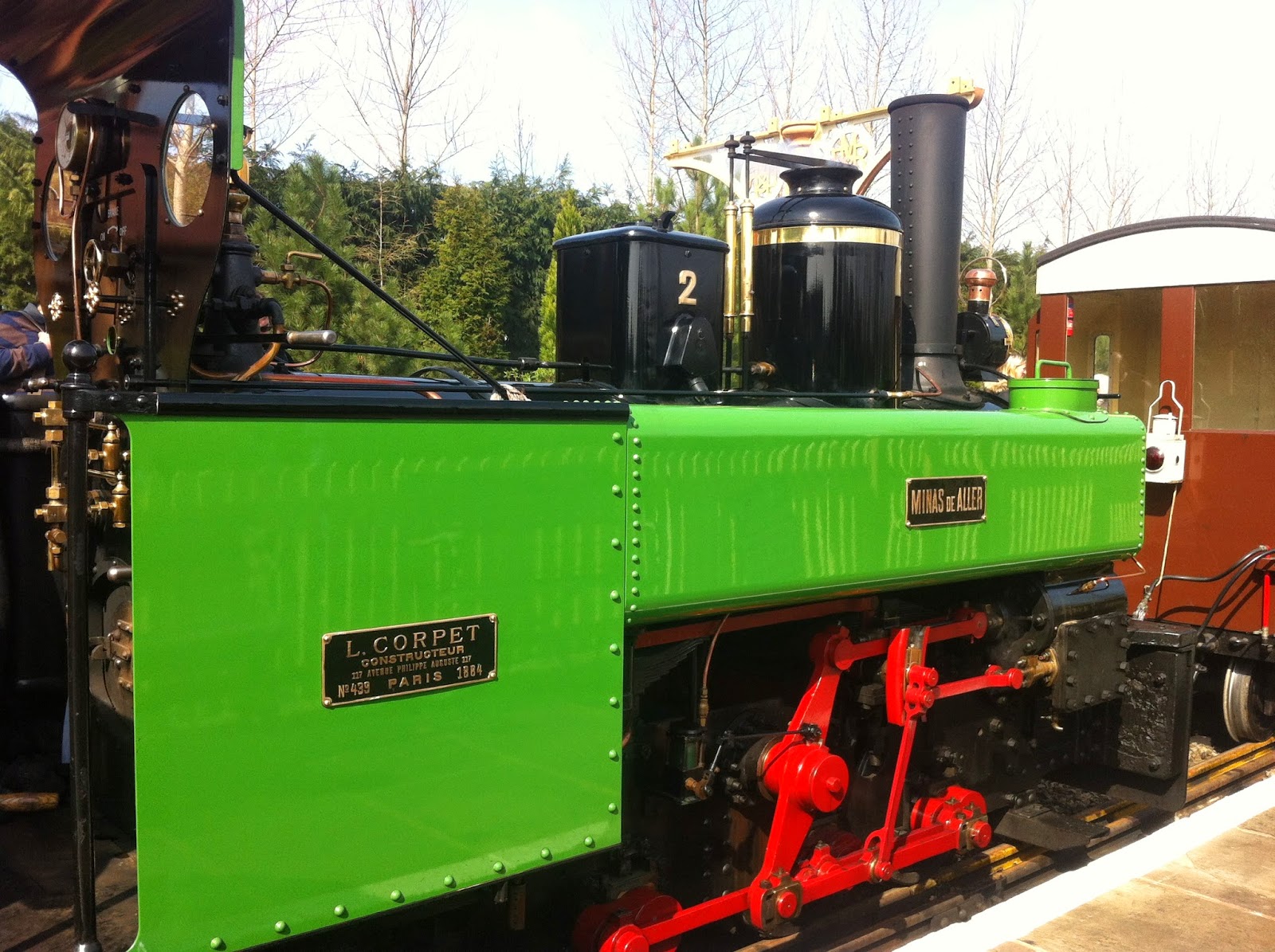
Driver John arrived at around 6:30 and began oiling up the Corpet as I continued to tend to the fire and finish off the final cleaning jobs, such as the brass-work. The Corpet carries the unusual Brown valve gear; a method of actuation which utilises rocker-arms in order to transfer the indirect-drive from the piston rods to the leading cranks. The engine is also outside-framed, making everything easy to get at. Though it looks complex, the arrangement seems to work very well and the Corpet is a proven, elderly machine. Built in 1884 by Corpet-Louvet of Paris, the engine was rescued from Spain and was "Minas de Aller" No2. Minas de Aller is Spanish for Aller Mines and I believe the engine worked in the Aller area: a strong coal mining location. This engine: No439: was one of five of this type based at Minas de Aller and worked in service until the 1960s. She was preserved in Spain initially but arrived at Statfold in a dilapidated state after Mr Lee bought her in 2010. After a thorough rebuild to sparkling, original condition the engine steamed again in May 2012. We certainly had no trouble with her this morning, she steamed up easily behind the Hudswell Clarke 'GP39'...
An unusual factor with the Corpet is the lack of any kind of dampers. Therefore, once you've lit a strong fire, the primary air flow is considerable and uncontrollable. This is not a Statfold modification - I don't think it ever had a damper by the looks of it. This, for the Fireman, means that No439 should be treated carefully in terms of coal consumption when full steam is not required for a while! She was lit from cold at 6am this morning and by around 8:00am she already had around 40psi on the clock. I can't even say there was a big fire in the box' - there wasn't. I guess its just the level of draft that's being drawn all the time, even without the blower. She steamed up beautifully and the fire was soon left to burn through, leaving just a very light covering on the grate in order to keep the loco nice & hot. She sat pretty on shed through the 9am Safety Brief and awaited her turn patiently. Trains began full operation at about 9:40am, once everything had got safely into position. As we were blocked in by other locomotives, we were the second-last to leave shed, about 11am. The loco was then backed down to the new shed-road disc signal to await the road, with the fire now back up to 'running standard'...
With the signal 'off', we steamed down to Statfold Junction past the attractive signalbox. The loco was then given the road & the shunt signal to steam into the bay platform to collect our passenger stock. Once coupled up, away we went! Our first run was in reverse and we collected the token before steaming out into the fields. The engine chugged along nicely with the fairly light 2-coach train and we exchanged tokens at Oak Tree before steaming down the bank. The loco then ran easily along to the Baloon Loop, which we traversed before heading back out onto the main. After a good run back up the line, we were soon sat watching the resting Corpet from the comfort of the station bench in the warm sunshine...
Once we had been 'shunt released', it was time to head back on shed. John then uttered the infamous phrase: "fetch coffee lad"...
At about 1pm it was our turn again and away we went, back down to the station...
For this trip we would be running forwards and with the heavier passenger train to boot. With a good fire in the box, the Corpet blew-off most of the way! Once she'd got the weight moving the needle just crept up until the Salter safety valves lifted. The trouble with Salter's is that now & again once they've lifted they don't shut straight away. For example, the Corpet runs at 150psi full pressure, but the Salter's didn't knock off until around 125psi! Sometimes if you're chugging along at a good pace the vibration can shut Salter's bang on time but if you're on shed or rolling along slowly then they stay open for all to see! One of the SBR's roving photographers: Jeff Cogan: was out in the fields today and captured this fine little shot of the Corpet chugging happily along with the heavy passenger train...
"Corpet In Full Steam" - J.Cogan
After an enjoyable second run, we were back on shed again and it was time to put some more water into the boiler...
"Injecting Water" - K.Eyre
I took a quick photograph of the basic cab controls early this morning, before the brasses were cleaned. The attractive pressure gauge is situated at the top, with the steam brake visible beneath it. Below the steam brake valve, left & right, are the two injector steam valves. The next row of valves is the sanding lever (left) and the blower (right). Finally we have one gauge glass and, in the event of an emergency, two test cocks. The large screw reverser can be seen on the right and the handbrake is on the left. The regulator is on the manifold outside the cab on the right hand side, just out of view. All in all a primitive layout but the age of the locomotive (130 years!) should be considered...
We had one more bunker-first public round trip before returning to shed again. The engine was later utilised on two shunt-release duties and also an ECS run to Oak Tree at around 5pm. Here the engine is waiting for the disc-signal to change into the 'off' position on the Oak Tree approach. I drove the engine down from Statfold and, despite a heavy regulator, she is a pleasure!...
With the main rake of coaches put away, the Corpet joined the rest of the engines for the cavalcade and 'big whistle'. We then returned to the shed. I must thank Ken Eyre and Jeff Cogan for sending in images for this post. Here's one from Ken in the name of vanity...
"Fireman Sam on No439" - K.Eyre
Following the cavalcade we returned to the shed and disposed of the Corpet, along with the rest of the engines. It had been a most enjoyable day and I must thank the owners & staff of the railway for inviting us along to crew once again, and for making us so welcome...it was a grand day out! Finally, I will leave you with a few shots that Mr Hanks sent me of the other engines in operation...
"Eddie and Dan-Dan Aboard GP39 at Oak Tree"
"Peckett 'Harrogate', Hunslet 'Trangkil No4' and Bagnall 'Isibutu' On Shed"
"The New Engine, ex-Fiji Hudswell Clarke 0-6-0 Tender"
"Jack Lane" in the Garden
For a video of the events of the day there is a good one on Youtube here. Thank you very much for reading folks and I hope you enjoyed this post. Cheers - Sam...


Saturday, 29 March 2014

Statfold Prep Day...

Hi guys. Today I went to Statfold again to help with the preparations for tomorrow's forthcoming Open Day. Upon my arrival at Midday two engines were already in steam: the big blue Jung Mallet and the large Fowler 0-4-2 "Saccharine". Both engines stood on shed, joined by Hudswell GP39, the Corpet, "Trangkil" and the massive new Hudswell Clarke 0-6-0 tender engine. Inside the shed, "Sybil Mary" was also in sight. The first task was to get the big Hudswell onto the 'big engine railway'. This involved taking her down the line using the 2ft 6" gauge Hunslet diesel, known as "Badger". I rode aboard the Hudswell, riding the handbrake. This is a brand new restoration and, as the engine arrived in a horrific state from Fiji, it is mostly a brand new loco too. Her bogie tender rode like a coach as we continued down the line towards Oak Tree, and the overall appearance of the engine was beautiful (see above pic). Once at Oak Tree we stopped and then began shunting coaches. Two 2-coach sets would be required on the 'big engine railway' and so "Badger" and "Saccharine" got to work getting things ready. "Saccharine" would potter back & forth from Statfold Junction with the coaches before returning light engine, whilst myself & Phil continued to get more stock out using "Badger"...
"Fowler 0-4-2T Saccharine at Oak Tree"
"Badger" was then used to push the new Hudswell down to the Baloon Loop where a newly fitted cross-over allows trains from the 'big engine railway' to use the loop too. This is another first for the SBR. As the big engine railway is 2ft only, "Saccharine" was required at the loop to collect the 0-6-0 tender engine as "Badger" cannot travel on that line for obvious reasons! With the new Hudswell on the big railway, the Fowler took her off to "Statfold" whilst myself & Phil followed the pair along the double-track section, heading for Oak Tree. At Oak Tree, with the coaches for the big railway ready and the new Hudswell on the new line, we decided that it was time to begin collecting engines. For those who are reading this post and thinking that we had only been working for a few minutes...we hadn't...we were now at about 2:30pm! Safe shunting really does take time, particularly when moving stock over a 1.75 mile long railway. In the Grain Store at Oak Tree, there is now a beautiful roundhouse. The turntable is surrounded by the wonderful SBR fleet, both steam & diesel. The pride of the fleet: in my eyes anyway: is the Bagnall 4-4-0 "Isibutu". This beautiful green side tank engine is huge on 2ft gauge rails and is one of Bagnall's best. She's just lovely...
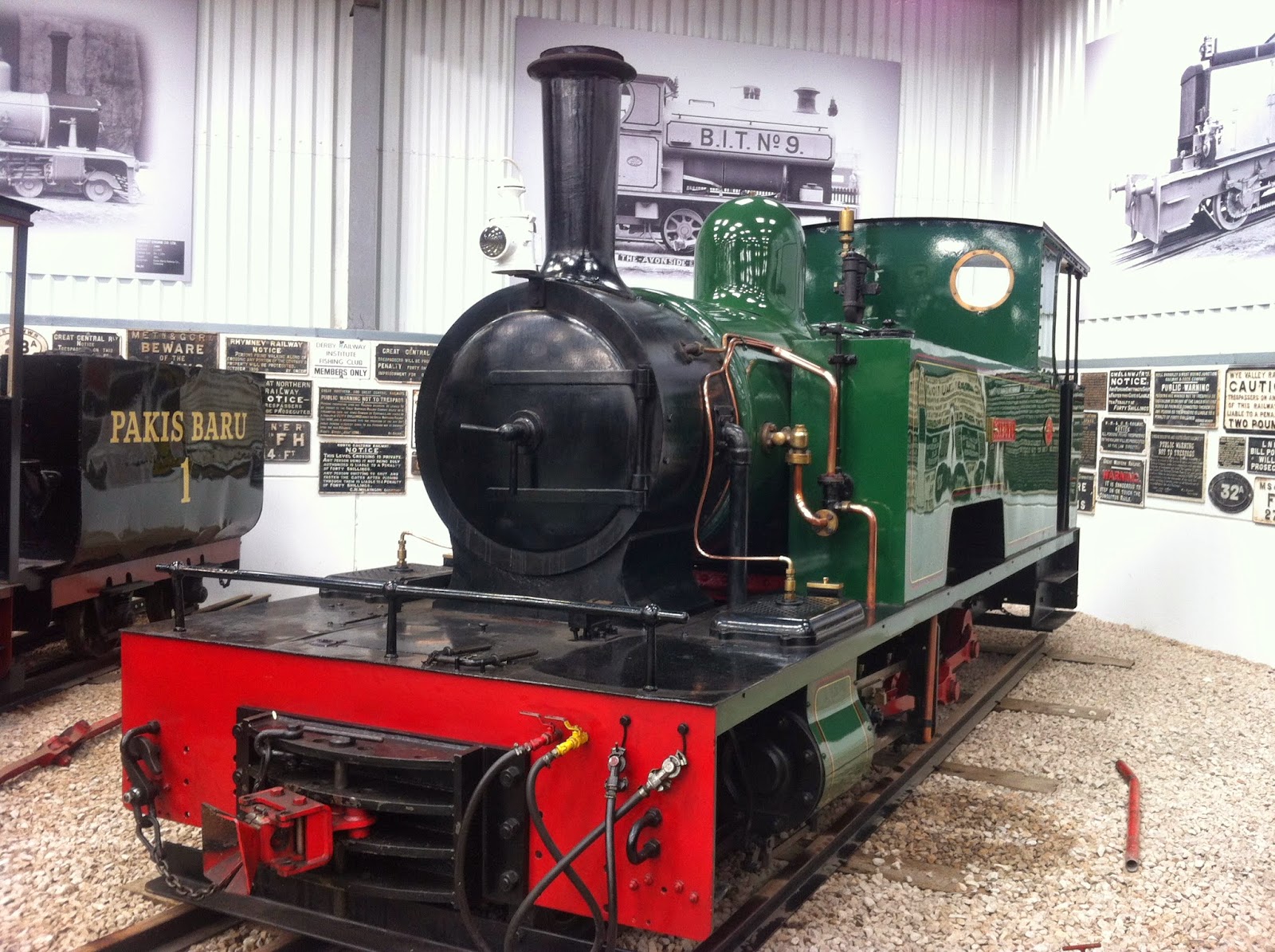
"Bagnall's Best: Isibutu"
Also in the Grain Store were spotted the two Peckett sisters: "Triassic" (formerly of Bala) and "Liassic". Neither of these Peckett's have been restored yet but maybe one day, ay. They are very attractive little engines...
"Peckett Pair: Triassic & Liassic"
Three of the 2ft 6" engines would not be taking part: the Pakis Baru pairing of No1 and the Mallet No5, and the Le Meuse tank. Certainly the former two are serviceable but I'm not sure on the latter. One by one, "Sragi No1", "Sragi No14", "Isibutu" and "Marchlyn" would have to be removed and taken to Statfold running shed. Luckily one engine had already been taken by the Fowler: No19...the 0-4-0 Hudswell, also from Fiji. This was the view in the half-emptied roundhouse at about 3pm...
"Half Empty Roundhouse"
Myself & Phil soon fired up the 'Plymouth' diesel locomotive and began shunting "Isibutu". She would be the next engine to head to Statfold Junction. The loco was turned by hand on the turntable (and she is heavy!) before the 'Plymouth' began with the shoving. I rode on the footplate of the big Bagnall as Phil pushed with the diesel from behind. The diesel certainly roared as the bulk of "Isibutu" was marched up the steep hill to the running shed. Once secured, the 'Plymouth' returned to Oak Tree with Phil & Tom whilst I stayed at Statfold and began cleaning out the Corpet's firebox. With the grate clean and the tubes, water level, fusible and smokebox checked, I laid a light covering of wood across the grate and mixed it with paraffin-soaked rags. A final layer of wood was thrown on top and then left ready for the morning. The strike of a single match will then get the Corpet straight into action at 6am tomorrow! The remainder of the day saw me cleaning the frames and Brown valve gear of our steed for tomorrow: the Corpet: whilst other locomotives slowly arrived on the shed frontage, pushed by the 'Plymouth'. I eventually left at 5:30pm after a tiring afternoon, but I am so looking forward to the morning: first steam of 2014! Best Regards, Sam...

Thursday, 27 March 2014

Achilles Report No51: Smokebox Success at Last!...

Hi there. Regular readers will probably have been keeping up with the steady progress on my locomotive "Achilles". She has been under-going a repaint as well as some repairs for the last three months now, off & on. One of the biggest problems has been the smokebox as the various paint types and manufacturers I've tried so far have not worked. The last post on this blog regarding the loco saw the smokebox in a grey Exhaust Spray paint, designed for high temperature applications. However, the finish was very powdery. As you rubbed your hand across it, even when totally cured, the effect was dusty at best. The paint also had pretty poor coverage for a spray paint and so, enraged as one gets with these constant irritations, the smokebox again found itself under paint stripper. The paint blistered like mad as it was sanded away from whence it came. White spirit was then used to clean away the debry and the remaining paint stripper. What was then revealed was probably the cleanest paint-free finish yet on the smokebox. The new brand of paint: another high-heat type: is Hammerite Matt Black. This stuff was applied yesterday. It has much better coverage, settles much more nicely and dries quickly. It also cures without heating which is a bonus. However, even with a much better finish than had yet been achieved, the paint still reacted with the final remnants of the old paint underneath. After pondering it over a cuppa', I decided that there was only one course of action left. As paint stripper would not even think about touching some of the 27-year old paint, it would have to be lightly chipped off until bare metal was found. So, with a sharp straight edge and lots of care, I set to work. One of the worst areas of reaction was at the foot of the smokebox near the running board...
From the front running board I worked my way up the smokebox face, following the trails of the reaction. Eventually, the smokebox face was fairly clean and was then sanded to become as flat as possible. This was the result...
"The Greatest Struggle Ever!"
With the best possible finish achieved, I tried the paint again with much better success. The paint took to the smokebox face beautifully with no reaction. The only remaining parts of reaction are some very small spots around the snifting valve (probably oil residue) which can easily be chipped off, sanded and repainted. The smokebox will need a final coat anyway. The smokebox door also later received a coat of matt black ready to join its counterpart in the near future. Thank goodness for that...
It was then time to head off the job until this morning when work recommenced. So, today, the job continued with the rubbing down of the chimney ready for spraying. The brass area was heavily masked for protection and then the black liveried areas rubbed down. It will also be sprayed with the Hammerite high-heat so as to match the smokebox when time allows...
Meanwhile, the expansion links and their trunnion bearings have also received attention. The old, worn bearings have been replaced with new ones which we turned from phospher bronze bar. The holes in the centre are completely central but have not been made to drawing, instead they've been made to a good running-fit with the trunnion pins. This is to save replacement of the trunnion pins themselves as they are still in fairly good condition. Obviously any wear on the pins themselves will be taken in account by the new bore in the new bearings, rather than worrying about replacing both. The engine will still work just the same. The new bearings look fairly smart and just need to be pressed into their housings before having the oil-way hole drilled. These simple tasks will take place once the housings have been painted which is being done in due course...
"More New Bearings!"
A close up of one of the expansion links with the new trunnion bearings...
The smokebox paint had fully cured by this morning and is beginning to look rather smart. I just have some more tiny bits of reaction to remove and then she can have her top coat and the door replaced. I will then lag the boiler...
"Smokebox Nearly Done"
The new whistle valve was tried today with the pipework to the whistle itself. Eddie kindly did some modifications to the whistle as it did not fit the manifold when it arrived. The smart-looking valve is a Reeves product, much like the loco, and should look well when fitted to the engine...
The final task of today was to sand and prime the four trunnion bearing housings. The four received their first coat of primer just before I stopped play for today. They'll just need a final coat of primer (or maybe not if it has settled well) and then a coat of matt black. It will then be time to press the bearings in and drill the oil-ways before painting the slide-bar hangers from which these housings also hang. Once those jobs are complete, the expansion links can be refitted ready for action...
"Trunnion Bearings in Primer"
As you can see guys "Achilles" is now marching along quite nicely. Most things are progressing well and I am quite enjoying the various tasks at present. I am so relieved that the smokebox has now settled as that was becoming quite a worry. Best Regards, Sam...