Sunday, 6 March 2016

Tyseley: A Winter's Tale...

Evening all. Today was another very chilly day volunteering over at Tyseley. I arrived at just before 10am to find the shed alive with the unmistakable, ear-splitting sound of rivet caulking. The deafening bangs of the air hammer really carry through the shed! Having changed into my overalls I was off to help with some shunting that was going on outside. The yard of the former 84E requires some strict navigation with so many locomotives on site and thus the completion of a simple A to B manoeuvre can take longer than anticipated. A beautiful sight at the shed doors today was the LMS pacific No6201 "Princess Elizabeth". Built at Crewe in 1933, "Lizzie" is the second of Stanier's powerful 7P Princess Royal class. Having returned to steam in 2015 at Tyseley, the maroon giant was today enjoying some TLC from a few members of her loving owning society. You can just imagine those Crewe men standing there in shock at the lineside as she steamed by, having been used to the much smaller Fowler 2P 4-4-0s and such like. The change must have been staggering.

After the shunting, I found myself helping out with a few small jobs on the ever progressing overhaul of 7029 "Clun Castle". The shed, like any steam shed in this weather, was very chilly today. After such a mild Winter I don't see why March has become so bitter but, allas, that's life. Any all-year-round railway volunteer will know what I mean when I say the feeling didn't return to my toes until I was driving home! Later in the day, after lunch, we did some return shunting to put everything back where it was before shutting down the diesel shunter for the day. I left at around 4:30pm for my drive back through the Birmingham suburbs towards the M42. It had been another very pleasant day at Tyseley Loco Works and I often feel like a kid in a sweet shop with all the kit and interesting projects one can study whilst there! Cheers all, Sam...

Sunday, 28 February 2016

Churnet Valley Railway: Winter Steam Gala...

Hi everyone. The Winter months often herald the arrival of two things: low levels of light and high levels of boredom for the steam enthusiast. Thankfully, on this extremely cold weekend, the Churnet Valley Railway in North Staffordshire was holding its Winter Steam Gala. Myself and JB decided to go along for a visit and so at 8am this morning we were creeping onto the M6, northbound towards Stoke-on-Trent. The Churnet Valley Railway operates heritage trains on a 5.5-mile route between Froghall and Leekbrook Junction, with the main operational base being Cheddleton Station. Formally part of the North Staffordshire Railway's Churnet Valley line, today's CVR began its preservation life in the 1970s. Since then it has gone from strength to strength and now boasts a thriving steam fleet as well as an enthusiastic band of operating volunteers. Froghall Station is just under 70 miles for us and we arrived at around 9:20am. Having purchased our tickets and wandered out onto the freezing platform, a shrill whistle was soon heard on the wind. Sure enough, in rolled the top and tailed first train of the day which would make up the 9:45am trip. Heading up the BR stock for the departure would be S160 2-8-0 No6046...
This huge beast of an engine weighs over 135 tons and was built by Baldwin's. For those not familiar with the USATC S160, it is an American contraption which found itself on British soil during the Second World War. They helped out on Britain's railways during the conflict, hauling heavy freight across the country. In all, 2120 of these engines were built and they worked on railways in Asia, Europe, Africa and South America. 6046 herself is a Churnet Valley resident and is quite striking in her gloss black livery. The engine has recently returned home after having heavy repairs carried out at Tyseley, following an incident last year in which water carryover destroyed the left-hand cylinder. Although American stuff isn't really my thing, it is interesting to note the differences between their engines and ours as well as appreciating the contribution that the S160s made to WWII...
"USATC S160 No6046 Awaits The Right Away"
Whilst I was staring deep in thought at 6046, JB had meandered through the amassed hoards and found us a seat in the steam-heated lead coach. With a loud blast on the 2-8-0s piercing whistle, the train was away. A banking engine would be tailing the S160 as far as Leekbrook; the big Yankee engine continuing alone from there. A trolley service soon passed and we enjoyed a hot cuppa' whilst perusing the timetable...
After a pleasant run along the chilly Churnet Valley, it wasn't long before 6046 rolled into Cheddleton. Though the CVR terminates a mile after Cheddleton at Leekbrook Junction, the track continues across the moorland and the railway is graciously allowed to take advantage of this on certain days. The steeply graded route to Ipstones Loop is as challenging as 1 in 37 in places and 6046, despite her size, would certainly have her work cut out. Having roared through the 531-yard long Leekbrook Tunnel, the engine slowed to a stop so that the tail engine could be uncoupled. With a Right Away from the Guard, the S160 lurched forward and tore at the foot of the bank like a thing possessed. We soon found out why this initial burst of enthusiasm took place as the engine dug into the stiff climb. Even with a fairly easy load of 5-coaches, 6046 was working well; the Driver later reported that 50% cut-off was used to attack the bank. After 20-minutes or so of lovely crisp beats shattering farmhouse windows, the train regrettably reached Ipstones. The S160 duly uncoupled and ran forward in preparation for running round...
There are currently no passenger facilities at Ipstones: not even a platform. The desolate landscape provides only a run-round loop...
"6046 Runs Round at Ipstones Loop"
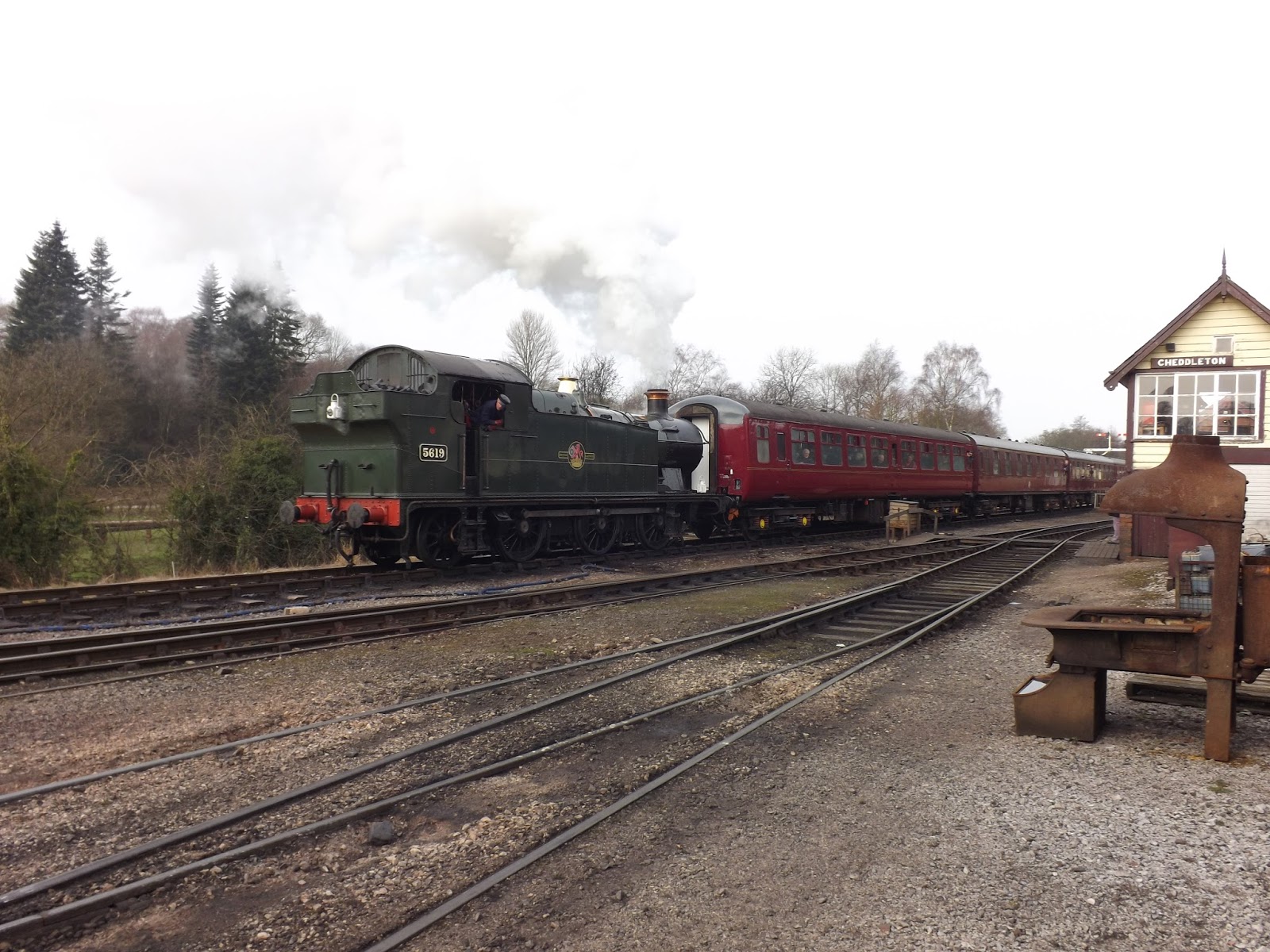
Once the big American engine was back at the head of the train, the slow descent of the route back to Leekbrook Junction began. Due to the severity of the gradient, there are numerous Stop Board's and thus progress is sedate at best. At Leekbrook Junction the train was held so that the Pilot engine (5619) could be coupled on for a double-headed jolly to Cheddleton. Back through the tunnel we went in a cloud of steam and soon enough we found ourselves alighting onto the chilly platform at Cheddleton. A shunting operation then took place so that Great Western Taff Tank No5619 could become the sole train engine, thus releasing 6046. The Taff Tank is spotted below...
"Guest Engine - Taff Tank 0-6-2T No5619 of 1925"
Having replaced the S160 as the train engine, 5619 duly got the stock away on time. This engine is actually owned by the little Telford Steam Railway in Shropshire but is hired out to larger railways due to her capabilities as a powerful and reliable performer...
JB was famished after all the excitement and thus a hot Bacon & Sausage Cob was the only way to go, finished off by a nice cup of coffee of course...
Whilst we enjoyed our cobs during a brief moment of remotely warm sunshine, our former tail engine forged through the platform with a non-stop service for Leekbrook Junction. This engine is TKH 0-6-0T No2944 "Hotspur"...
"Stand Back From The Platform Edge: The Next Train Does Not Stop Here"
Stomachs replenished and toes turning blue, we decided it was time for a wander around the loco shed and prep yard. The TKH soon returned with the Local set and the S160 then took over to provide the power for the next departure to Froghall...
Inside the locomotive shed stood the frames of another S160: No5197. I believe that this engine is owned by the same chap who has 6046 and it too has worked in preservation. It is gradually nearing the end of an extensive overhaul; her boiler lying only feet from her chassis. These American types have huge all-steel boilers which sit atop bar frames for ease of access and maintenance. 5197 sure is coming along and soon enough the Churnet Valley will almost certainly boast a pair of working S160s...
The nearby Carriage & Wagon shed was also open for viewing. Though there was only a wagon in there as a 'work in progress', I felt that the equipment available for the volunteers/staff to carry out their tasks was worth a shot. With the right equipment, you can do great things...
Having found our way over to the prep area, we found the TKH lounging in the sun. A TKH is another foreign engine. In fact, the TKH is a product of Poland and they were very successful shunting engines. Their success resulted in 477 of them being built between 1948 & 1961. I know of at least half a dozen examples that now live in the UK and most of them have worked at one stage or another. The class was never native to Britain in their working days but budding preservationists heard of their talents and began importing them. Little did the Polish engineers who built them know that these chunky tank engines would find themselves one day hauling passenger trains for tourists on Britain's heritage railways. 2944 herself was built in 1952 and is one of a pair based on the railway. Along with 6046, she provides the basis of the Churnet Valley steam fleet...
Along the sidings we found a tell-tale pile of steam locomotive bits. The first clue was a set of wheels - "leader" said John. We then found two intermediates and a crank axle before the penny dropped that I had remembered a forlorn Stanier 8F residing here. We soon discovered the rusting frames of No48173 of June 1943; an 8F that needs a substantial amount of time and money to ever see steam again. Rumour has it 48173 is on the cards once the two other 2-8-0s are complete: lets hope so. Whilst we contemplated a lottery win, a familiar ticking was heard in the distance. The Taff Tank was approaching from Consall and was slowing up for a water stop as I snapped her...
During the water stop, 5619's Leekbrook Pilot was attached - this role being performed by "Hotspur" the TKH. Once coupled up, the unusual pairing pulled forward into the platform...
"A Polish TKH Pilots A Taff Tank"
Having crossed the level crossing to watch the departure, 2944 and 5619 got underway. The TKH was certainly showing signs of strain and primed away into the distance; the drain cocks being opened a few panels down the line...
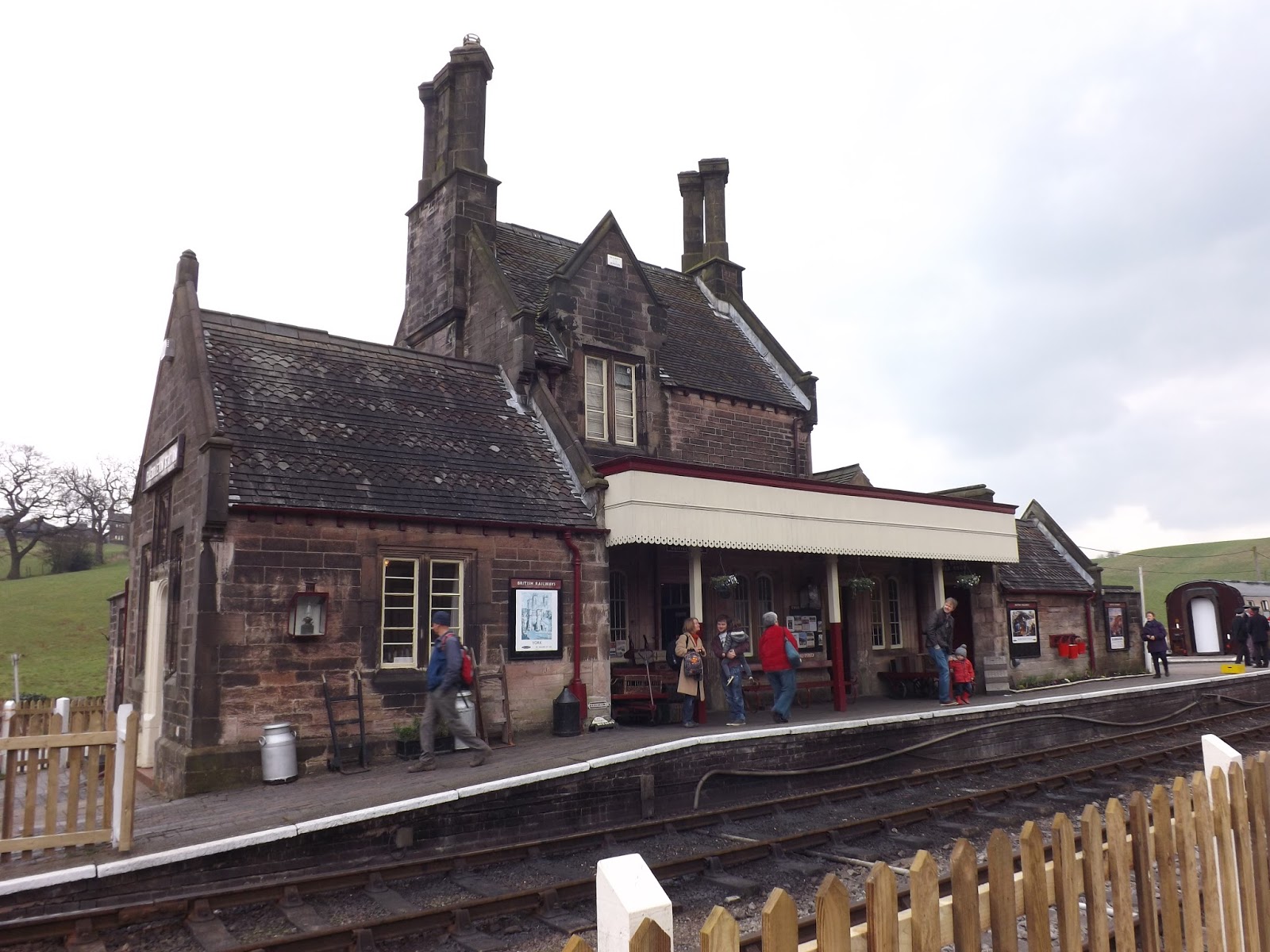
Cheddleton Station is an attractive little country stop. The station opened in September 1849 and is still happily serving passengers today...
With 5619 now on the Ipstones route, 2944 returned to Cheddleton for stabling. She would relieve 6046 on the Local and form the 1:56pm departure. Myself and JB joined the Polish tank on this trip and enjoyed a pleasant ride to Froghall in the warmth of a cosy BSK. Upon arrival at Froghall, 2944 is seen again...
The tank engine was duly uncoupled and ran swiftly around the train in readiness for a prompt departure back to Leekbrook via Consall and Cheddleton. Its nice to see industrials: imported or not: still serving a useful purpose on preserved lines. The Churnet Valley is unusual for me in that, in the future, two S160s and two TKH's (as the line also has No2871 under overhaul) will provide all steam services. It just shows how useful certain designs from other countries can be, whilst also providing a varied and cultured roster for the visitor. The striking green No2944 "Hotspur" is seen here preparing for the off...
With 2944 having stormed off into the cold afternoon air, JB decreed that it was time for another cuppa' in the Tea Room. Having enjoyed a nice brew by the fire in an attempt to get some of the feeling back in my fingers, a thundering rumble heralded the arrival of 6046 again. We decided to stay and watch her depart with the 3:20pm train before heading back to the BMW for some warmth and the run home. Never has one been so forceful with the term "get that bloody heater on!". I must thank JB for his company today as we had a most pleasant day out despite the dark and bitter weather. The Churnet Valley Railway had provided a pleasant and interesting day out amongst a varied selection of loco's. It was of course most pleasant to see the Great Western's No5619 but the quirks of the two foreign engines really did provide something different. Many thanks all, Sam...

Sunday, 14 February 2016

Very Sad News: A Tribute to Ken...

It is with great sadness that I must write that Ken, a good friend and the builder of "Achilles", passed away on Thursday night at the age of 91. Regular readers will know of my involvement with Ken over the years and it was his kindness and generosity that led to me eventually owning his beloved 5" gauge tank engine. Ken built the engine from scratch in the mid-1980s and spent 3 years in his home workshop doing so. The locomotive was completed by 1987 and Ken was in fact running the engine on the day that Coventry City won the FA Cup. I first became involved with Ken and the engine in 2009 and, despite mechanical faults, Ken was determined to keep her going. In 2011, Ken paid me the most generous gift: the ownership of his locomotive...
Since then, Ken continued to be a great help to me as I learnt the various trials and tribulations of steam locomotive ownership and their various needs. He was very supportive and was instrumental in encouraging me to delve further into the hobby. As a former tool-maker, Ken could turn his hand to almost anything engineering-wise and, even if something was readily available off the shelf, would relish the chance to have a go at making the component himself. No engineering obstacle was too great. Particularly in my younger years, his experience and unassuming nature were inspiring. Ken also continued to regularly come to the track when he knew "Achilles" would be out, as seen here in 2012 when Ed is seen on the regulator...
"Achilles, Ed and Ken" - 2012
Throughout the various repairs and overhauls that I've since carried out on "Achilles", Ken was always kept in touch and often gave good advice on things which I wasn't sure of. After the repaint of the engine, Ken came along to be reunited with her in steam in September 2014, the picture below later appearing on the cover of the CMES newsletter...
Outside of railways and model engineering, Ken was a keen musician and learnt the Saxophone and Clarinet during his 80's! There would be many a Steam Up afternoon where Ken would be playing his Sax to the enjoyment of onlookers and passing steam drivers. Also, "Achilles" wasn't the only engine Ken built. He also made a lovely 1.5" Allchin traction engine and a 3" Atkinson steam lorry. His final project was a 3.5" Heilan Lassie. Ken even came along to Shackerstone on one occasion back in 2011, enjoying his first ever footplate ride on a standard gauge locomotive in the form of GWR 3803. I am very sad to be writing this post and I believe that CMES has lost a very committed, kind and experienced member. To me, he was a very kind and generous friend and an individual who's can-do attitude was second to none. He will be greatly missed by all who knew him and I am very sorry to be saying goodbye. Rest in Peace Ken.

Tyseley: A Chilly Day...

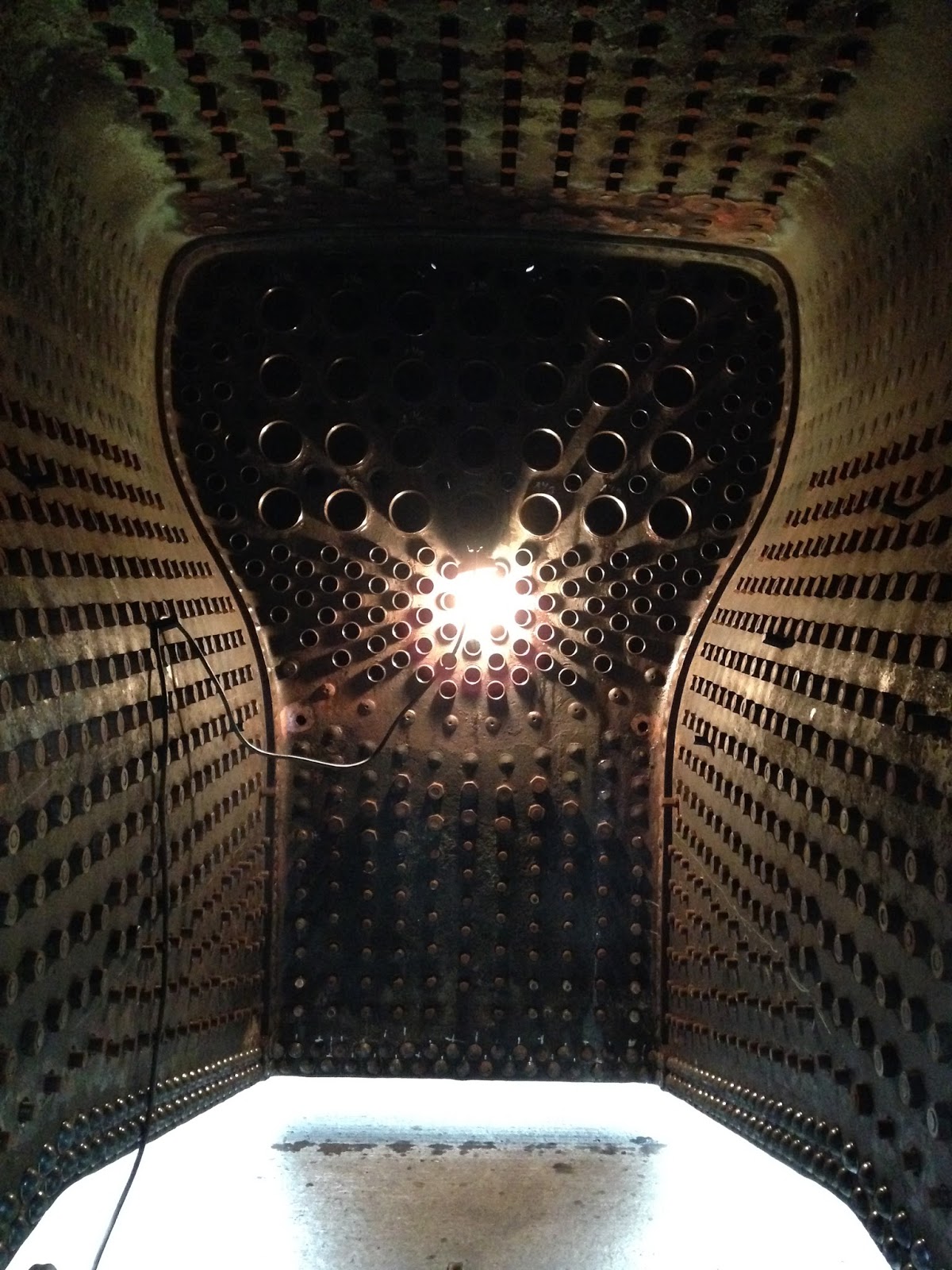
Hi everyone. Today was another most enjoyable day volunteering at the former 84E: Tyseley Locomotive Works. I arrived at around 10am in chilly weather. The Winter is really biting at the moment and creates little more than a distinct longing for Spring. Todays activities again centred around 7029 "Clun Castle"; the 1950-built Swindon 4-6-0. "Clun" is gradually nearing the end of an extensive overhaul and it has been my privilege to help with some of the ongoing tasks in recent weeks. Below, we see an unusual view inside a locomotive firebox: the lead-lamp hanging up on the tube-plate creating an impressive image...
"Through The Firehole Door" - Great Western Castle
As can be seen, the locomotive firebox is made up of several hundred rivets and stays. The small tubes we can see are the Smoke Tubes, whilst the larger tubes are the Flue Tubes which will later surround the superheater elements. One very noticeable missing feature is the brick arch. The arch protects the tubes and flues from incoming waves of cold air which access the firebox through the firehole door. The arch is also inclined so as to divert the hot gases up into the combustion area towards the crown. Naturally the engine will also have a fire-grate and an ashpan when complete. However, it is only with back-to-basics views like the one above that we can appreciate the construction methods involved in steam boilers. All this helping out at Tyseley has proved a fantastic learning curve so far and I am very much enjoying it as there is always something new to get involved with - I should have done this years ago. Best Regards, Sam...

Sunday, 7 February 2016

Tyseley: Another Riveting Day...

Hi all. Today I was on my way over to Birmingham for another day volunteering at Tyseley Loco Works. Its fair to say that the weather was rough - all rain and wind - with plans for it to get even worse as the day wore on. A hardy bunch of volunteers had turned out despite the rainstorm and work began at around 10am. The object of the day was to finish off riveting the foundation ring of 7029. The foundation ring, for those not familiar, is the seal between the inner and outer firebox sheets. Some call it a mud ring, as the various scales which leave the boiled water during evaporation settle in the foundation ring due to it being the lowest point. Having helped with some hot riveting the other week as the 'runner', this week I was playing the part of the 'warmer'. Here are some of the rivets prior to heating...
Wearing all the necessary PPE, three of us began riveting during the mid-morning. The job of the warmer, quite obviously, is to heat the material ready for riveting. Hot riveting is done with the metal in a literally red hot condition so that the hammer and jammer can crush the rivet into the desired shape. In the case of the GWR Castle, the design requires the crushed rivet on the outer firebox sheet to be flatter in size due to limited clearances when the boiler is placed between the frames. Designs do vary, with some engines having what looks like another rivet head almost identical to the 'factory' type crushed onto their end after riveting.

As the warmer, I was in charge of the oxy-propane torch and was warming the many rivets up on the warming table. Naturally, it is HOT work - every part of you seems to start baking! It is however interesting to do as the metal needs to be critical enough to be crushed easily without losing temperature at an alarming rate but also needs to not get so hot that it melts. There is a very fine line between good and gone let me tell you! With the rivet hot and ready to go, the rivet is taken with tongs and quickly handed under the foundation ring and fed into the required hole from the inside of the firebox. The head therefore stays on the inside, as per design. A jammer is then placed on the head to secure it whilst the hammer on the other side uses compressed air to crush the rivet with the cylinder inside bashing the bullet against the forming tool which thus repeatedly bangs the rivet into shape. It takes more skill than I've described to crush rivets but its hard to write what I mean! A row of crushed rivets is seen below, against the outer firebox sheet...

We went on riveting for the rest of the day, eventually finishing 7029's foundation ring completely. Its amazing just how many rivets go into a GWR Castle's foundation ring alone, let alone the rest of the firebox and boiler. Due to the massive pressures attempting to force their way out at every inch of the boilers plate-work, the countless fixings (stays and rivets) are necessary! Below is another video that is available on YouTube. It shows hot riveting taking place on the foundation ring of another Great Western engine - a 56XX type Taff Tank 0-6-2. The variation between designs can be spotted as you will notice that the rivet is crushed into a larger head on the upside-down firebox of the 56XX, unlike the Castle where a flatter outer head is required...
Hot riveting is very hard, loud and extremely noisy work but it is interesting to see the process in action. It is also interesting to appreciate the speed of the process. From the warming table to fully crushed takes only a matter of seconds as the room temperature and of course the chilly plate-work of the boiler will steal the heat away very quickly, making crushing almost ineffective. We finished at just after 5pm, with the persistant rain still beating down hard on the shed roof of 84E's fairly recent extension. All in all it was another very enjoyable and rewarding day volunteering at Tyseley and 7029 can now enjoy her fully riveted foundation ring. The 1950-built Castle is progressing - one more step closer to steam. Best Regards, Sam...

Sunday, 31 January 2016

Tyseley: Oil, Tubes and Flues...

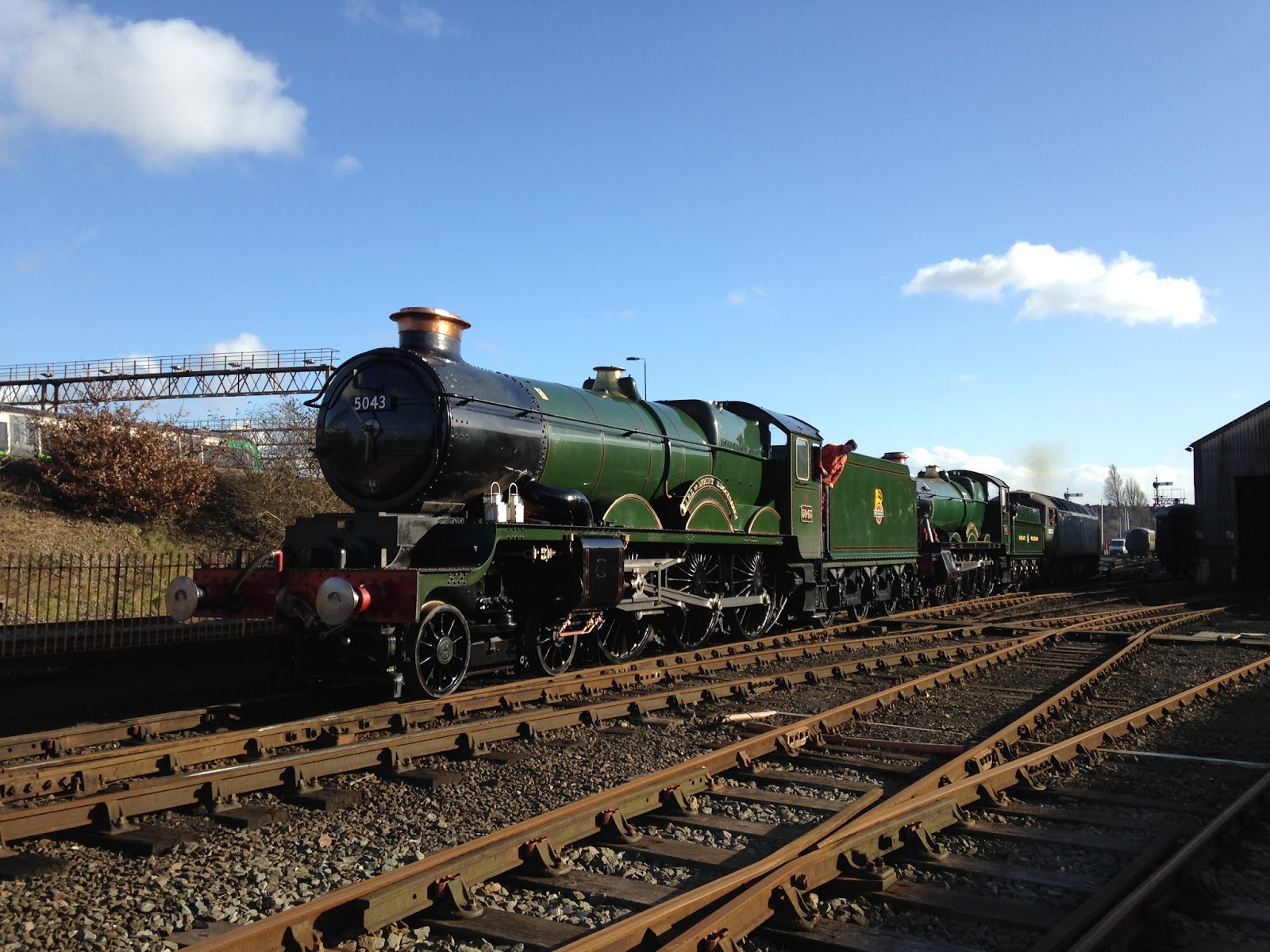
Hi all. Today was another volunteer Shed Day at Tyseley Loco Works. I arrived at just before 10am and immediately sought the warm sanctuary of the cabin where some of the other volunteers were already gathered. Work during the morning was simply to move some of the loco's around in an effort to keep them well oiled, rather than letting them root to the spot during their Winter rest period. The BR Green Class 47 was therefore soon roaring into life, coughing smoke up into the blue skies. Having warmed up and made air, the 47' moved forward and coupled to the stalwart pair of Great Western 4-6-0s: 5043 and 4965. Having been well oiled, the Western pair were moved outside into the chilly morning air for a push-pull working up and down the yard...
With the locomotives having blown away a few cobwebs and been returned to the cover of the shed, the 47' was shut-down. After Lunch, work continued on the boiler of 7029 "Clun Castle". Today we were starting to slide in the Flue tubes.

A super-heated steam boiler contains two types of tubes: Smoke Tubes and Flue Tubes. The smoke tubes are the numerous small tubes, there to allow heat drawn from the firebox to boil the water in the barrel efficiently before the gases then leave the smokebox end for ejection up the chimney. The Flue Tubes are much larger as they contain the superheater elements. The elements are basically pipe-work which provides a longer steam circuit for steam leaving the boiler at the regulator. The steam enters the superheater elements where it is taken back through the boiler within the elements which are fitted inside the Flue Tubes. Eventually the steam enters the steam chest for admission via the valves into the cylinders. This process raises the temperature of the steam further, thus drying it, and providing superheat. (A non super-heated engine is known as a saturated type). 7029's boiler is typical of a GWR main line 4-6-0 in terms of general construction but there were variations between the 171 sisters of the Castle Class. "Clun" for example carries the final development of the boiler, with 28 Flue Tubes spread over 4 rows, the larger superheater being provided for the double-chimney engines. 5043 also has this arrangement, though I believe that the other 6 preserved Castle's are all the single chimney type with lower superheating capacity. The flues are very heavy and are threaded into the firebox tubeplate. Therefore, when fitting, lugs are tagged onto the smokebox end and the flue is then fed gently into its chosen hole in the tubeplate. Once threaded in, an adapted fitting is used with a large rachet to drive the flue into the firebox tubeplate on its thread. Once firmly in place, attentions turn to fitting the next flue. Naturally, once all the flues are in place, they will be expanded and beaded where necessary. The smoke tubes will also be expanded and beaded.


Its very interesting helping with boiler work as it provides an astonishing learning exercise into the design and construction of steam locomotives as a whole. All the best, Sam...

Saturday, 30 January 2016

Great Central Winter Gala: A U-Boat Off Loughborough...

Evening all. Today was the annual pilgrimage to the main event of the out of season calendar: the GCR's Winter Steam Gala. Due to the amassed hoards of bobble-hatted enthusiasts that normally descend upon the railway during the weekend, we felt that the Friday would be a better choice this year. Though a slightly quieter timetable: five loco's instead of eight: it would also be a quieter day passenger-wise so all the better for us. I left work at 11am as usual for a Friday day-shift before having a blustery run over to Quorn station. Eddie & John had arrived a little earlier and were on route back towards me behind one of the visiting engines. For me, this one was the one to tick-off: U Class No31806. The engine's 12:22pm departure was drawing near and soon enough she was spotted from a distance chugging happily along the double-track away from Woodthorpe...
31806 has shut-off steam on the approach to Quorn and coasts easily towards the road bridge for the station stop...
I boarded the rearmost coach where I found Eddie and John casually chatting about the merits of various steam locomotive designs. Discussion then turned to the chunky engine at the front: the U Class. What is now No31806 entered service in 1926 as a K-Class 2-6-4 Tank. The K-Class became a scapegoat for a serious accident that occurred in 1927, in which 13 people lost their lives. Following that all 20 K-Class engines were immediately withdrawn before being rebuilt as 2-6-0 Mogul tender engines under the U Class design. 31806 was rebuilt as a U in 1928 and is the only survivor of the K-Class rebuilds. The U Class eventually numbered 50 examples and were classified as 4P, with 6ft driving wheels and a 200psi boiler. I like these engines; there is really something about them. Anyway, the U Class (known affectionately as a U-Boat) took us easily up to Leicester North where she was captured running round - the Fireman is just pulling the points to allow the Mogul to set-back into the loop...
Having not lunched yet due to heading straight to the GCR, I decided to board the Gresley Buffet Car for a Bacon Cob and a nice cup of tea. The welcome surroundings of 24278, built at York in 1937, were very pleasant on this chilly Winter afternoon. I must admit, it was very pleasing "Taking Tea In The Teak", as I later described to Eddie, as you don't see many Teak's around in comparison to other coaching stock...
"A Rather Civilised Journey"
The Mogul steamed tender-first to Rothley where we alighted to watch her departure. I don't know if they were having trouble with it, but the Fireman was just refilling the hydrostatic lubricator with cylinder oil...
31806 barked out of Rothley leaving her voice on the breeze. I suppose we must have the obligatory ridiculous picture of local forgetter of the alarm clock 'Eddie the Late' who seems to be doing his best Flamingo impression when snapped...
Eddie and John went off to have a look at the pretty G-Scale Garden Railway whilst I chatted to a couple who bring their engines to my miniature steam rallies - I always find someone I know! Just then, clanking in from Loughborough, came 34053 "Sir Keith Park". She was the other visitor, attending from the Severn Valley Railway...
A Local set soon arrived behind the BR Black Eight-Freight, clanking non-stop through the station with snifters rattling. Having halted under the protection of the Outer Home, the 8F was relieved by recently restored Modified Hall No6990 "Witherslack Hall". We duly boarded the Hall's train and enjoyed a pleasant run back to Loughborough in very comfortable seats. Once there, I was treated once again to the sight of No34053. An unusual typo in the GC's Gala Guide billed the Pacific as being a two-cylinder machine: Mr Bulleid would not be amused...
A lovely thing about the GCR is the shed area, as it just has the atmosphere of a working steam shed. Wandering cautiously down the ash pathway, I came towards the beautiful Black Five No45305. The remaining engines for the weekend portion of the gala were dotted around with warming fires already lit. The 5MT was sitting quietly, crackling away to herself with just a light plume of smoke drifting half-heartedly skyward...
On the shed front stood the smallest and largest members of the GCR Steam Fleet: Standard Shunt ('Jinty') No47406 and BR Standard Class 9F No92214. Due to her livery, double chimney and copper cap, 92214 is masquerading as the very last steam engine built for BR - No92220 "Evening Star", now preserved at the NRM...
"David & Goliath" - 47406 and the 9F"
The massive bulk of the Nine Freight was soon moved forward to begin shunting. 777 "Sir Lamiel" was smoking up a storm in the shed and so I'm guessing the move was to eventually result in getting the King Arthur outside. The 9F is well kept...
Having wandered around the shed for a spell in the stiff breeze, soaking up the atmosphere of soot, oil and grime on a damp Friday afternoon, I headed off back towards the platforms. Having seen a good few more people I know (from various railways - including Shack!) I boarded the 3:15pm train behind 31806. The boarding of this train involved bumping into two more people I know - I seem to spend half my days out just nattering to people I know: its such a small world! I alighted from the U-Boat's train at Quorn and was immediately met with the sight of immaculate Modified Hall No6990, which was tailing the Local train hauled by the Mickey Mouse (Ivatt 2)...
"Recently Restored 6990 'Witherslack Hall' Tailing The Local"
31806 was just about to make an audible departure and is captured beginning to pull away. I like this engine and am very glad that I've ticked her off the list. The U-Boat's were clearly a useful and powerful tool which leads me to question their 3F capacity. I guess the 3F is due to her big legs as the 4P is a little more encouraging. Another nice old gal' this is...
Having watched in awe as Driver Tom Tighe took the U away in fine form, it wasn't long before she was pounding away into the distance. I decided to wait around to see the next train pass through - this just happened to be the 8F on the Windcutter Minerals...
Once the 8F had clanked through (it looked a picture) I began my short walk back to the car. The welcome heat upon my commencement of the journey home was something I was very much looking forward to! As I got to my car I saw the Bullied pass by one last time, thinking about how Southern men must have felt to be presented with such a spaceship of an engine after life on classes such as the U's, the Nelson's and the Arthur's. Anyway, it had been another very pleasant day and another worthwhile visit to the GCR's Winter Steam Gala. I've been coming to this do for years and its always been very good, not to mention it being a welcome settler for my steam craving during the winter months! Cheers all, and thanks to Ed and John for their company. Good Evening...

Tuesday, 26 January 2016

Statfold Barn Railway Miniature Steam Rally PLUG...

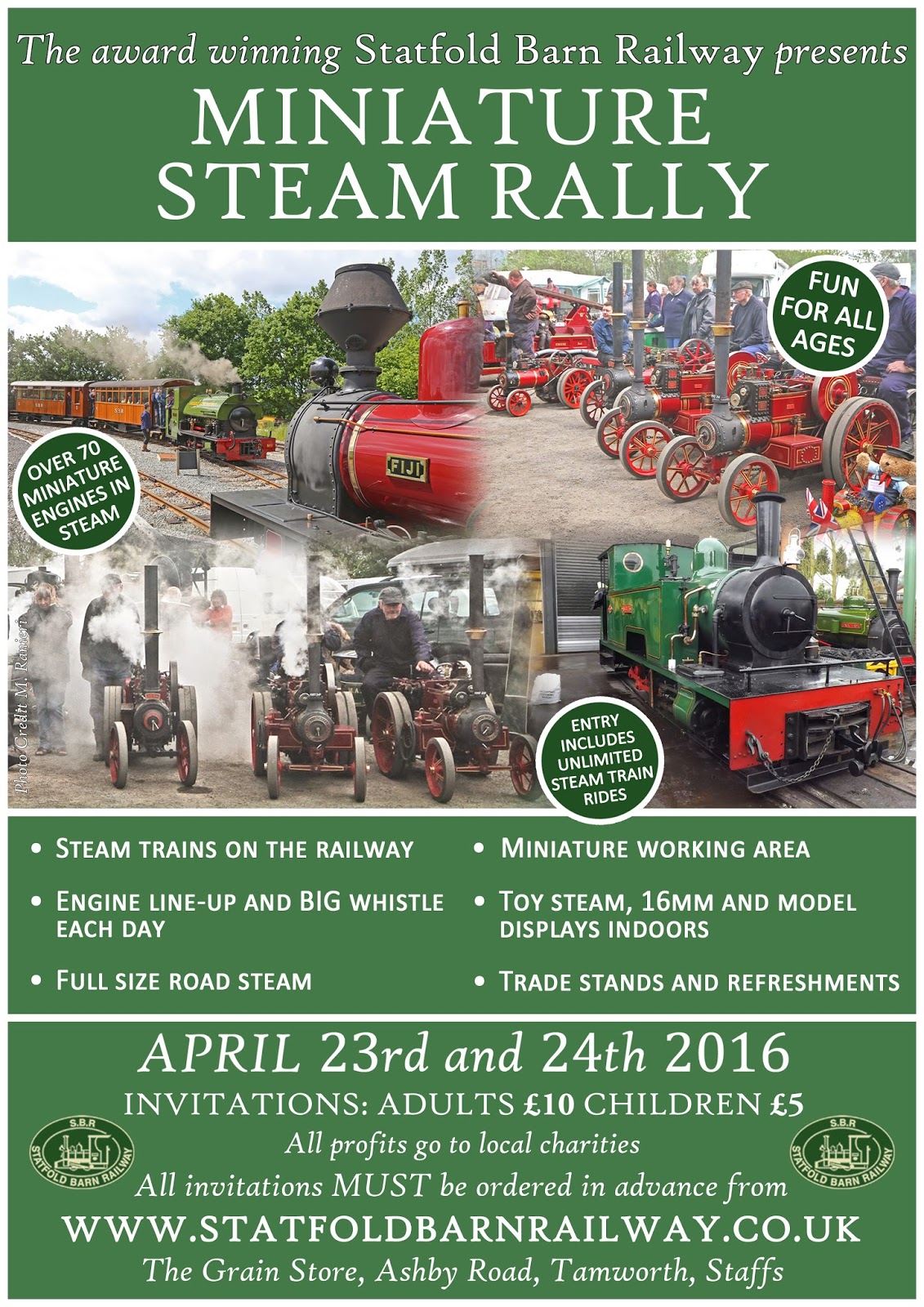
The annual plug is here guys, albeit for a change of venue. Join us at the award winning Statfold Barn Railway over April 23rd/24th for the line's first family-friendly event. This impressive but usually private narrow gauge railway is holding its first Miniature Steam Rally over this Spring weekend and will be welcoming over 70 miniature engines in 1.5" - 6" scales. The engines range from traction engines to steam lorries and of course steam rollers, representing most of the well known manufacturers of bygone age road steam. The engines will be milling around the site whilst a select few members from the Statfold Barn steam fleet offer unlimited travel on the narrow gauge railway between Statfold Junction and New Road. The locomotives in action are planned to include these two: Peckett "Harrogate" and Hudswell Clarke "Fiji": amongst others from the award winning fleet...
"Two Wonderful SBR Engines" (M.Ranieri)
Regular readers will remember that I created and organised the Market Bosworth Miniature Traction Engine Weekend that had its first show in 2013. I went on to do three of them, with the final one last year welcoming over 50 wonderful examples of miniature road steam from across the country. The venue of my organisation activities changing to Statfold Barn is a great step forward I feel and indeed the level of interest from exhibitors has been over whelming. The prospect of welcoming over 70 engines to the event is fantastic. This was some of the 50+ we brought to MB last year...
"The Last MB MTEW - 2015" (M.Ranieri)
As well as the miniatures on display we will have the following attractions:
  • Three Full Size Road Steamers
  • Miniature Working Area - 4" Sawing, 2" Cultivating and Corn Milling too
  • At Least Four SBR Steam Engines in Service
  • Photo Opportunities with the Locomotives, Traction Engines and Turntable
  • Engine Line-Up and BIG Whistle Up at 2pm Each Day
  • Peters Railway Book Stand with Author Christopher Vine
  • Indoor Displays of Toy Steam, Meccano & 16mm Live Steam Layouts
  • Trade Stands of 00 Gauge and Model Engineering
  • And Much More!
As well as seeing the engines in action you'll be able to ride on the Statfold Barn Railway as well as chat to the owners of these marvellous machines. If you're thinking of building or buying an engine then I guarantee you will enjoy this event as we will be showcasing most scales, designs and models...
"Harrogate With The Author Driving - June 2015" (G.Cryer)
Invitations to attend this event are available HERE on the SBR website and for these we request a donation of £10 per Adult and £5 per Under 14, with all profits going to deserving local charities. As I say this is the FIRST Statfold Barn event to welcome Under 14s so please come along for a steam-filled family day out. (Please note that we cannot accept entry on the gate on the day without a valid pre-booked invitation). I look forward to seeing some of you at our new venture and I hope you will enjoy it - its going to be a whopper! We'd better get some polish on these engines...
We hope you can join us for a day out with steam, celebrating miniature representations of those engines of a bygone age when steam ruled the roads, the fields and the rails. Many Thanks All, Sam...

Saturday, 23 January 2016

Shackerstone Memories: Prepping A Locomotive Recollections...

Hi everyone. This post is all new as I don't usually do posts like this. Most of the posts on this blog relate to the telling of a days events, generally following progress from the start of the day til' the end. In this post, I'm going to talk a little more about the mornings on shed with a full size locomotive; poetic though some of it may be. The information will date from as early as 2008 but I'm just trying to give that little insight into the day to day tasks that were involved in doing the job whist involved at Shackerstone and the mixture of different characters encountered. I hope you'll enjoy it...

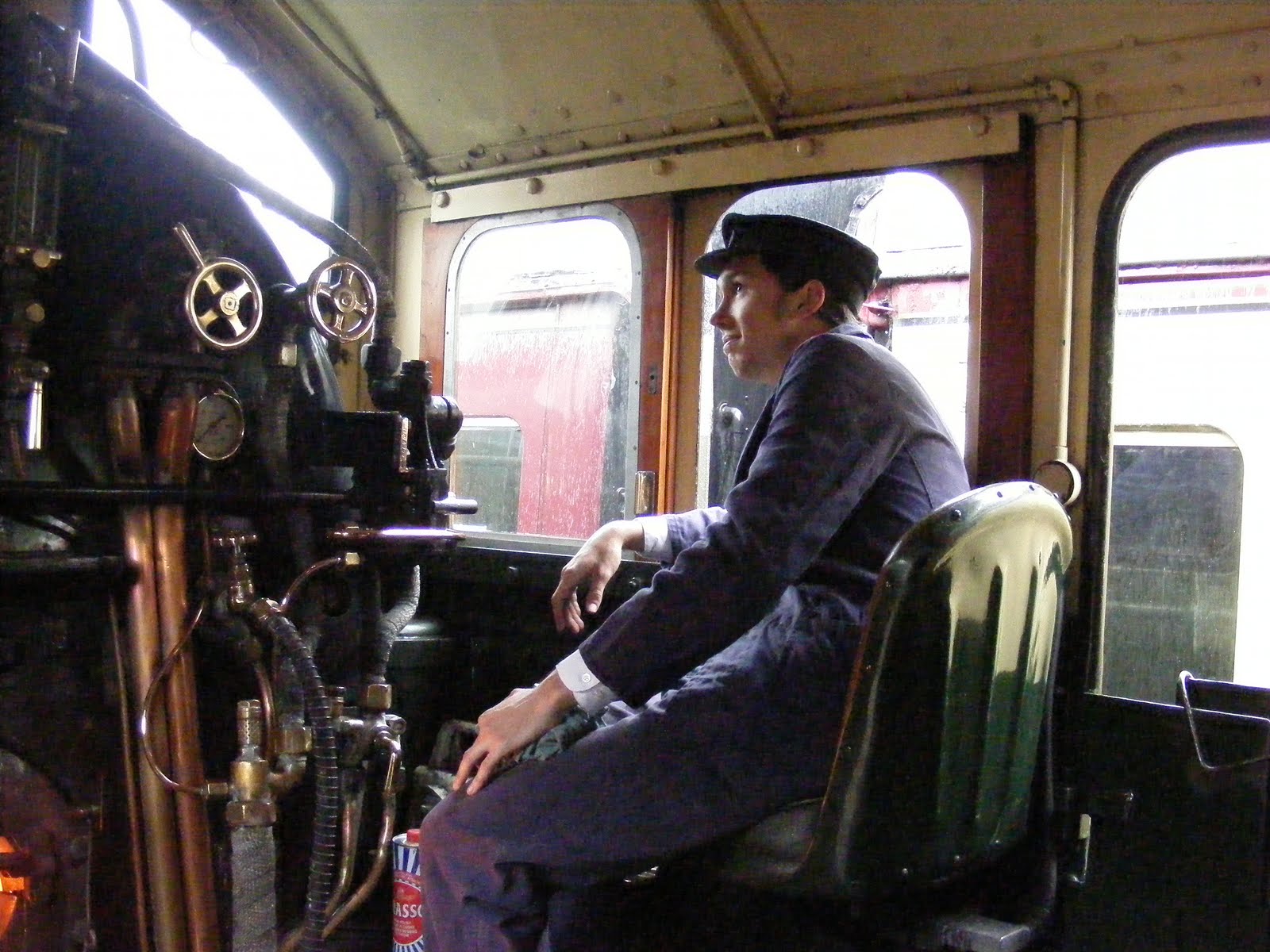
To understand the mind-set of someone awoken from their slumbers before 5 o'clock in the morning, picture yourself leaving home whilst the rest of the world peacefully sleeps. Leaving home early is a trait that is inevitable with steam locomotives, particularly the big ones. In order to get up a good head of steam and carry out all of the necessary preparation tasks without making yourself late for the engines first duty, punctuality is key. I used to like to get in 30 minutes or so earlier than necessary, giving me that little bit of spare time that one would give all the money in the world for later on in the day. Arriving at Shackerstone when even the birds had barely risen, the first task was to grease up your hands opening the gates and then trundle the short distance to the station car park. The usual juggling act of carrying all of your kit along the dimly lit M6 widening of the ash pathway was then endured before falling gracefully through the door of the engine shed...

"The NRM T9 Steams Up" (April 2013)
Once inside, if all was well, the locomotive would be good & hot and a blanket of heat would engulf its vicinity. The false sense of security that heat gave to a yawning Fireman was taken from me in a flash one day when that heat just wasn't there! It turned out that the warming fire had not been as meaty as perhaps the locomotive required and, though she was good and hot, the fire hadn't created any steam. Recollection fails me on what engine that was but one of them had me sweating long before everyone's favourite Driver "I'm not a morning person" Eddie the Late turned in. Finding a locomotive in not quite the condition you expected seems to create two great phenomenons: 1) an unusual speed to every duty you perform and 2) the speeding up of time, reducing your once valuable hours to mere minutes in what feels like the blink of an eye. Mornings like that soon have you running for all the wood you can find which, in Shack shed, was minimal at best and often made a half-empty box of Swan Vesta's look like severe deforestation. By the time the fire was lit you were praying it would go, spilling every accelerant you could find on it to try and draw out some heat. Every Fireman, despite what they may say, has stood there looking at a pressure gauge before trying the ever reassuring..."its broken! This gauge is broken!". No, allas, it isn't broken, its just your luck! Another good one for those moments is the light hearted tap - as if a mere tap will suddenly generate a hundred pounds of steam - I've done it myself countless times when all hope seems lost! The engine would of course eventually spring into life and we were rarely late off shed, but these situations did create experience for the lowly Fireman and ones recollections of such situations were better than an alarm clock on cold winter mornings for getting you up on time! Theres nothing worse than the Driver looking across to you and saying "better get that needle up Sunshine" (a Batesy quote from 2012-ish)...
"A Good Warming Fire in 3803" (2014)
As a trainee, between 2008 and 2011, arrival at the shed was different each time. In your heart you wanted just to get on and have a go but it was nice, in a way, not to have the responsibility for the engine at the time. During the wonderful "Mayflower" years, I remember the late Gerald Boden always having classical music playing loudly whilst 1306 gracefully raised steam, a tradition later adopted by Pockets before the unfortunate demise of the radio. Gerald's ear for classical seemed to give more atmosphere to an engine warming through on a cold winter's morning, relaxing the crew effortlessly. In later years, you could tell who was on by the bark of the radio as some of the lads stuck on Kerrang whilst Jason was unmistakable in his choice of the well known Ukulele player George Formby! "Oh Mr Wu" was at one time a shed ballad whilst the engine came around. Anyway, I've gone off track (as it were). Back as a Fireman, the first job would be to check the water level in the boiler and of course have a look in the firebox, checking the stays, plugs and the general condition of what was left, if anything, on the grate. I remember happy mornings sat inside the roasting firebox of Great Western 2884 No3803, chipping away at the fire bars to free off clinker from that pesky open-cast Welsh Coal that burnt a treat but melted half the grate it sat on. At 6:00 in the morning, the last thing you want to do is sweat your weight in a firebox, chisel in hand and covered in ash. But, we do it and we'll continue to do it for the love of our steam engines - and quite right too...
"A Gloomy Grate Whilst Rocked in 3803" (2012)
Ashing out is perhaps one of a steam locomotives most wonderful tasks. Some engines, such as 3803 and the Black Five, included a rocking ashpan which was fabulous once the ash was nicely wet (stops the dust). On other engines, like the Standard Shunt's (Fowler 3F - 'Jinty'), you have to do it yourself with a rake and a hose which is, of course, no problem. What is a problem however are the little things that happen. A favourite of mine when ashing out, as was always the case at Shack whilst learning to do it as a youngster, was the fabled 'sleeve trick'. When ashing out, you wash the ash as much as possible, feeding the hose in as much as you can without melting the end. Then its time to rake the ash out but the water used to miraculously separate from the ash, join the cold metal of the rake and then travel neatly down its length and land perfectly in your sleeve. I've lost count of the amount of times that water from the ashpan has landed itself with expert precision in the sleeve of my overalls! The trouble is it runs down your arm too and you end up with a wet back...but HOW?...the laws of physics amaze me! If the water on the rake didn't get you then the old fashioned 'boot in a lake' would. Whilst you're raking your ash, the hose would be gently filling the pit and, once you'd got two piles of ash an accidental boot-deep splash into the created reservoir was completely inevitable. Many a wet boot has been enjoyed that way! Finally of course, there was the ash that could get you. I remember once Gerald was under "Mayflower" (which had a hopper pan but to keep the engine clean the ash would be washed thoroughly from underneath) and called for a "little bit more" and a "tiny bit more". This process went on for about 30 seconds before the final "little bit more" provided a satanic avalanche of filthy ash, engulfing not only the B1 but also the shed in a cloud of thick dust. Gerald came out looking like he'd spent a week at the coal face! Ashing out is perhaps one of those tasks that we all treat with that little bit of respect...
"The Then Trainee Me On 1306" (2009)
Another recollection from the countless was the amazing fan incident. Whilst burning the Russian coal, the engines were smoking the shed out of a morning. One morning a crew member on one of the engines recalled two old fans that had been in the roof since No11 pulled the first brakevan ride in the 1970s I reckon. On switching it on, to everyone's amazement, it worked and drew a whisp of the smoke out through the roof, aiding its gentle lift skywards. We then retired to the rest area for a cuppa', leaving the engine to sing away to herself before an almighty BANG was heard. The fan had quite happily released itself from its habitat in the shed roof and was sprawled across the shed floor in a mash of bits. The fixings must have been rusted through but it was just the way it worked for a second and then fell down!...
"The Beattie Well Tank - 30585" (March 2013)
Anyway back on the engine, the locomotive would gradually come round with the Fireman gently feeding the flames with whatever coal we were using at the time. We burnt it all: Russian, Polish, Welsh, Scottish and I think we had Daw Mill at one point. Each coal required a different fire and a different way of firing, particularly when raising steam. The Welsh stuff for example sat there waiting for Christmas, barely murmuring even when battered horrifically with the fire irons. It was fairly lifeless until the engine got it good and hot on a run. The Driver meanwhile would be going about the mornings tasks of oiling up and doing the routine FTR. I've had many good days on many engines at Shack and in particular I remember a cracking day on No323 "Bluebell" with JB. You can read the post about that here but it was a great time. I remember squeezing like a circus act into the motion of the little P Class to oil up the eccentrics and main cranks - I don't think I could do it now!...
"323 On Shed" (2014)
Another job of course around the engine shed is cleaning. Shack was always notoriously short of Cleaners as regards volunteers just there to Clean. Naturally the Driver and Fireman (who ever they were) had all been cleaners at some point but a lot of the time it was hard to do justice to a good clean on an engine with only two of you, particularly when considering that you'd often have 5 trains to do and possibly a Foot-Ex too!...
"The Shining Black Five 45379 at Shenton" (Sep 2012)
All of these things I write, though perhaps trivial to some, are all part of the general operation of a steam locomotive. They are labour intensive machines that require a lot of care and attention to keep them running but they, to me at least, are always worth it. The thrill of taking the regulator of an engine to gradually draw her outside into the morning sunshine under a cloudless blue sky is a great feeling that I never tire of. Lets say, it made all those blurry eyed mornings worthwhile...
"An Austerity On Shed" (September 2015)
Once the engine was off shed: fired up, checked, oiled and cleaned: it was over to you and the driver to make things happen. Maybe I'll revisit some posts and talk about driving and firing the line one day, but not in this one. Some drivers drove them like they weren't just hobbyists, but like they'd known the engines all of their lives and had some unusual affinity with them whilst others drove them with all the finesse of a house brick crashing through your front room window - everyone was different. Some drivers you could set your watch to; every movement and action, allowing you to fire accordingly and thus economically. Others seemed to think they were on a different railway each trip with some seemingly envisaging a King with 13-on topping Dainton Bank whilst the next trip would be a horse drawn wagon-way re-enactment at nothing more than 10mph. I personally liked the previous Drivers! All these recollections show though is that everyone is different and peoples varying perceptions of the steam locomotive create different actions. I've met some wonderful characters doing what I do and have many fond memories to show for it on some beautiful pieces of kit including the T9, the Black Five and the various Great Western examples...
"4141 Steaming Up" (March 2015)
Shackerstone, though its in the past for me now, offered a lot of learning and during my 8 years on the railway I drove and fired a lot of different types that I wouldn't have had the opportunity to otherwise. I hope you've enjoyed this unusual post which is basically a list of recollections to stop me from forgetting them in a hurry. Thanks for reading all, Sam...