Monday, 24 December 2012
"Of All The Bars In All The World"...
Hi everyone. Today I was working the Bar Car "Jessie" at Shackerstone, with Craig & Mia. It was our 2nd to last day of 'Santa Specials', with trains departing Shack at 10am, Midday, 2pm and 4pm. The loco on service was again 3803, fresh from our day out with her yesterday. My dress-code today was strictly smart, with grey trousers, black shoes and shirt with a tie. There was certainly no room for bib & brace overalls today! Throughout the day we were kept busy, serving everything from hot & cold drinks to confectionary and mince pies. The bar area of the coach was particularly popular, with a wide variety of spirits and real ales being sold. Though it was a very busy day for us, it was very enjoyable and, once in a while, it is nice to work on "Jessie". One can often find themselves repeating the famous Cassablanca quote: "Of all the bars in all the world you had to walk into mine" in a tradional American accent - I don't know why! After a long day at Shackerstone I eventually left at just gone 6pm, for the last time before Christmas. Merry Christmas guys. Sam.
Sunday, 23 December 2012
Last Day on 3803?...
Noel, Noel! I arose on this typically British winter morning to find persistant rain falling down. Looking out of the window at 4:30am everything looked quite hideous, and I didn't really fancy going out in it for the day! However, dutie calls, and at 5:20am I was stood in the pouring rain under the illumination of the Saxo's headlights, unlocking the Shackerstone gates. Driving along the old trackbed through the dense darkness I could see the one floodlight on the station approach shining away. I parked up on Platform 1, attempting to get as close as I could to the shed. I left the Saxo in the gloom under the footbridge and hurried to the signing on room to pen the book. From there it was a soaking wet dash through the dark to the engine shed, almost throwing my keys into the lock to get in as quickly as possible. There was a sigh of relief as I stumbled into the works, with 3803 stood directly in front of me. After changing into my overalls I clambered up onto the footplate and checked the water level: 3/4 of a glass. The steam pressure stood at a healthy 40psi and the firebox was tight with only glowing embers left from yesterdays warming fire. Next came a very important job: warming my soup. Slightly cracking a tin of Heinz soup and placing it on top of the manifold works wonders and, within 90 minutes or so, your soup is piping hot and cooked right through. 90 minutes?!, I hear you say. Well, when you are prepping a loco that time flies by!
With all well, I raked out what was left of the warming fire and then put the usual bed of coal down, 1-lump thick. We are now on Welsh coal, rather than the Russian stuff we have used for the last year or two. The new coal is larger and has even more slack, though it smokes alot less. With the bed down, a good pallet's worth of wood was thrown in as well as a couple of lit parrafin-soaked rags. The inferno was soon under way and 3803 began singing.

Having been cleaned yesterday the locomotive was already more than presentable and so we were alright on that front. I drained and filled the hydrostatic lubricator and also began going around the locomotive with the oil feeder. Driver Eddie arrived at 7:15am.
Having been lit early, the engine was making steam very well. With no blower on and only the dampers open the loco had reached full pressure by just gone 8:30am, showing the importance of a good warming fire. There she sat, feathering at the valves outside the shed with a quiet fire and a well filled boiler. By 9:15am we were over on the train and steam heating, cooking the breakfast on the shovel in the meantime...Yum!
Today the railway was again running its 'Santa Special' trains, with departures from Shackerstone at 10am, Midday, 2pm and 4pm. The trains were relatively well filled, with the two middle trains being the busiest. Due to the increase in bookings on certain trains, a 7th coach had been added to the set, making the train 'just' short enough to fit our current infrastructure. For example, at Shenton the train could only just fit in the loop in order to leave room for the loco to run round. As far as the extra 30 tons or so of weight was concerned, 3803 took it all in her stride and pulled the trains admirably. The braking was certainly easier with the extra coach, though something was definately dragging somewhere, perhaps a brake cylinder not releasing properly.
The more observant of you will have noticed the 'Last Day on 3803' title. Well, though we aren't sure yet, myself & Eddie predicted that this would probably be our last go on this locomotive whilst she is at Shackerstone. Yes, sadly, having arrived in March 2011, 3803 is due to leave us again in March 2013, just after the closed season. She will take part in the remaining Santa's as well as being in steam on New Years Day for the Mince Pie Trains. Following this we have our usual 2-month closed season. The loco's very last weekend with us will be the 2013 Steam Gala over the weekend of March 16th/17th. The Sunday will of course be her very last day on the railway. With only a couple of steaming days left before she goes, we guessed we should make the most of today with the old gal'. All joking aside, though she is a Western, she has been a reliable, powerful and attractive performer whilst on the Battlefield Line and has completed a few thousand miles here during her 2-year stay. We will miss her I'm sure.
During the day we were kept well watered by both the rain and the staff on the Buffet Car 'Jessie', with tea arriving on the footplate at regular intervals...just what you want on a day like today ;) . I fired the first two round trips before getting a chance to drive on the 3rd one: the 2pm. The old girl moves away gracefully and is quite responsive on her heavy regulator. Despite the poor weather conditions she was remarkably sure footed and moved away easily with the 7 coaches on each start off. It has honestly been a pleasure to have the chance to fire and especially, to drive this locomotive during her stay. I never thought I'd get the chance to drive anything quite this BIG(!), let alone on a regular basis ;)
We did have a minor problem during the day...one of the drain cocks kept getting stuck open. It turned out that the plunger was simply getting stuck inside the main body, and a quick wiggle with the spanner soon cured the problem.
With all well, I raked out what was left of the warming fire and then put the usual bed of coal down, 1-lump thick. We are now on Welsh coal, rather than the Russian stuff we have used for the last year or two. The new coal is larger and has even more slack, though it smokes alot less. With the bed down, a good pallet's worth of wood was thrown in as well as a couple of lit parrafin-soaked rags. The inferno was soon under way and 3803 began singing.
Today the railway was again running its 'Santa Special' trains, with departures from Shackerstone at 10am, Midday, 2pm and 4pm. The trains were relatively well filled, with the two middle trains being the busiest. Due to the increase in bookings on certain trains, a 7th coach had been added to the set, making the train 'just' short enough to fit our current infrastructure. For example, at Shenton the train could only just fit in the loop in order to leave room for the loco to run round. As far as the extra 30 tons or so of weight was concerned, 3803 took it all in her stride and pulled the trains admirably. The braking was certainly easier with the extra coach, though something was definately dragging somewhere, perhaps a brake cylinder not releasing properly.
| 3803 Outside The Shed |
The weather today was just awful; the worst we've had on a footplate turn in a while. However, with the weather sheet protecting the back of the cab and with our overalls and winter jumpers on we got through OK. The main problem was the rain getting the back of your jacket because you never seem to be able to dry out on a footplate...believe it or not.
| A Roaring Fire & Tea On The Tray |
During the day we were kept well watered by both the rain and the staff on the Buffet Car 'Jessie', with tea arriving on the footplate at regular intervals...just what you want on a day like today ;) . I fired the first two round trips before getting a chance to drive on the 3rd one: the 2pm. The old girl moves away gracefully and is quite responsive on her heavy regulator. Despite the poor weather conditions she was remarkably sure footed and moved away easily with the 7 coaches on each start off. It has honestly been a pleasure to have the chance to fire and especially, to drive this locomotive during her stay. I never thought I'd get the chance to drive anything quite this BIG(!), let alone on a regular basis ;)
We did have a minor problem during the day...one of the drain cocks kept getting stuck open. It turned out that the plunger was simply getting stuck inside the main body, and a quick wiggle with the spanner soon cured the problem.
| The Culprit Drain Cock |
After a successful day including a spirited, spark ejecting last run we retired 3803 to the shed for one last time. Finally we had a rather vain and self obsessed crew photograph with the loco to signify our potential last day...
All in all guys, a very successful day indeed and very enjoyable. Thanks to Eddie and everyone at Shackerstone for another good time. The Britannia wannabe with her huge substitute whistle had performed well and we had kept pretty much to time...all good stuff. Well, thanks for reading guys...Merry Christmas. Sam.Saturday, 22 December 2012
Getting 3803 Ready...
Hi everyone. Today, after finishing work for Christmas (YES!) it was off over to Shackerstone in the damp afternoon air to help prep our engine: 3803: for tomorrow's turn. When a locomotive is due to work both days of a weekend, the majority of the preparation work is carried out on the Friday. The most important part of this prepartion is the warming fire which, not only warms the engine through slowly so as to prevent potentially harmful speedy expansion of the boiler and firebox, but also allows the crew (us) to come in at a relatively reasonable (5:30am) time, rather than 8 hours prior to the time at which the loco is required to work. Eight hours is probably about right with an engine as big as 3803, from cold to working. Jason was on hand to light his first warming fire today, so myself, Eddie and Dave could get on with the job of cleaning 3803 and breaking up tomorrow's lighting-up wood. Normally the engine gets cleaned on the morning of service but, as we thought it would potentially be our last turn on 3803 tomorrow, we felt we would make a big effort with her - despite the awful weather forecast!
Cleaning an engine can take many forms. The bottom end is cleaned with a parrafin & oil mixture so as to remove grease and provide a shine to the black and bare metal livery. The sides of the smokebox are blackened and shined with steam oil, whilst the door is polished up using Auto Glym. The boiler barrel & cylinder covers are also polished and the red bufferbeams are parrafin washed. The running boards are cleaned with white spirit so as to be clean & shiney but not slippery, and of course all of the brass and copper is shined up with the traditional Brasso, as are the whistles. All in all, after a few hours work by a good few hands you can end up with a very clean locomotive. However, 3803 is very, VERY big!
| Where Do They Get These Drivers?! - Eddie Cleaning 3803 |
One of the jobs which I tend to enjoy is Brasso-ing up the whistles. The 38 carries two Great Western whistles as per design: a regular use whistle and a deeper-pitch Brake Whistle. However, just lately the 38 has been carrying a multitude of different whistles, as has "Sir Gomer". I personally like an engine to carry its original whistle but this replacement is particularly nice. It is a Britannia chime; the same as those carried on 'Oliver Cromwell' and 'Britannia' herself. Though the 38 is about as much an express engine as 'Sir Gomer' is an A4, the whistle does sound brilliant and with 225psi roaring through it can create some brilliant tones. When you are driving 3803 at 25mph through the countryside you feel like Casey Jones blasting that thing!
| 3803 Is Now A Britannia Wannabe!
Cheers guys. Sam.
|
Friday, 21 December 2012
Merry Christmas 2012, from Sam...
"Hi everyone. This is just a small note to wish all of the readers of this blog a very MERRY CHRISTMAS 2012, and of course a HAPPY NEW YEAR for 2013. As I write the sceptics of this world are stocking up on tinned food & Farleys rusks ready for tomorrow's rather inconvenient apocolypse. My plan is to head up to Shackerstone tomorrow to help prep our engine: 3803: for Saturday's turn with Eddie...end of the world permitting of course. Fingers crossed all will be well and we can get the old gal' sorted for our Santa trains this weekend. Following that, as stated, I'll be firing the engine on Saturday and I will also be at the railway on Sunday, probably doing more tree cutting. Then, ladies and gents, its the all important big day...a time where we receive countless pairs of socks, eat too many mince pies and stuff ourselves silly with turkey and real ale...can't wait! ;) . Anyway, as I say, I wish everyone who reads this blog a very Merry Christmas 2012. Thanks guys - All the Best, Sam".
Sunday, 16 December 2012
Stewarding the Santa's & A Gift...
Hi all. A very short post from today: I stewarded 'Coach 3' (a BR Mk1 TSO) on Shackerstone's 'Santa Trains' for the day. All four of the days departures saw good loadings on Coach 3 and so I was kept busy. The usual jobs took place, including seating the passengers, serving drinks, giving out cartons, mince pies and sweets as well as clearing the tables and seeing everyone off the train after their 90-minute journey. Of course we then had to clean our coaches in a swift 10-minute slot before the next passengers boarded! Even though it was a hard day, I do really enjoy it, but only 2-3 times a year! As well as the stewarding I got a very nice gift from my friend Dave, who I helped with his training when he was a trainee fireman...he having passed out on the Black 5 No45379 at the September gala. Dave presented me with a large print of a photograph that has appeared many times on this blog; that of the poorly Prairie 5521 and the beautiful 5MT 45379 leaving Shackerstone on the 9am freight on Gala Saturday. The photo is significant in the respect of the effects displayed: the black smoke, the ejection of the steam from the '5', the sunlight coming through the trees, the leaking steam from the piston glands and the shine on the paintwork. If I remember, I recall that 5521's brake shoes were rubbing slightly, making her work harder, and 45379 was having terrible trouble getting her feet down on the greasy morning rails...still covered in dew. All of that exertion by both loco's was multiplied by the heavy freight train behind them and, courtesy of Mr Norman Bates who took the brilliant image, they have created a fabulous picture. Thank you Dave...
You may well ask, why me? Well, if you look closely, thats me leaning from the cab on 5521...watching the train out of the platform. And, yes, I can be blamed for all that black smoke coming from the Prairie but in my defence there was a very deep fire in there, most of which was taken up out of the chimney once we began shoving the Black 5 up the bank, and pulling the freight train! Once the old Prairie got hot she steamed relatively well, though the run was a very loud and smokey drag. You can read more about that day in my post from September 15th. Cheers guys. Sam.
Monday, 10 December 2012
Christmas on 3803...
Hi guys. Today at 5:30am I was staggering blurry-eyed into the loco shed at Shackerstone. I was down for another rostered turn on the GWR 2-8-0 No3803, which was simmering away with 80psi still on the clock after a late, evening train the night before. Today we would be performing four round trips to the tried & tested 'Santa Special' timetable, with departures at 10am, Midday, 2pm and 4pm. Naturally the 4pm would be performed under the cover of darkness with only our parrafin headlamps and cab handlamps as illumination.
The first thing to do was to check the water level as normal, which read a healthy 4/5 of a glass. It was then time to check the firebox: all tight and nothing to report. However, on a Sunday morning in particular, when there has been a full fire in the box the day before, the Fireman must often go into the box armed with a torch and a brush to clear the ash. The fire-irons can be handled from the cab in order to break up the worst of the clinker and pull back some of the ash but for large piles there is no option but to clamber inside; no matter how much you don't want to! Today there was a fair bit in the firebox, particularly on the lower section of the grate. There is of course the option just to 'rock the grate' from the cab and see what happens but, as the old saying goes..."the cleaner the grate the better". Having cleaned the grate entirely, I laid a full bed of coal and then added a pile of dry wood and parrafin rags. As soon as she was lit the big Western began to 'sing' again as she slowly began to bring up pressure for the days work.
Passenger loadings on the train seemed to be about average for the 2nd weekend of Santa's, with two more left to go. It was much nicer to be back on the engine than serving the drinks on the train. That said, the Stewarding isn't a bad job...just not that good compared to firing the engine ;)
Well, after another good day on 3803 we put her to bed in the evening darkness, tucked up and simmering away in the shed. Thanks for reading folks. Sam.
| Festive 38 At Shenton Before The Hat Blew Off On The Way Back! |
My Driver for the day: Adrian: soon arrived and we prepped the loco together. On the train with the steam heat running by 9:45, we left on the first run fairly 'on time'. The format with the Santa's is pretty much the same year on year. We leave Shackerstone and make a very steady run to Market Bosworth where we stop and screw the loco down. Once Santa has seen everybody on the train we continue at a usual pace to Shenton where the locomotive runs round as normal. With the right away from the Guard at Shenton we make a bit of a dash for Shackerstone, non-stop, at line speed. Back at Shack the loco runs round again, taking water if necessary, before reconnecting to begin steam-heating again for the next trip.
3803 steamed well throughout the day, putting in some loud and impressive performances. The recently made Santa headboard looked well and was carried on the loco throughout the day.| 3803 At Shenton Headshunt, Or Coming In From Nuneaton? |
| 3803 Feathering & Ready For The Off With The 3:15 off Shenton |
Sunday, 9 December 2012
Stewarding for Santa 2012...
Hi guys. A very short post from today, just to say that I stewarded on Shackerstone's three "Santa Special" departures of the day. I was working 'Coach 3': one of the BR Mk1 TSO's. The trains were fairly well loaded for the 2nd weekend of Santa's and so the three stewards on board were kept busy. I was involved in seating my passengers to their allocated tables, serving the adults drinks, giving the children juice and sweets, serving mince pies and many other fetching & carrying jobs. It was a most enjoyable day and the passengers seemed to go away happy, which is the main thing of course. However, tomorrow I'll be glad to get back to my home...on the footplate! Cheers guys. Sam.
Sunday, 2 December 2012
NRM Post 3: Reunion with "Union"...
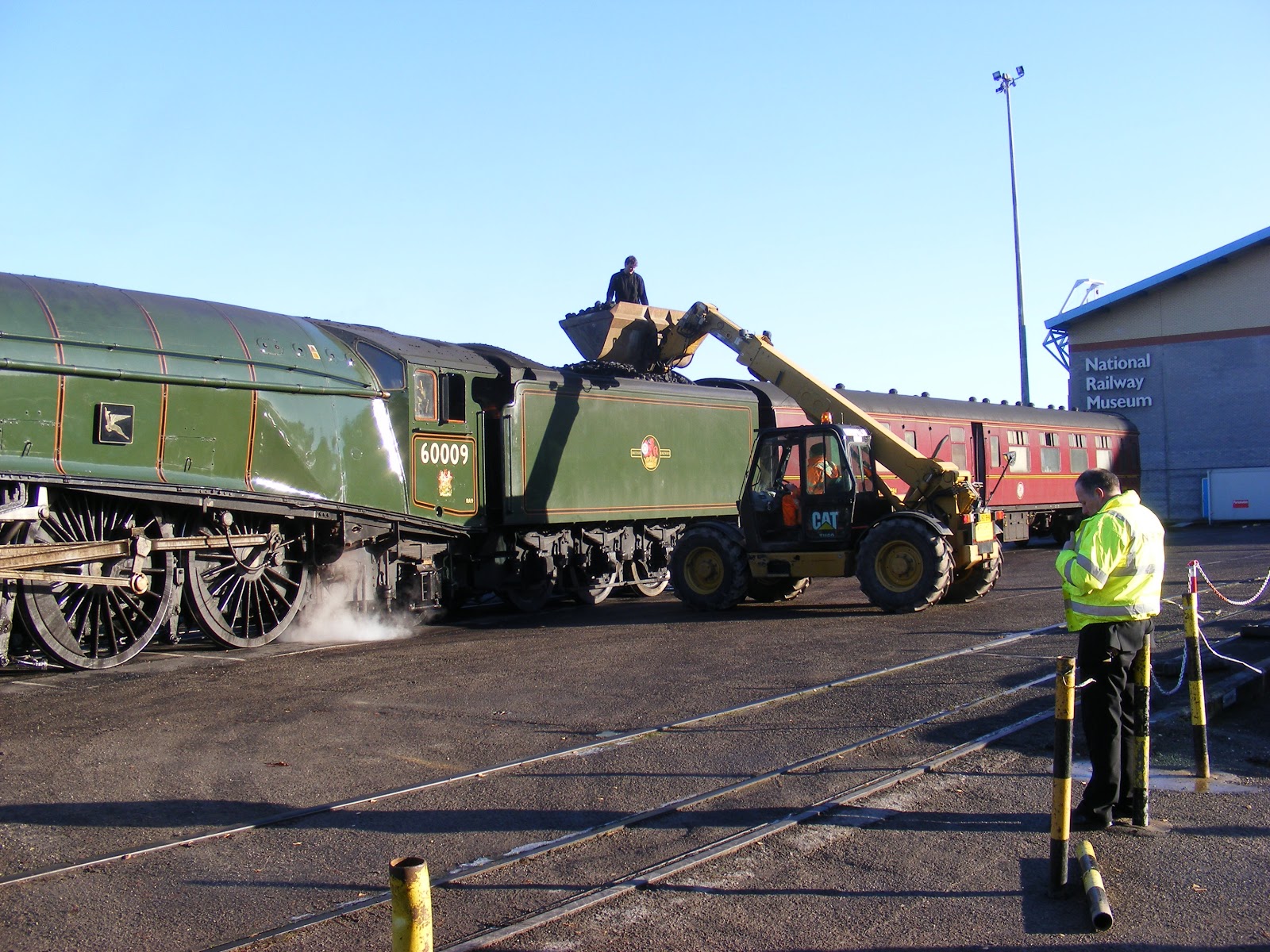
Hi everyone. Well here is post 3 of 3 from our visit to the NRM. Having found out earlier in the week that "Sir Nigel Gresley"; the blue A4; would be visiting York on a railtour from the North, I decided that I would make the effort to try and seek her out. Even as we stood in the chilly south yard at the NRM, I heard the familiar note of an A4 chime whistle on the wind, as the graceful 4-6-2 came in through the suburbs with her lengthy train. The engine dropped off the passengers and stock in the historic York station before drawing out with her support coach towards the NRM service area, directly in front of the Great Hall entrance, off Leemans Road. As we stood inside the Great Hall I saw plumes of steam on the horizon before a green tender - not a blue one - appeared pushing a support coach. The green livery could only mean one thing: it was 60009 "Union of South Africa". Asking around in the yard I managed to find out that the sister engine: "Gresley": had failed the week before on a similar tour and so "Union" was deputising. Last time I saw this engine she was just beginning her overhaul at LNWR's in Crewe, back in November 2009. She looked to be in a sorry state then...see here. Since then the engine has been fully restored and returned to the mainline this summer. She was built in 1937 at Doncaster and based at Haymarket shed in Edinburgh from new, retiring from Aberdeen in 1966, after only 4 years with her 'new' shed.
Today the engine looked graceful in the winter sun, as she took coal from the NRM's JCB, in the shadow of the Great Hall. She is now owned by John Cameron, who also owns the lovely 3-cylinder Gresley K4 "The Great Marquess" which, coincidentally, was sat just a stones throw from the A4, hiding in the paint store at the NRM, only just visible through a very small window. The JCB quickly loaded the A4 with her all important fuel whilst the support crew checked her over.
Having spotted the A4 in her shining green we walked back into the warmth of the NRM. It was freezing outside today.
Thanks very much for reading folks. It was very nice to see the A4 again today, in much better condition than the last time. Thanks guys. Sam.
NRM Post 2: A Rant About "Flying Scotsman"...
Hi guys. As part of our visit to the NRM at York; as mentioned in the previous post; we passed through The Works. The Works is exactly what it sounds like; the main engineering workshop of the NRM. It houses a wheel drop, milling machines, lathes, fitting benches, cranes and everything else you would expect from a railway workshop. The project stood in the centre is none other than the famous Gresley A3 Pacific No4472 "Flying Scotsman", built in 1923. Often billed (even in my book) as the most famous locomotive in the world, 4472 has had more owners than one cares to mention and has hardly experienced plain sailing during her preservation career. Now for my rant. Everybody else seems to be giving their unadulterated opinion about this locomotive and its restoration with the NRM and now, justified or not, heres mine.
Firstly, we must look at what this locomotive is. She is a 3-cylinder pacific, she is unique, she is big and powerful and indeed she is no stranger to main line running, with speeds of up to 75mph allowed when certified. All of these qualities make her a must for the enthusiast. What better than travelling behind a unique Gresley pacific on the main line at 75mph? A nice treat ay? Her power will also make her attractive to train operating companies as she can haul large loads, carrying many passengers at once. However, we must also look at the fact that she is famous...very famous. This quality is perhaps "Flying Scotsman"s nail in the coffin. This fame has bought her a massive army of followers; the young, the old, the enthusiasts, the families. She has fans worldwide, of all ages and they all want a piece of her. Before ownership by the NRM you may have found "Flying Scotsman" on the odd railtour, the odd preserved railway visit and even on the British Pullman from time to time. When the NRM purchased her for the nation for that pricely sum of £2.3 million in April 2004, the loco was 'treated' to running countless railtours to Scarborough, with leaflets I saw at the time seeing her doing that job a few times a week, with two round trips per day, despite the poor mechanical condition of the engine. Reports in various railway tabloids at the time reported that the loco failed on most of these journeys with a variety of ailments.
Are we surprised? No. Later, in October 2005, the locomotive was briefly loaned to Tyseley Loco Works where it hauled (to my memory) five railtours. As far as I know, under the care of the experienced staff at Tyseley, it successfully managed to complete all five trips. Indeed, I travelled on the 2nd of the 5 runs. The A3 took us from Solihull to Didcot, via Oxford. The poorly A3 tore along the main line, apparently achieving 82mph at one point, according to one on board enthusiast with his speedometer. Indeed it clanked and banged like an engine needing overhaul but it did do the job. On return to the NRM the loco entered the workshops for overhaul...an overhaul that has been ongoing for the past 6 years. Over £2.7 million (400k more than the purchase cost of the loco!) has been spent so far, with the overhaul not complete as yet! One of the debacles with the A3 has been its boiler. The NRM purchased the loco with an A4 boiler, along with a spare A3 boiler. The plan was to patch up one of the boilers, and then sell off the other to perhaps an A4 owner as a spare. However, with all that money spent, why patch up a boiler of that age? The argument I heard was for originality purposes. Originality? Ha! "Flying Scotsman" is no more original with an A3 boiler than with an A4 one. No doubt almost everything on this iconic engine has been patched up or replaced over its long, hard life and therefore a brand new boiler would be nothing more than an improvement. If they think running this locomotive in LNER Apple Green with German Smoke Deflectors and a chime whistle is original then in my mind they are incorrect. The locomotive would have never ran in that condition. The only time the smoke deflectors would have been right is when Pete Waterman owned the engine and ran it as 60103 in BR Green. Though attractive in the same state in LNER Green, it is about as original as "Tornado" is. A recent debate with this locomotive has seen Tyseley supremo Bob Meanley; a much respected engineer; get involved and release a damning report about the state of the engine when the NRM purchased it and continued to run it: and rightly so. I can't think of anyone who would not trust Mr Meanleys opinion, particularly with his track record and the condition of the Tyseley stable of engines. A prime example is 5043: the double-chimney Castle. She won Engine of the Year and was restored entirely at Tyseley to a beautiful standard, with enthusiasts saying she is the 'one to watch' in the performance stakes. It would be my honest opinion that 4472 should be owned by the NRM, but not restored or operated by them. Somewhere like Tyseley would seem the ideal choice, giving 4472 mainline access to preserved railways and various mainline destinations, whilst also preventing her from being abused. One could speculate that, as before, the locomotive will be expected to complete mile after mile of mainline performances with minimal maintainence and resting periods whilst under the control of the NRM. I appreciate that the public want to see the engine, experience her and ride behind her but, in honesty, sometimes you need to sit back and appreciate the health of the engine. Currently, yes, she is safe in the fact that she is non operational. However, I do worry that the engine will be thrust straight into alot of hard work once complete: which would not be fair at all. I understand that the NRM probably do have the best interests of the engine at heart but in the past it has been proved that 4472, unless properly looked after, is no more reliable than any other engine, despite being the most famous locomotive in the world.
The overhaul has been a long and painstaking one, costing a massive amount of money for what seems very little gain. Though I do think 4472 should be ticketed and indeed main line certified (under the right operator/care taker) the locomotive is no longer owned by/run by steam railwaymen - it is owned by a public museum. The previous owners like Marchington, Waterman, Pegler, McAlpine etc all had backgrounds in steam engineering and maintainence and were fully aware of what the locomotive could do, how it should be treated and what maintainence should be carried out. The damning report sent out by Tyseley can only highlight the poor mechanical condition at the time and the fact that it continued in service with those ailments can only be classed as abuse in my book. Indeed, this is the "peoples engine". It is without a doubt the most famous locomotive in the world and without it, British railway preservation would be nothing. The one household steam locomotive name, if there is one, is "Flying Scotsman". I do feel however that unless she is going to be properly looked after then she may as well remain stuffed and mounted inside the NRM. At least there the sight and grace of her could be enjoyed. The unveiling of the loco at Railfest 2004 where it ended up being pushed through its banner by a diesel due to it failing was nothing less than undiginifed. I am by no means small minded with my opinions on "Scotsman". She is a true gem of railway preservation. I simply feel that, judging by what has happened with her condition in the past, she should be a sort of 'high days' and holidays locomotive. Daily running can do little to help an elderly engine, let alone one that is expected so much of. It would be brilliant to see "Scotsman" travel around to various preserved railways so that people could enjoy the sight of her again once completed, perhaps undertaking a few railtours as well. The worlds most famous locomotive deserves much more than this. Sam.
NRM Post 1: On The Walkabout...
Hi everyone. Today, in freezing weather, we were off to York. The medieval city of York is home to the famous National Railway Museum. From the city centre you can make your way on foot to Leemans Road where the Museum entrance sits close by the East Coast Main line, in the shadow of the arches of York Railway Station, which were famously caved in during the World War II air raids. In fact, the roof was not the only thing to suffer: A4 pacific No4469 "Sir Ralph Wedgwood" was damaged beyond repair during the raids, after a bomb struck York North Shed (now part of the NRM) where she was stabled. Walking into the NRM your entry is FREE, with the exhibits being split into two main halls: the Great Hall, and Station Hall. We began in Station Hall where we saw the usual exhibits including the luxury 'Royal Train' stock and the TPO coach. Station Hall has recently received a bit of a revamp and is looking very smart. At the back of Station Hall we stepped out into the South Yard, where a familiar little engine stood simmering away...
This little Peckett is "Teddy". I remembered her well but this is the first time I'd ever seen her in steam. The locomotive used to be owned by Teddy Boston and, after a brief spell steaming at Shackerstone in the 1970s, the engine ended up stored on Teddy's front garden, as part of the Cadeby Light Railway collection. Visitors to Cadeby will remember her imposing presence on the front lawn there, where she stood for many years. When the Cadeby railway unfortunately closed in 2005, the collection was sold off and "Teddy" (then nameless) was purchased and restored. Back on the rails, she makes for a very small engine with tiny driving wheels. Built in 1941, she is currently providing the NRM with a useful and powerful addition to its fleet and takes turns with "City of Truro" giving train rides up the yard. I was really pleased that I saw her. Whilst outside I also heard a familiar sound on the wind; the lengthy cry of an A4 chime. (That was "Union" on her way into York).
From the Great Hall we passed through into the Warehouse section, which houses everything from railway cutlery to signals, 5" locomotives and the V2 "Green Arrow". You could spend hours in this place alone!
From the Warehouse we climbed the ramp through th Flying Scotsman Story, reading about her tragic trip to the USA and the slightly better trip to Australia. Leaving this exhibition we took the stairs up to the York Station viewing platform and through the signalling display area. We then passed through the Works where we spotted the ill-fated "Flying Scotsman" (see next post) and "Olton Hall" before reaching the Great Hall again.
We did seem to whip around the NRM very quickly but then again we have visited many times. It is huge, and the locomotives on display are immaculately kept. The museum is a real gem, and is worth a visit from anybody. I love it here, I really do. If you haven't been up there then get up to York and have a look around...its FREE...what more do you want?! Cheers guys. Sam.
| "Teddy" With Her Coach & Brakevan |
As well as "Teddy", I particularly enjoyed seeing the 0-4-2 "Gladstone", which carries a beautiful LBSC livery. From Station Hall we continued through the subway under Leemans Road to the Great Hall. The impressive size of this building is the first thing to hit you as you enter. The engines stand proudly around the working turntable, with others stored to one side on other spur sidings. The A4 "Mallard" (recently repainted) stands proudly on her road, looking as impressive as the day she was built. This beautiful pacific reached the highest speed yet achieved by any steam locomotive in the world: 126mph, back in July 1938. The A4s were a 35-strong class of 3-cylinder pacifics designed by Sir Nigel Gresley of the LNER. Of the 35 sisters, 6 remain in preservation. "Bittern", "Union", "Mallard" and "Sir Nigel Gresley" remained on home soil, whilst the other two (60008 & 60010) went to the USA. However, happily, in 2012, the pair have returned to their UK roots, in a massive movement organised by the NRM. 60010 "Dominion of Canada" is currently at the NRM Shildon whilst a dusty 60008 "Dwight D Eisenhower" stood not far from "Mallard" in the Great Hall today. Her tender has been repainted but her streamlined casing still carries the livery applied by BR before she left for the US. I am glad they were brought back, if only for a photograph. However, it does seem a shame that with all that money spent the two A4s will still be going back to the US again, within 2 years.
| 60008 With Its Rods Painted A Horrid Grey |
From the Warehouse we climbed the ramp through th Flying Scotsman Story, reading about her tragic trip to the USA and the slightly better trip to Australia. Leaving this exhibition we took the stairs up to the York Station viewing platform and through the signalling display area. We then passed through the Works where we spotted the ill-fated "Flying Scotsman" (see next post) and "Olton Hall" before reaching the Great Hall again.
We did seem to whip around the NRM very quickly but then again we have visited many times. It is huge, and the locomotives on display are immaculately kept. The museum is a real gem, and is worth a visit from anybody. I love it here, I really do. If you haven't been up there then get up to York and have a look around...its FREE...what more do you want?! Cheers guys. Sam.
Subscribe to:
Posts (Atom)