Hi folks. Today, after such a long time away, I welcomed the presence of the slightest feeling of normality as I joined Phil and a few other friends for a day out with steam. Our destination was Didcot Railway Centre, home of the Great Western Society and its wonderful collection of copper capped locomotives. Phil had mentioned the plan to visit Didcot a few weeks before and so, with nothing else to do, I thought "Why not?". After a pleasant run down the M40, I joined the A34 and eventually arrived in the car park at around 10:30. The railway centre is situated within a triangle of busy main lines, meaning that access is gained via a subway from the main Didcot Parkway station. Having paid and displayed, I wandered steadily down towards the station in good time for my 11:00 allotted entrance time. A wisp of steam in the distance was followed by the sight of Large Prairie No4144 departing enthusiastically from the platform on the museums main demo line. Due to the Covid-19 pandemic, the museum was operating a staggered entrance policy at half hourly intervals but they did kindly let me in ten minutes early. After meeting with Phil and the gang, we wandered towards Didcots evocative engine shed where the majority of the collection are housed...
I was on my third visit to Didcot today and on all three occasions I've found the shed to be brimming with atmosphere. Although all of the engines we saw indoors are currently out of ticket, their very presence seems to bring the past to life. The first engine was of a very familiar design: 5700 Class pannier tank No3738 of 1937...
Standing impressively behind the pannier tank was His Majesty The King. Yes, it was Didcots impossible dream: No6023 "King Edward II", known in recent years as the 'Blue King'. The beautiful blue beast retired in September last year following expiry of her boiler ticket and now awaits her turn in the overhaul queue. A nice touch was the return of the original chimney and safety valve bonnet which were sadly removed when the engine was cut down for possible main line trials a few years ago. For me, the cosmetic changes totally ruined the look of the engine and gave the impression of a severe military haircut! Now back in her full form, she looks quite wonderful; the very symbol of power and elegance. Very nice indeed...
As I said above, Didcot has a wonderful collection of Western engines and most types are represented. You name it: there's a pair of Halls, a Manor, a pair of Castles, a trio of Prairies, a heavy freight 2-8-0 and so on. On the third of the four roads we found a set of steps leading up into the cab of Hall Class No5900 "Hinderton Hall" of 1931. Safe to say we just had to explore the cab...
As we made our way out towards the shed frontage, I looked back to take a going away shot of the engines on the third road. It was quite a line up...
I've always liked Great Western. There are those in the movement that come out with the same old one liners: "There's only one Great Western and that's the North Western" etc. I particularly enjoy that phrase as most of those who spout it have never crewed a North Western engine. Now I'm not knocking North Western: they made some beautiful stuff: but I do question the validity of that phrase. The GWR made a particular effort to make their workhorses beautiful, with even the humblest of tank engines receiving the characteristic brass embellishments and cab side plates. They're just lovely things. As we wandered down through the site, we came towards the second of the demonstration lines: the branch line. Here, the sweet little "Trojan" was simmering quietly at the head of a rake of wagons. "Trojan", built in 1897, has recently returned to service following a period of overhaul and looked quite a picture...
It wasn't long before "Trojan"s crew arose from their station bench to propel the short freight train back to the transfer shed, which was our next destination. The transfer shed rests at the end of the site and contains the broad gauge engines...
The transfer shed contained "Fire Fly" and "Iron Duke", both replicas of Daniel Gooch designs built for Brunels 7ft (broad) gauge railway. "Fire Fly" has spent its life at Didcot but it was very nice to see the larger "Iron Duke" (part of the National Collection). "Iron Duke" was built in 1985 using components from two Austerity tank engines to celebrate the 150th anniversary of the Great Western railway. Both of them are quite imposing due to their great width and are very impressive to see...
Leaving the transfer shed behind, we wandered back towards the turntable where the Large Prairie Tank No4144 was being turned to the delight of onlookers. 4144 had been on the main demo line for most of the day and had now been replaced by little "Trojan". The Prairie seemed to glide around on the manually operated table...
Fair play to the guys, they kept on pushing!...
Outside the shed there was a small line up of saddle tanks...
Our next stop was the coaling stage to see the little trucks used to replenish bunkers and tenders at Didcot. 4144 had just taken a truck worth before moving forward for disposal on the pit road. We were then treated to Phil Bates' rendition of 'Coal Stages Through The Ages' as he absolutely loves a history chat...
4144 beds down for the night on the pit road near the coal stage...
Before heading for home we watched "Trojan" bark up and down a bit on the main demo line. I used the picture I took of her with the wonderful passenger coaches as the title image so I've chucked in another of her on the branch line earlier in the day...
With that, as closing time neared, it was time to hit the A34 and fly back up towards home. It was so nice to get back out again and to see a few steamers at work. The Great Western Society has a fantastic collection and Didcot is always worth a stroll around. Thank you Phil and the gang for the invitation and the company. Hopefully a return to the footplate soon beckons! Take care all, until next time, Sam...
Hi everyone and a very belated Happy New Year to you. Lets all pray that 2021 has better things in store for us than last year! So, where have I been? Nowhere! What have I done? Well, nothing really, hence no posts on the blog. I've never been much for recapping old stories just because there's nothing new to write, so I've just kept quiet through these dark Winter weeks. With nowhere to go in search of steam, I've kept myself busy with household tasks and DIY. The only thing I have recently completed is a bit of a restoration on a very old Mamod I had languishing in a scruffy box in the workshop. The story of this goes back probably five years now, to when I was asked to sort out a Christmas gift for my uncle. The request was to find and test a Mamod SR1A: their signature steam roller: and make sure it was right before being given for Christmas. Examples of these engines are numerous on Ebay though can vary vastly in condition. Me being me, I ended up with a mass of parts and mixed them together to create a nice little roller, leaving me with a box of scruffy old bits. The post on the original roller I did is here. The remaining bits I had didn't include a boiler so back then I managed to purchase myself a scruffy old Mamod TE1A boiler (from the traction engine) and had it painted where I used to work. And then the project stalled...
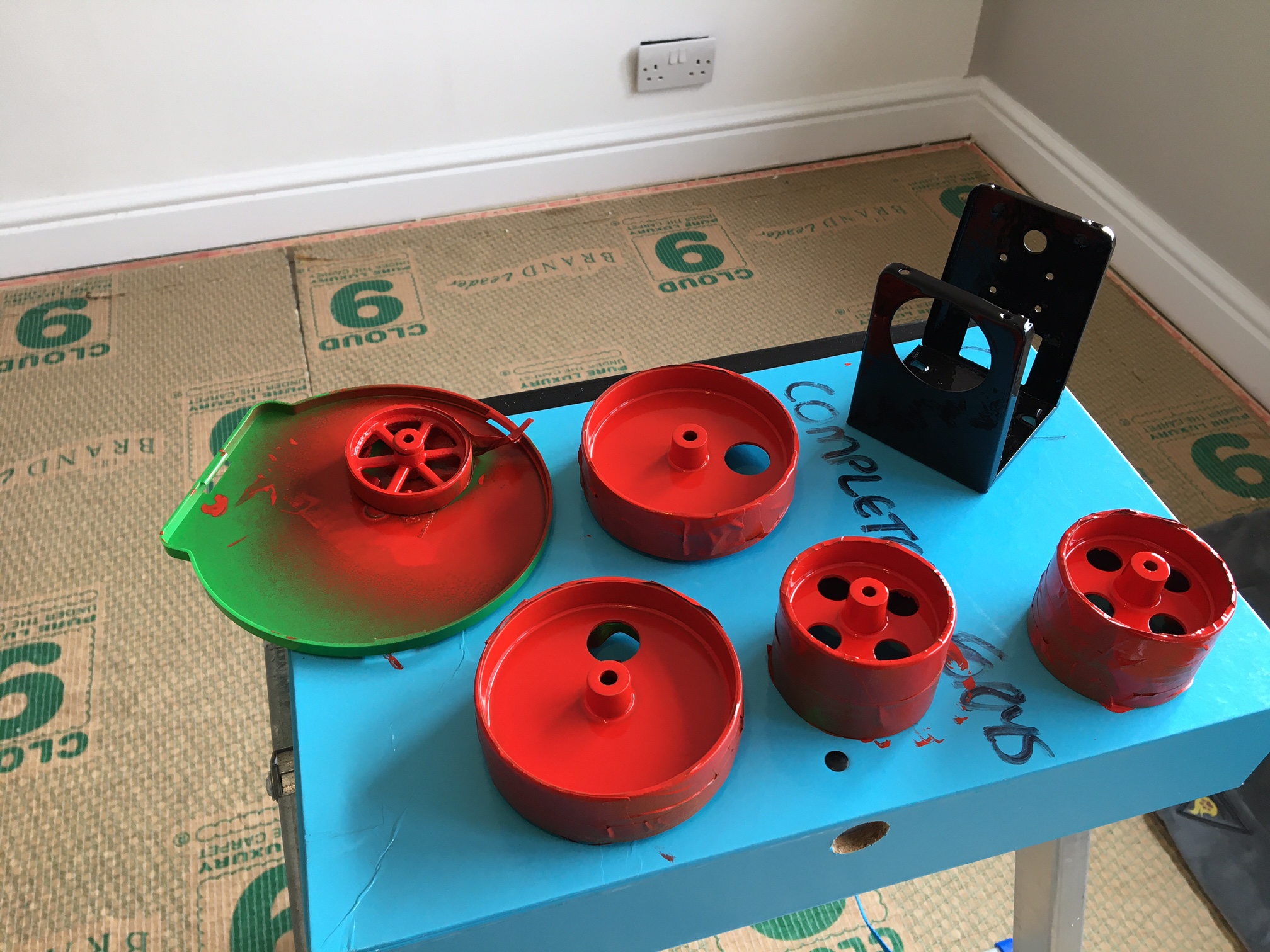
Much later, in 2021, all it took was the complete eradication of my hobby to get the job on the move again! The shot above is very much the before image, showing the myriad of bits and pieces and their pretty poor condition. You couldn't just throw the thing together again as it was, otherwise it would have looked quite appalling. I had it in my head that I'd use my repainted boiler barrel and then redo the reds and blacks on the engine myself. The other parts would take some cleaning up but the majority would be fit for reuse. Below we see a before shot of one of the rear wheels. As you can probably guess I'd decided to make up a roller using the slightly longer traction engine boiler, sometimes then known as the 'Long Boiler Roller'...
The paint on the wheels was already pretty loose and so the gentle application of a heat gun freed off the remaining bulk. The wheels were then pinned with a cap head bolt into the chuck of an electric drill and spun up before being polished with various grades of sandpaper. I also took the opportunity to polish the very dull outer edges of the wheels. The resulting finish was quite good and left a clean surface for painting...
Paint choice among Mamod owners can often start a heated debate so I'll be honest about my choices. The red is an RS Pro red gloss spray and the black is a heat resistant matt version from Screwfix, both chosen for their good reviews. As the current damp weather doesn't really lend itself to painting, I sprayed the parts up in the workshop before bringing them inside to the warmth of the house to dry. Luckily I was in the depths of redecorating the spare room at the time which gave a good drying area. The reds were given two coats of gloss to get the shine...
After 24 hours drying I decided to unmask the red parts. The mask had done its job very well and any spill onto the burnished edges of the wheels was easily cleaned off with a sharp knife. For what was just a pile of old bits in a tatty cardboard box a few days before, I was very happy with the finish on the wheels and flywheel. Not bad for a cheap job completed in quick time by a buffoon...
The matt black parts also came out well after drying...
One of the two firebox cowls I had had been chosen for this roller due to its better condition. I'd spent some time cleaning it up with Peek a few years ago but have since discovered the wonderous cleaning properties of Autosol. The latter brought a very good shine to the polished metal before it was reinserted into the repainted housing. As is usual with Mamods, the majority of the engine is held together with pop rivets of varying sizes. The other parts meanwhile were cleaned up using Autosol and, well, scrubbing ability. The results were again quite pleasing...
This engine has the water filler plug type boiler which dates it pre-1978 I believe as that's when the sight glass boilers came in. It also (if original) has the meths burner and I believe the engines used solid fuel as of 1976 so really it should be at least 45 years old as I write! Once the firebox cowl was riveted together, it was time to slide in the boiler. The boiler is held in place by two blind copper pop rivets which then seal the fitting holes. With a new seal on the cleaned up water filler plug, that was refitted too. The mounting bracket for the main shaft is then riveted on with slightly larger rivets. It certainly felt like it was coming on at this point...
The smokebox had turned out well in its new matt black. I managed to retain the original Mamod paint at the front by keeping that masked up. The smokebox was then riveted on and the three copper pipes (one feed, two exhaust) cleaned up with Autosol...
The final results of the engine then came together quite quickly after a few evenings work here and there. I'd never really thought about the dummy running board before but having seen how they enhanced other peoples Mamods I thought one would look nice on this, and it does. It's pretty nice quality too...
I also fitted two extra brass boiler bands and a small bucket hung beneath, which all seem to add to the appearance of the engine. I'd never really been one for all this accessorizing but in this case the features seemed to add something. Now the engine has pride of place on the workshop shelf, along with my Mamod SW1 and Wilesco D405. For a box of scruffy old bits it has turned out quite well and I'm pretty happy with it for a little lockdown project. It looks quite nice...
The engine didn't take much to do really. It had a respray, a clean up and some new seals and rivets. I managed to save most of it but it has been treated to a new whistle as the old one was the rarer push-button type which would undoubtedly burn your fingers! So there we are, post No1 of 2021. Who knows when the next one will be? Roll on Statfold for some sweet, sweet handle! Cheers all, stay safe...
Hi all. I trust everyone had a quiet but safe Christmas during this continued period of restrictions. It was an unusual one this year to say the least, but all we can do is hope for better things in 2021. With a definite absence of steam in my December calendar, I decided to fire up "Achilles" again to cure my Cold Firebox Syndrome. After all, "if you can't find any steam, make your own!". I last steamed the engine at Easter (in much sunnier conditions) and during that running session the axle pumps refused to operate. Since then I've stripped them down and freed off the ball bearings which were no doubt stuck to their seats after a few years without water. Having checked the engine over yesterday, I couldn't see any signs that the pumps were not going to work and so, spanners in hand, I put the lower halves of the pumps back in...
The operation to steam an engine at home is hardly stress free. There is a substantial amount of kit to be moved around in the workshop and then a steaming area has to be set up outside. Not only that, but todays weather forecast was a mixture of snow and light rain, accompanied by a biting cold wind. However, having made the decision to steam, I wasn't going to let any of that stop me! A little before 10:00 the engine was outside on my main workshop table. A gift for my recent birthday was a set of 5" gauge rollers which make steaming the tank engine so much easier. The old finger trapping method of attempting to chock the loco up on blocks isn't fondly remembered and the rollers also give better visibility on the inside workings...
The next job was to get water into the boiler. Having started with the handpump, it was obvious that the snow and rain was getting more fierce so I didn't want the engine sitting cold too long in these damp conditions. Although the cladding is fairly protective on "Achilles", I didn't want to risk any chance of wet lagging. I decided to remove a safety valve and fill the boiler more promptly, allowing me to speed up the steaming up process. I'd replaced the fire grate yesterday and so the firebox was duly filled with some paraffin-soaked wood. The lighter was then employed to start the fire, followed by throwing in a burning piece of wood and allowing the flames to catch...
The smoke effects from well soaked wood are quite dramatic, particularly with the little power socket battery I use for my electric blower when steaming at home. The blower runs slightly slower on this small battery so the smoke isn't ejected away as well as usual. I don't know what the neighbours must have thought...
With the wood burning away nicely on the grate, I opened the firehole doors and added a liberal application of Welsh steam coal grains. With the deep firebox on "Achilles", I tend to fill it right up and let the engine get on with it: it's a technique which has yet to fail me! With the doors now closed and the heat being gradually pulled through the tubes, I nipped inside to make a coffee. Upon returning to the engine the needle was just off the stop, with the fire burning nicely. I switched over to the engines own blower at this point; it being more effective than the battery blower at anything above 20psi. With the needle nearing the red line I decided to try to start the engine moving. After a little protesting whilst the auto drain cocks sorted their lives out, she burst into life and gradually settled down to a comfortable running speed...
Whilst the engine steamed away merrily outside, I kept myself in the dry of the workshop doorway, clutching my coffee like my life depended on it. The persistent snow showers were getting heavier as the morning wore on and if you stood out in it for too long you were soaked. The engine didn't seem at all bothered by the cold weather and if anything seemed quite content with the safety valves blowing...
Here is a short, low quality video I took rather quickly on my phone whilst "Achilles" turns over on the new rolling road...
The engine was steaming very well and so I was pleased with the coal. This is a new bag of Signal Fuels stuff in grain size. I was initially disappointed that I didn't order the larger beans, although the grains will be perfect for when I next steam the Atlantic. Usually I mix house coal in with my steam coal but today we went on purely the steam stuff. With a bright fire the engine steamed without issue, merrily pumping water until the boiler was full and then remaking steam when the bypass was opened. You could knock her back to about 50psi and then wait for the valves to lift again a short while later. It would be fair to say that I was impressed...
I surprised myself really. Usually when I steam the engines at home I get them going and then once you've proven the previous issue out you blow down. Today, "Achilles" was going so well that I just kept running her...and drinking coffee in the background of course. It turned out to be a pleasant way to pass a morning...
Here, the safety valves lift again as the snow continues to fall...
Eventually, after a few hours running, I decided to blow the engine down. This is the worst part of steaming at home: it's awkward and very messy. I managed to drop the grate and then spin the engine on the rollers to get it away from the dropped fire (at the track the grate falls into an ash bin below) before blowing her down...
As with larger engines, the blowing down process attempts to eject any deposits which have left the water during evaporation. The blow down tap is situated at the lowest part of the firebox: the foundation ring. The final task is to drain the tanks before getting the engine back into the workshop out of the weather to cool. Soon enough, filthy but basking in the triumph of a successful run, the tank engine was back inside...
It was then time to do all of the other lovely jobs such as washing the table down, sweeping away the ash, tidying the tools away etc: all the things you don't think about when you have the fabulous idea to steam the engine at home! I won't get too negative about it all though as it was a pleasant morning and it was nice to see "Achilles" in fine form. Apart from a slight weep on the gauge glass bottom nut (needs a new seal) she ran pretty much faultlessly, which is always pleasing. I must thank her for allowing me some steam in December 2020...she was my only chance! With that, I'll sign off. I wish you all a very Happy New Year. We can but hope...
"Twas the night before Christmas, and all through the house, not a creature was stirring, not even a mouse". I'll be honest, I've missed adding the odd festive quote to my Christmas posts this year...there haven't been any to add one to! After a year to forget, this is the first Christmas in recent memory that I haven't driven a steam engine of some kind. My weekends have been spent either decorating, watching TV or out in the workshop tidying up. I never get tired of clearing out the workshop: it's amazing how much rubbish you can end up with! So, with the big day tomorrow, all that remains for me to say is that I wish you a very Merry Christmas and a Happy New Year. I won't miss 2020 and just hope that 2021 will be better but, alas, I won't put money on it! Take care all and thank you for reading the few posts I've managed to scribble this year. Eat, drink and be merry! I'm starting with pork pie and Purple Moose...
Finding myself at a loose end this afternoon, I decided to head over to grab myself a brief steam fix at Shack. If this year has taught us anything, it's that nothing should be taken for granted...and that includes the sight of an engine in steam! I knew David was driving today so thought it would be a good opportunity for a quick catch up. Knowing the regular timetable like the back of my hand, I parked up along Congerstone Road and wandered across the footpath to the field gate alongside the railway. Soon enough, ticking into sight came GWR 4575-Class Small Prairie No5526, built at Swindon in May 1928. Despite not being native to these parts, Prairie tanks seem to be more common on the old Ashby & Nuneaton joint these days than they were on the Western region! Whilst the engine braked for an upcoming 10mph speed restriction, David and Carl waved enthusiastically from the cab as they passed by. Watching the tail lamp disappear towards Carlton, I decided to head over to Shack to grab a cuppa'. An autumn wind was biting as I trotted up the muddy driveway to the station. Having chatted with a few old faces who seemed incredibly surprised to see me, I watched the Prairie tank roll in from Shenton. Soon she was watered and back at the head of the four-coach train awaiting her final departure at 15:30...
It was nice to see the old gang, particularly after a year which has brought into question just about everything we hold dear. It was also nice to see 5526. She spent her working life in the West Country before being retired in June 1962 and ending up at Barry. These days she is resident at Buckfastleigh on the South Devon Railway but has spent much of the extremely short lived 2020 season at Shackerstone. As departure time neared, the vacuum ejector was brought into action before the engine received the "Right Away" from the Guard. With David in control, 5526 hissed into life, pulling away from a windswept Shackerstone. See you next time, David...
As the engine chugged away towards Market Bosworth, I wandered back down the driveway towards the car. It was then time for a blustery drive home through the lanes but it felt good to have seen (and smelt) some steam again. Who knows when I'll next see an engine in steam but, with all things considered, I think it'll be next year. I hope not, but that's my prophecy. Roll on the next time. Cheers all and stay safe...
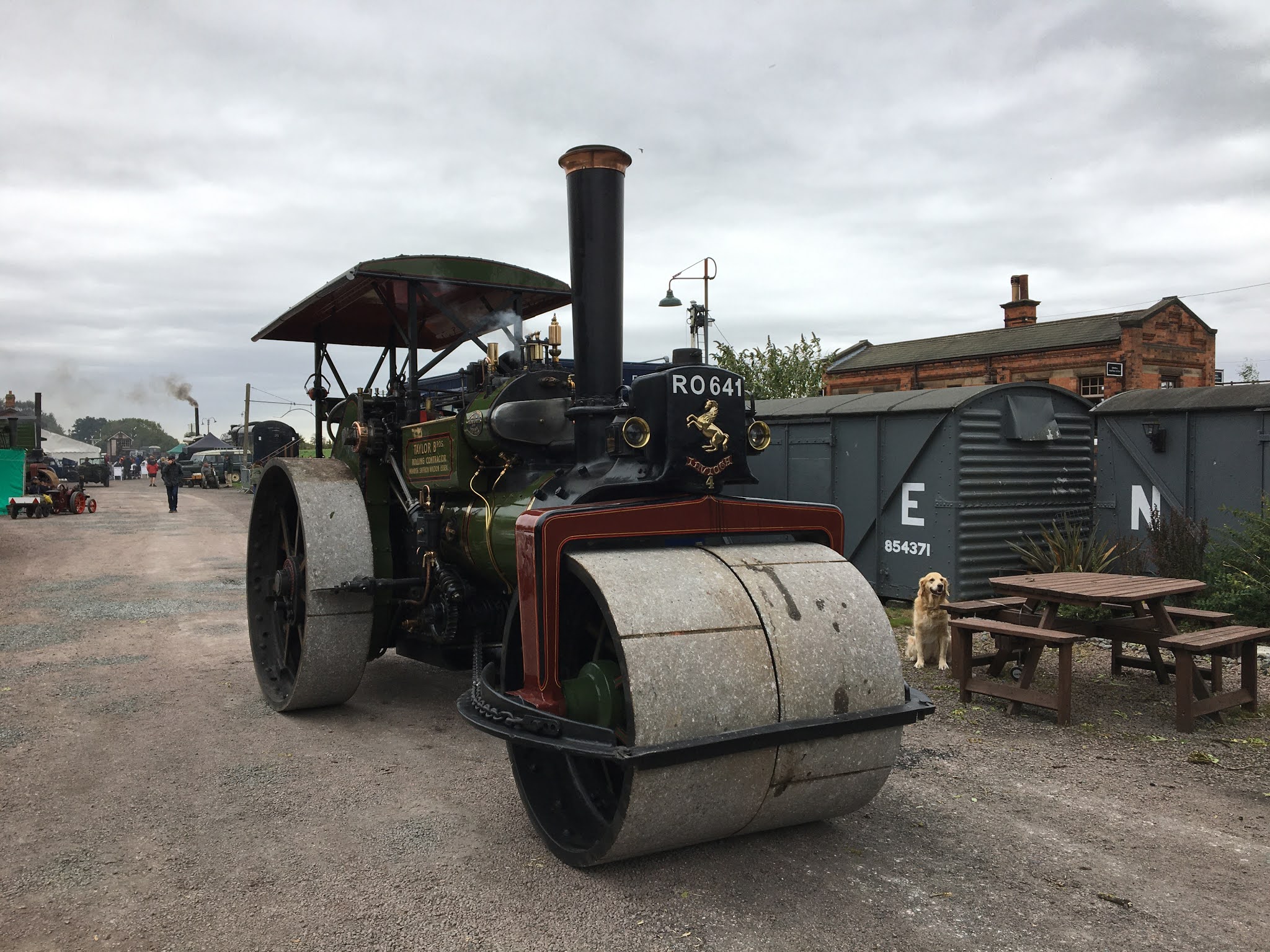
The end of September normally brings two things: autumn and end of season steam gatherings. This years steam season has to have been the shortest since the birth of preservation, having only really began following the easing of lockdown at the end of June. Sadly, Covid-19 continues its merciless rampage across the UK, affecting the health, jobs and livelihoods of millions. I can only hope that we can return to some form of normality as early as possible next year, though unfortunately even I remain doubtful. All that aside, this weekend saw a small socially distanced steam event taking place on the dusty apron of Quorn & Woodhouse Station yard on the Great Central Railway. As Batesy had his 1925-built Aveling & Porter steam roller there, I didn't take much persuading once an invitation came my way. I arrived at Quorn a little before 09:30, in crisp conditions. Under the beautiful blue skies stood the pretty Ivatt Class 2 Mogul No46521, built at Swindon in 1953...
The Mogul was simmering quietly at the head of a five-coach train, carefully steam heating as mask-wearing passengers boarded. The GCRs Covid service sees departures from Quorn only, returning via Leicester North and thus keeping the public clear of its Loughborough base. The returning trains drop off here before returning to the headquarters of the GCR for cleaning prior to the next working. Having admired the Ivatt, a Guards whistle heralded her on time departure. Summoning her strength, the 2-6-0 departed in a cloud of condensate. I was as green as her livery with envy as I longed to be aboard the footplate again! With the Ivatt clear of the station, a rumbling Class 40 soon appeared shoving the hissing bulk of BR Standard Class 5 No73156 into position for display in the yard. This engine was built at Doncaster in 1956...
After a prolonged absence from Tyseley, it was nice to see some big railway engines moving around. Having met up with Batesy, he tasked me with lighting up the roller. He kindly granted permission for me to imagine I was "on the Castle", so I did! Soon enough, with all of the usual checks made, a pile of rags were lit on the shovel before being flung onto the grate. It felt good to be lighting something up...
With the rags burning nicely, a generous helping of dry wood was added from a bag in the bunker. Once the wood had taken hold, a few rounds of Welsh coal were added and the engine left to "get on with it". Watched pots never boil they say...and it's quite true! By now Caroline was beneath the engine ashing out, whilst Phil was starting to white spirit the barrel down. I followed him round with a buffing off rag, before setting to work on some of the top brasses. The fire was crackling away nicely in the firebox, with the reassuring plume of smoke rising steadily from the chimney confirming that all was well. "Louise" looked quite a picture as she brewed up under the persistent morning sun. I really like the registration number applied to the headstock: it seems to give the engine a whole new look. As usual the engine was presented in fine condition...
As the engine quietly raised steam, I went around with the oil cans. Phil and Caroline are very happy for even the rarest of helpers like myself to get involved with the engine, and for that I'm very grateful. It was a quiet and stress-free morning on the yard, with a chilly autumnal breeze blowing through to help drive away the smoke...
It often feels quite alien to be aboard one of these strange iron road steamers. I've never had the greatest confidence with them, simply through lack of experience I would imagine. Give me something that stands atop rails and sleepers and I can get my head around it fairly quickly, but put me on road wheels and I lose all sense of control! Joking aside, it's always nice to experience something a little different and learn some new skills. It was pleasant just to be around the engine today...
Whilst I topped up the various oiling points, Phil was busy slaving away over a hot camping stove to create us a fine breakfast. I swear it was the tastiest I've had in many a year and my compliments must go to the chef for a great effort...
Another thing that was very pleasant about today was seeing plenty of people we know...socially distanced of course! At events like this we never fail to bump into a few faces and today was no exception. After such a steam drought this year, shut away from our countless acquaintances, it was lovely to be able to chat with some of them for a bit and pass some time. Later on, I got to drive "Louise" up and down the yard, much to Phils amusement as he knows I find it all quite different...
Having taken water from seemingly the worlds slowest hosepipe, I cautiously backed the engine down the yard as the steady crowds of visitors parted to let us through. The engine came to rest (of her own accord) outside the beer shed and a local pint of ale was duly enjoyed in the company of 46521. The Ivatt was, by now, on her last working of the day with a relief crew having taken over from the morning pair...
Here, two Aveling rollers slowly trundle through Quorn yard...
As the time neared 5pm it was time to hit the road. By now there was a chilling wind and the dark skies were threatening rain. Heading home along the A46, I reflected on what an enjoyable little day it had been. I must thank Phil and Caroline for their kind hospitality: it is always appreciated. Take care all, Sam...